
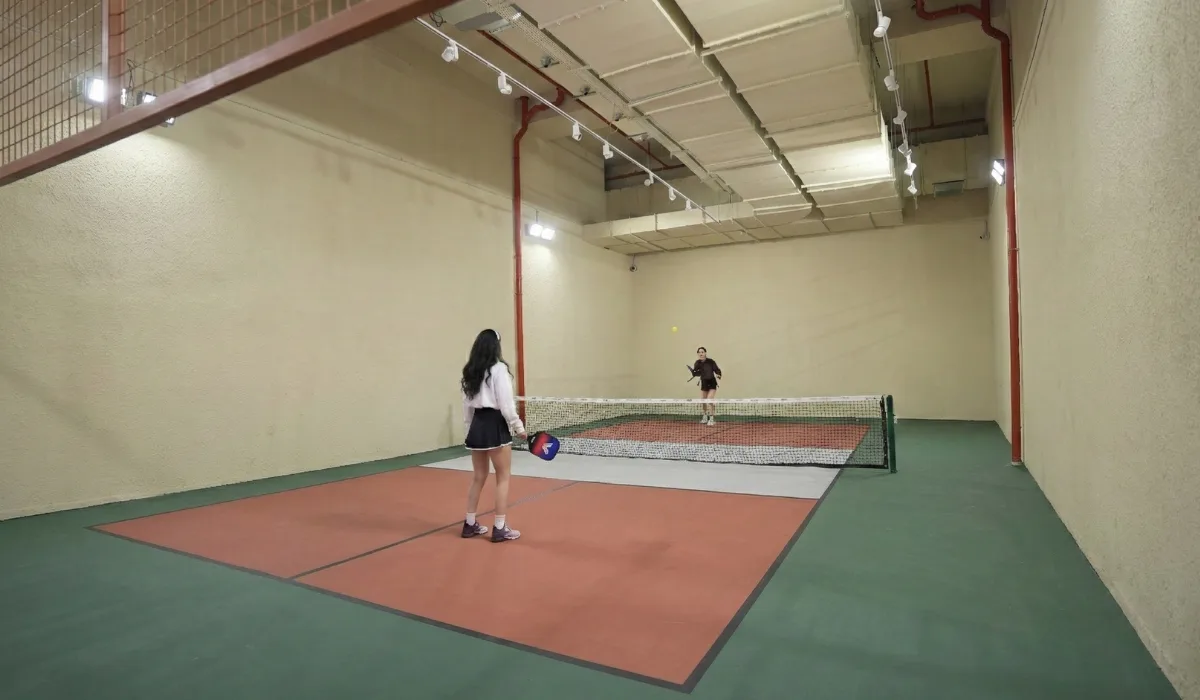
Padel racket weight and balance point are the reason two rackets of the same shape can feel completely different in your hand. Weight is the racket's total mass and ranges from 340–390 g in adult models; the balance point shows how many centimeters from the end of the handle that mass is concentrated. The short answer: a light, low-balance racket gives control and speed, while a heavy, high-balance racket gives power; for most club players the sweet spot is 355–370 g with a balance of 26.5–27.5 cm.
In this article, as the O’Padel Beytepe coaching team, we explain the physics of the two variables, how they relate to each other and how to calibrate them to your own game. We will also show you how to measure the balance point at home and how to adjust it with tape. If you are undecided, remember you can write to us on WhatsApp to ask about trying rackets of different weights on our courts at O’Wellness Beytepe.
Summary
- Weight = total mass (g). Light (340–355), medium (355–370), heavy (370–390).
- Balance = distance from the center of mass to the end of the handle (cm). Low (≤26.5), medium (26.5–27.5), high (≥27.5).
- If you want control: medium weight + low balance. If you want power: medium-heavy weight + high balance.
- If you have elbow or shoulder sensitivity, balance is more critical than weight; stay away from head-heavy rackets.
- You can shift the balance by 1–3 mm with frame tape and an overgrip; weight, however, can only be increased.
Weight and Balance Are Not the Same Thing
The most common confusion is mixing up “a heavy racket” and “a head-heavy racket.” A 360-gram racket feels like 350 if its mass is concentrated near the handle, and like 375 if it's concentrated in the head. The scale says 360 for both; your arm doesn't.
In physics this is called the moment of inertia. The racket head works like the end of a pendulum; the farther the mass is from the axis of rotation (your wrist), the faster the racket head moves at the same arm speed and the more energy it carries. But it also takes that much more force to get that mass moving and to stop it. That's why, for most players, the balance point is even more decisive than weight.
When choosing a racket, always read these two values together. Manufacturers don't always list balance; when they don't, the shape gives a good estimate: round tends toward low balance, teardrop toward medium and diamond toward high.
Weight Ranges and What They Mean
| Range | Feel | Advantage | Trade-off | Who it suits |
|---|---|---|---|---|
| 340–355 g | Light, agile | Fast preparation, low fatigue, arm-friendly | Limited power, gets pushed back on fast balls | Women players, juniors, players with elbow sensitivity, beginners |
| 355–370 g | Balanced | Power-control balance, broad fit | No notable weakness | Most adult club players |
| 370–390 g | Heavy, solid | Stability on block volleys, mass behind the smash | Fatigue, slower preparation, arm strain | Strong, technically sound advanced players |
Know this too: the weight on the label can deviate by ±10 g because of manufacturing tolerance. Two copies of a model labelled “365 g” can come in at 358 and 372. Serious players weigh them in the shop or try several of the same model and buy the one that feels best in the hand. Demo rackets may not carry a weight label; trust the feel in your hand.
How Do You Measure the Balance Point?
You don't need special tools to measure balance. This method is enough:
- Lay the racket horizontally on your index finger, with the handle on one side and the head on the other.
- Slide your finger until the racket balances without tipping to either side.
- Mark that point and measure from the end of the handle (including the cap) in centimeters.
Around 26 cm is low balance, around 27 is medium, and 28 or above is high. With the same method you can compare two rackets in a store in 30 seconds. The butt cap model and number of overgrips affect the measurement by a few millimeters, so always measure under the same conditions.
Balance Ranges and Their Effect on Your Game
Low balance (≤26.5 cm)
The racket feels light in the hand and the head is easy to move. It gives you an edge in quick volley exchanges at the net and on delicate shots like the chiquita and dejada. Vibration is low and your elbow stays comfortable. The trade-off is that you have to generate the power for smashes and víboras with your own arm. The natural choice for beginners and control players.
Medium balance (26.5–27.5 cm)
Most teardrop rackets on the market sit here. Enough head speed on the bandeja, enough agility at the volley. It doesn't exaggerate any particular shot and doesn't penalize any either. The go-to for intermediate players who plan to do everything with one racket.
High balance (≥27.5 cm)
The racket head feels heavy and preparation is slower, but head speed on overheads is very high. This is where smashes leaving the court and víboras slamming into the side glass become possible. The trade-off is the torque placed on your elbow and shoulder; if your technique and fitness aren't up to it, the injury risk rises. There's a reason it's the choice of advanced players.
The Four Combinations of Weight and Balance
- Light + low balance: The most agile and arm-friendly combination. Maximum control, minimum power. Ideal for beginners and during rehabilitation.
- Light + high balance: An interesting middle ground: because total mass is low you don't tire, and thanks to the mass in the head you find power on the smash. Valuable for players with limited arm strength who want to play aggressively.
- Heavy + low balance: Rock-solid on block volleys, the ball doesn't push it back; thanks to the mass near the handle, maneuverability is still reasonable. The hidden favorite of control players with strong arms.
- Heavy + high balance: Maximum power, maximum strain. Only for advanced players whose fitness and technique are ready. The most common source of elbow problems in recreational players.
Practical Matters: Health, Fine-Tuning and Fitness
The health perspective: elbow, shoulder and wrist
The most common overuse injury in padel is lateral epicondylitis, or tennis elbow. There's no single cause, but equipment plays a big part: a head-heavy racket puts a greater braking load on the forearm extensor muscles with every shot. In the shoulder, high balance adds extra torque on the rotator cuff during overheads.
If you're in pain, the order of priority is: first lower the balance, then reduce the weight, then soften the core. Lowering the balance alone often makes a difference. We also cover how racket stiffness relates to vibration in our racket stiffness article we cover. For recurring pain, a movement analysis with a sports physiotherapist gives a more lasting result than simply changing rackets; recovery and wellness page has the details; you can also look there for post-match recovery options at O’Spa Beytepe.
Adjusting the balance yourself: tape and overgrips
If the balance of the racket you bought doesn't quite suit you, you can fix it with small tweaks:
- Lead/tungsten tape on the head: Adding 2–5 g of tape to the top of the frame shifts the balance up by 1–3 mm and adds power to your smash. It's applied under the head protector.
- Extra overgrip on the handle: Each overgrip adds about 5–7 g and pulls the balance down by 1–2 mm. It also changes grip thickness; we explain the effect of that in our grip guide .
- Frame protector: A protector fitted around the head adds 10–15 g and moves the balance up. Choosing a racket without accounting for it is a common mistake.
Remember: you can only add weight, not remove it. So if you're unsure, go slightly lighter; you can always add weight if needed.
The fitness and match-length factor
What most players forget when deciding on weight is the difference between the first 10 minutes and the last 10. When you're warmed up, a 375-gram racket feels great; in the third match of a 90-minute Americano, the same racket slows your arm and throws off your smash timing. Choose your racket with a tired arm, not a rested one.
A practical test: watch your shots in the last set of a match. If you're increasingly late on the ball, hitting the net or hitting the fence, the racket is too heavy or too head-heavy for your fitness. Tournaments and leagues if you plan to play them, it's smart to stay on the lighter side for all-day formats.
Instead of reading grams and centimetres in a table, feel them on court. Plan a session with rackets of different weights and balances on our indoor courts at O’Wellness Beytepe; membership is not required, booking via WhatsApp.
Grip thickness and perceived weight
Handle thickness also changes how weight is perceived. A thin grip lets your wrist work more freely and the racket head feels more “alive”; a thick grip locks the wrist, so the racket feels more stable but heavier. That's why when you try the same racket with two overgrips, it feels like it gained 10 grams, while the real difference is 5–7 grams. Keep grip thickness constant when deciding on weight, or you'll confuse the two variables.
A small note for left- and right-side players too: players on the left who carry smash responsibility usually lean toward slightly higher balance, while players on the right who build the point lean toward lower balance. If your role is clear, the decision is easier; if your role changes, medium balance is the safe harbor.
Starting Values by Level
- 1.0–2.5: 345-360 g, balance 26-26.5 cm. Control and arm health come first. Most demo rackets are close to this profile; try a few sessions before buying.
- 3.0–4.0: 355–370 g, balance 26.5–27.5 cm. Get a little help from the racket while learning the bandeja and smash.
- 4.5–5.5: 365–380 g, balance 27–28.5 cm. Power is part of your game, but listen to your elbow.
- 6.0+: Personal; usually several copies of the same model, fine-tuned with tape.
One more note on timing: make weight or balance changes at the start of the season or between leagues. Adjusting to a new mass distribution takes three to five sessions on average; during that time your bandeja and smash timing slips and your error rate temporarily rises. Switching rackets during tournament week is the surest way to make a good racket look bad.
These values are a starting point. A tall, strong 2.5 player may be comfortable at 365 g; a petite 4.5 player may stay at 355 g. Your body comes before your level.
Result
A padel racket’s weight and balance point are two legs of the trio that, together with shape, makes up a racket’s character. The number on the scale isn’t enough on its own; where that mass sits determines what your arm will feel. In Ankara, on Beytepe’s constant-temperature indoor courts, conditions don’t change in winter snow or summer heat, so you can tell the difference in weight and balance far more clearly. Try a few combinations, our coaches on your shot timing, and calibrate the numbers to your own arm. To see the full picture, our main racket selection guide brings all the variables together.
Frequently Asked Questions
Lay the racket horizontally on your index finger and find the point where it balances. Measure the distance from that point to the end of the handle in centimeters: around 26 cm is low, 27 medium, and 28 or above high balance.
Partly. The energy transferred to the ball increases with mass, but what really matters is where that mass sits. A head-heavy (high-balance) 360 g racket can generate more power than a handle-heavy 375 g racket.
Lower the balance first; a head-heavy racket is the factor that loads the forearm the most. Then reduce the weight, and after that soften the core. If the pain persists, see a sports physiotherapist for a movement analysis.
Yes. A protector adds 10–15 g and, because it sits on the head, moves the balance up. When choosing a racket, it's best to test it with the protector fitted.


 Padel Courts
