
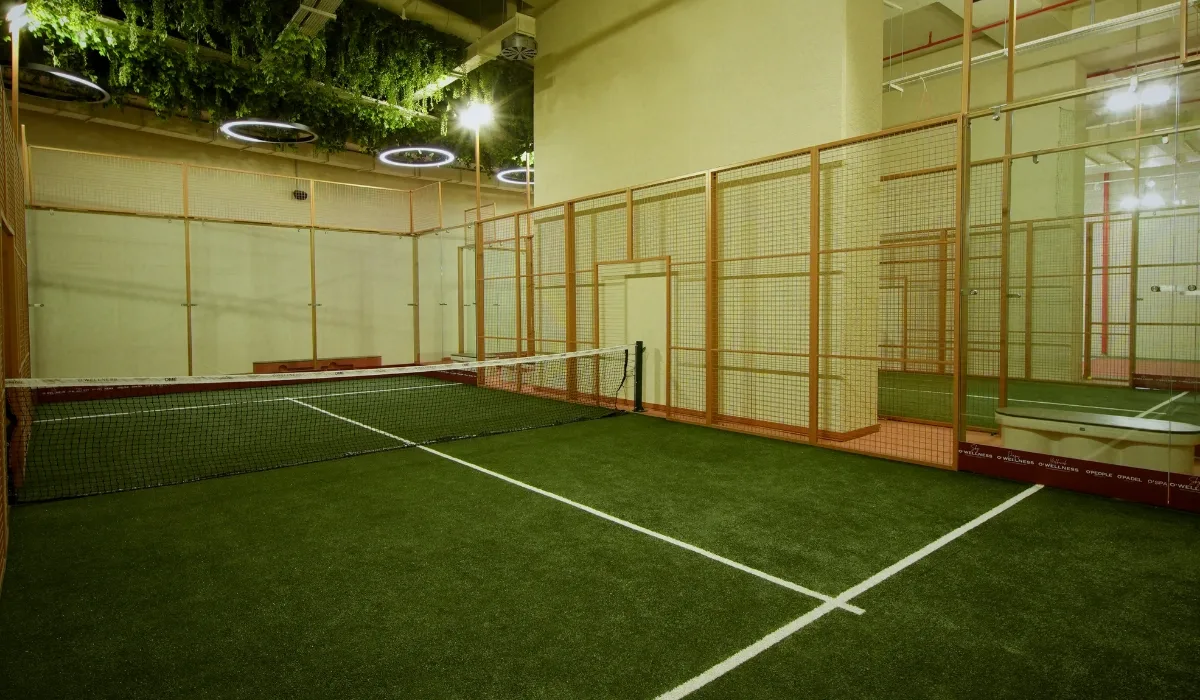
The padel glass rule can be summed up in one sentence: if the ball on the opponents’ side hits the ground first and then hits the glass or fence, play continues; if the ball hits the opponents’ glass or fence directly without touching the ground, the hitting team loses the point. A player can use the glass on their own side to send the ball over, but a ball that comes off their own metal fence and goes over is a fault. These two distinctions (touching the ground first, and glass vs fence) carry all of padel’s wall rules.
In this post, based on the official FIP rules, we go through every wall-related scenario one by one: the back glass, side glass, double glass (corner), metal fence, glass-fence junction, walls during the serve and balls that leave the court. For the general framework of the rules, you can check out our complete guide to padel rules you can take a look; here, as the O’Padel Beytepe coaching team, we focus only on the walls.
Summary
- A ball going to the opponents’ side must touch the ground first; a ball that hits the glass or fence without touching the ground loses the point.
- A ball that comes off the glass or fence after touching the ground is in play; it doesn’t matter how many walls it hits.
- A player can send the ball over by hitting it into their own glass (legal); they can’t do so off their own fence (fault).
- If the serve lands in the box and hits the glass, it’s good; if it hits the fence, it’s a fault.
- If the ball touches the ground and leaves the court, the player can go outside and play it, if the court allows.
Where are the glass and fence on a padel court?
On a FIP-standard court, the 20×10 metre playing area is enclosed by walls. The back walls generally consist of 3 metres of glass topped with a 1 metre metal fence, for a total height of 4 metres. On the side walls the glass steps down gradually; the glass is higher in the sections near the back corner, while near the net the fence section dominates. Our courts at O’Wellness Beytepe use tempered glass; for dimensions and structure courts you can take a look at the page, and message us on WhatsApp for current technical information.
From a rules perspective, there are two different surfaces: glass (flat, predictable bounce) and metal fence (irregular bounce). The rules treat these two the same in some situations and differently in others. In the rest of this post, you’ll see which applies when.
The basic rule: ground first, then wall
This is the backbone of padel’s wall rules. A ball sent to the opponents’ side must touch the groundbefore making contact with the glass or fence. After the ball touches the ground, it can hit the back glass, side glass, fence or any combination of these; play continues, and the receiving player must hit the ball before it touches the ground a second time.
- The ball touched the ground, hit the back glass, the player hit it: good.
- The ball touched the ground, hit the side glass and then the back glass (double glass), the player hit it: good.
- The ball touched the ground, hit the fence, the player hit it: good (during a rally).
- The ball hit the back glass without touching the ground: the hitting team lost the point.
- The ball hit the fence without touching the ground: the hitting team lost the point.
- The ball touched the ground, came off the glass and touched the ground a second time: the receiving team lost the point.
The most common mistake by players coming from tennis is hitting a powerful shot that goes directly into the opponents’ glass without touching the ground. In padel, this isn’t a “winner”; it’s a lost point. On the other hand, a ball that isn’t very powerful but touches the ground and rises off the glass is a good shot that puts your opponents in trouble.
Using your own wall: glass yes, fence no
Padel’s most distinctive feature is that players can use the walls on their own side as a playing surface. According to the FIP rule, a player can hit the ball into glass any of the walls on their own half; if the ball comes off the glass, clears the net and lands on the opponents’ side, the shot is legal. Hit off the back glass, this shot is known as the “contrapared” (counter-wall); hit off the side glass, it’s a side-glass recovery.
The same does not apply to metal fence . If the ball a player hits strikes the fence on their own side and goes over from there, the point goes to the opponents even if the ball lands on their side. The rule text makes this distinction explicitly; because of its irregular bounce, the fence isn’t accepted as a controllable hitting surface.
| The ball the player hit… | Result |
|---|---|
| Hit their own back glass, cleared the net, touched the ground on the opponents’ side | Legal |
| Hit their own side glass, cleared the net, touched the ground on the opponents’ side | Legal |
| Hit their own fence and cleared the net | Fault, point to the opponent |
| Hit their own glass but didn’t clear the net | Fault, point to the opponent |
| Hit their own glass, cleared the net and hit the opponents’ glass without touching the ground | Fault, point to the opponent |
| Hit their own glass, cleared, touched the ground on the opponents’ side, then hit the opponents’ glass | Legal, play continues |
The counter-wall shot is technically difficult and requires timing; being legal doesn’t make it easy. We cover the technique of this shot in our post contrapared technique , and the general principles of using the walls in using the walls in padel we explain in the article.
Glass, fence and junctions during the serve
The serve is subject to a different set of rules than the rally, and the walls are judged more strictly here. If the serve lands in the diagonal service box and then hits the side or back glass, the serve is good; the receiving player can play the ball off the glass. However, if the serve lands in the box and then hits the metal fence , it’s a service fault. This differs from the rally rule: in a rally, a ball that touches the ground and hits the fence is in play; on the serve, it isn’t.
A serve that touches the net is judged with the same logic: a ball that touches the net, lands in the box and doesn’t hit the fence is a let (the serve is replayed); a ball that touches the net, lands in the box and then hits the fence is a fault. All the serving rules are in our post padel serve rules .
The junction of glass and fence
Sometimes the ball hits the line where the glass meets the fence, or the metal frame holding the glass. In FIP rule interpretation, which surface these situations count as can vary depending on the direction of the bounce and the organizer’s interpretation; in professional matches, the referee decides. In club matches without a referee, the practical rule is: when in doubt, the ball is ruled in the opponents’ favor or the point is replayed. For handling these kinds of disputes, see matches without a referee and fair play article.
Corner, net and ceiling: tricky scenarios
In the corners of the court, the ball hits the side glass and then the back glass (or vice versa); this is called a double glass. There’s no difference in the rules: as long as the ball has bounced on the ground, it doesn’t matter how many walls it hits; the receiving player must hit it before the second bounce. In the corners, the ball’s direction changes unexpectedly; that’s a matter of technique and anticipation, not rules. We cover the tactical side of corner play in the article on corner play in padel.
There’s one more rule related to high bounces: if the ball touches the ground, comes off the glass and goes out over the court walls, the player can return the ball from outside if leaving the court is allowed. If the ball hits an object or person outside the court, the point ends and the hitting team (that is, the team that sent the ball out) wins the point, because the ball had legally touched the ground on the opponents’ side. Details in the out-of-court shot rule .
Glass and net together: tricky scenarios
On some points, the ball touches both the net and the glass, and it’s not immediately clear who won the point. The FIP rules apply the same two principles here too. During a rally, a ball that touches the net and lands on the opponents’ side is good; if that ball hits the glass after touching the ground, play continues. If the same ball touches the net and hits the opponents’ glass without touching the ground , the hitting team loses the point; touching the net doesn’t change the outcome.
Another scenario: a ball coming off a player’s own glass fails to clear the net, comes back over the net and lands on their own side. In this case, the ball is considered not to have crossed the net and the point goes to the opponents. Can the player hit this ball a second time? No; the same team hitting the ball twice in a row within the same rally is a fault. So a glass recovery comes down to one chance: if the ball is going to clear the net, it clears it; if not, the point is over. We also gather some of these tricky situations in our post double bounce, touching the net and body contact .
Ceiling, lighting and structures outside the court
On indoor courts, the ceiling and lighting fixtures are not part of the game. If the ball hits the ceiling, the lights, columns or any structure at the top of the court during a rally, the team that hit it loses the point. This rule matters especially for players using the high lob (globo); on an indoor court, ceiling height directly affects lob strategy. On our indoor courts, which offer year-round play in Ankara's cold winters and hot summers, you can comfortably practise your lob game with the ceiling height in mind; for current court information just message us on WhatsApp.
Knowing the glass rules on paper is different from timing a ball coming off the back glass correctly. Practise your wall play with confidence on our tempered-glass courts at O’Wellness Beytepe.
A quick decision tree for glass and fence rules
When you need to decide in a split second on court, follow this order:
- Whose shot was it? If it was your opponents’ shot, go to 2; if it was yours, go to 4.
- Did the ball touch the ground on your side? If no (it hit the glass or fence directly), the point is yours. If yes, go to 3.
- Did you hit the ball before it touched the ground a second time? If yes, play continues. If no, the point goes to your opponents.
- Did your shot hit your own wall? If it hit the glass and cleared the net, go to 5. If it hit the fence, the point goes to your opponents.
- Did the ball touch the ground first on the opponents’ side? If yes, play continues. If no (it hit the opponents’ glass or fence directly), the point goes to your opponents.
These five questions settle almost every wall-related dispute. In our lessons, we have beginners memorize this decision tree courtside; by the end of the second week, most players apply it without thinking.
Common glass and fence mistakes
- Hitting directly into the glass: A powerful shot into the opponents’ glass without touching the ground. Beginners’ number one way to lose points.
- Counting a recovery off the fence as legal: The “but the ball went over” objection doesn’t work; your own fence is a fault.
- Missing the second bounce after the glass: A ball coming off the back glass drops quickly; a second bounce loses the point.
- Confusing the serve and rally rules: On the serve, the fence is a fault; in a rally, it isn’t.
- Counting a lob that hits the ceiling as good: On an indoor court, the ceiling and fixtures are out of play.
Result
The glass and fence rules in padel come down to two simple principles: the ball must bounce on the opponent's side first, and when using your own wall, glass is allowed and the fence is not. Once you've got these principles down, the walls stop being a feared obstacle and become the strongest weapon in your game. We're waiting for you to work on wall play with the predictable bounce of tempered glass on the indoor, climate-controlled O’Padel Beytepe courts at the O’Wellness Beytepe complex in Beytepe Neighbourhood, Çankaya, Ankara; membership is not required, you can book via WhatsApp (+90 536 908 08 00), and our coaching team is ready to teach you to read the ball off the glass from your very first session.
Frequently Asked Questions
If the ball hits the glass or fence directly without touching the ground on the opponents' side, the hitting team loses the point. If the ball touches the ground first and then hits the glass, play continues.
Yes. A player can hit the ball into the glass walls on their own side; if the ball clears the net and touches the ground on the opponents' side, the shot is legal. The same doesn't apply to the metal fence; a ball coming off your own fence is a fault even if it goes over.
Yes. As long as the ball has touched the ground once on the opponents' side, it doesn't matter how many walls or which surfaces it hits; the receiving player must hit the ball before it touches the ground a second time.
The ceiling, lighting and structures above the court are not part of play. If the ball hits them, the hitting team loses the point.




 Padel Courts
