

Setting up a padel league rests on three basic decisions: splitting players into balanced level groups, writing a clear fixture list and points system that everyone can know, and then managing this system consistently through the season. A properly set up in-club league gives players a meaningful match every week and gives the club a lively, loyal community. With the experience we have gained running the seasonal league at Beytepe, we have gathered below the steps to set up a league from scratch.
Why is setting up a padel league different from a tournament?
An Americano or one-day tournament starts and ends in a few hours. A league, on the other hand, is a process spread over weeks, sometimes months. So in setting up a padel league, the real challenge is not writing the rules but keeping those rules fair for everyone over eight or twelve weeks.
The league's biggest advantage is that it creates continuity. Players face the same opponents several times, see their progress concretely and their bond with the club grows. If you are curious about the logic of one-day events, our article on the Americano format and scoring offers a good point of comparison.
On the other hand, a league demands more discipline from the organiser. Without a postponement rule the fixture list falls apart in two weeks; if level groups are set up wrongly, motivation drops after the first round. The steps below are listed precisely to manage these two risks.
Step 1: Define the league's purpose and format
First clarify who you are serving. A league aimed at competitive players and a social-leaning league that includes beginners are not run with the same rules. Once the purpose is set, choosing the format gets easier.
Fixed pairs or individual rankings?
The two most common models are:
- Fixed-pair league: Players register with their partners at the start of the season and collect points as a pair. Team spirit is high; but if a player gets injured, a substitute rule is needed.
- Individual (rotating) league: Partners change every week and points are kept individually. Ideal for communities that want to meet new people, and the missing player problem is easier to solve.
If you choose the fixed-pair format, it helps to guide players on choosing a partner; choosing a compatible padel partner our article gives a practical checklist on this.
Season length
In-club leagues work well with 8-12 week seasons. Shorter isn't enough to show progress, and longer is open to absences because of holiday periods and work pressure. In Ankara the academic calendar is decisive: taking into account the semester breaks, exam weeks and holidays of Hacettepe and Bilkent protects participation considerably.
Step 2: Set up level groups fairly
The fate of the league is decided in the level grouping. If a player at level 2.5 faces a player at level 4.5 in a group, neither side enjoys the match. The goal is for most matches within each group to be close.
Use three sources of data together for grouping:
- Declared level: The player's own estimate. Beginners generally rate themselves low and intermediates high.
- App rating: The level rating on platforms like Playtomic is a good reference for players who play regularly.
- Coach observation: In cases of doubt, having a coach watch a short evaluation match is the most reliable method.
Knowing how to read the level scale speeds up grouping; the padel level system from 1.0 to 7.0 in our article we described how each range looks on court.
Group size
In fixed-pair leagues, groups of 6-8 pairs finish in 5-7 weeks with a single round-robin. In individual leagues, groups of 8, 12 or 16 are mathematically the most convenient numbers for rotation, because every week the tables of four are complete.
Step 3: Write the points system simply and transparently
Complicated points systems look fair on paper but damage trust when players don't understand them. A good rule: every player should be able to work out in their head how the table will change as soon as the match ends.
| System | How it works | When suitable |
|---|---|---|
| Win-based points | Win 3, loss 1, no-show 0 points | Fixed-pair leagues; if you want to reward participation |
| Set-based points | 1 point for every set won (2-0 win 2, 2-1 win 2, 1-2 loss 1) | To reward the loser too in close matches |
| Total games | Games won in each match are added up | Individual rotating leagues, timed matches |
| Ladder | You challenge the one above you; the winner swaps places | Long-running in-club competition with a flexible schedule |
Giving zero for not turning up and one point to the loser is a small but effective detail: it encourages the player to come to the match even if they lose. For tie-breaks use, in order, head-to-head, set average and game average; share this in writing at the start of the season.
Match format
In in-club leagues the most practical format is two sets and a super tie-break (to 10 points) if tied. When you reserve the court for 90 minutes, this format almost always fits. Decide at the outset whether the golden point will be used; golden point and tie-break rules our article helps you make this decision.
Step 4: Prepare the fixture list and postponement rule
The fixture list is the backbone of the league. In fixed-pair leagues the classic round-robin is used: each pair meets every other pair in the group once. If the number of pairs is odd, one pair has a “bye” each week.
There are two approaches to the fixture list:
- Fixed day and time: All matches are played, for example, on Tuesday at 20:00. It is easy to organise and court planning is clear.
- Flexible week: Pairs arrange that week's match on whichever day they want during the week. It is more accessible for players with busy work but needs tracking.
Whichever you choose, there must be a postponement rule. An example rule: “A match can be postponed at most once; if the postponed match isn't played within two weeks, the side that requested the postponement is counted as having lost by default.” This single sentence prevents the pile-up of unplayed matches that builds up in the middle of the season.
Step 5: Result reporting, communication and the table
Running a league is largely managing communication. Players need to know where, when and how to report the score. The simplest solution is for the winning side to write the score into a WhatsApp group or shared table after the match; the losing side confirms.
Update and share the points table at least once a week. A visible table keeps the pulse of the league; players talk about the rankings and come to the next match more eager. For disagreements that may arise in matches without a referee our article on self-refereeing rules we recommend sharing as an addition to the league regulations.
What the regulations should include
- Match format, golden point decision and warm-up time
- Ball rule: whether a new ball is opened for each match and who brings it
- How the court fee is split
- Lateness tolerance (e.g. forfeit after 15 minutes)
- Substitute player rule and level limit
- Ranking criteria in case of a tie
Step 6: Promotion, relegation and end of season
If there are multiple level groups, movement between groups at the end of the season is the most exciting part of the league. Generally the top two pairs of each group move up to a higher group and the bottom two drop to a lower group. This way the groups balance themselves each season and nobody stays stuck in the wrong group for long.
Closing the season with a final day makes the league unforgettable. A short play-off with the group winners, followed by a prize ceremony and a meal together, noticeably increases players' desire to sign up for the next season.
Setting up a padel league at Beytepe: practical application
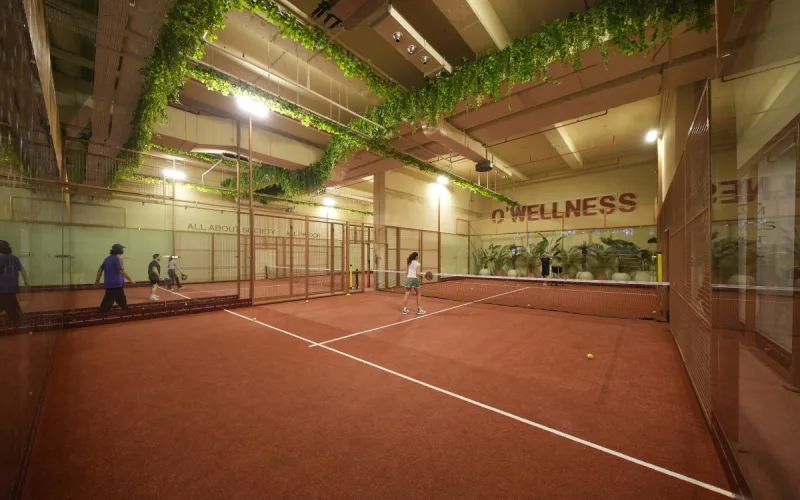
If you want to start a league among your own friends, at your company or in your university club, the set-up at Beytepe makes things much easier. O’Padel Beytepe's indoor, climate-controlled courts mean the fixture list doesn't get disrupted by weather even in Ankara's cold winter; this removes the biggest problem of outdoor leagues from the outset.
In practice you can proceed like this:
- Gather participants: Start with at least 12 players or 6 pairs.
- Determine levels: For players you are unsure about, from padel lessons our page you can arrange an assessment lesson.
- Plan courts: For a league with fixed times, court booking at the same day and time all season is the most orderly method; with packages the cost per session goes down.
- Share the regulations: Turn the list above into a one-page text and send it to everyone before the first match.
- Plan the finale: Put the final day in the calendar at the start of the season; for a get-together after the match, the lounge area is a natural gathering point.
If you would rather join a ready-made structure than set up your own league, our club's seasonal Beytepe Padel League and monthly events are on the tournaments page. If you are curious how the league works in detail, see our Ankara padel league guide .
Keeping the league alive: motivation and community
In the first two weeks of the season everyone is keen; the real test comes in the fifth and sixth weeks. A few small touches to keep players interested at this point noticeably increase the league's completion rate.
- Match of the week: Announcing the closest match with a short note creates a story for players to talk about.
- Mid-season stats: Fun data such as the pair with the longest winning streak or the pair that has played the most super tie-breaks adds colour to the table.
- Mid-season get-together: A short mixed Americano where all groups come together introduces players of different levels to each other.
- Feedback: A two-question survey mid-season gives a chance to fix format problems before the season ends.
Although these seem small, when a league is more than a scoreboard, players feel part of a community. We covered in more detail why the social side of padel is so strong padel community culture in our article.
If the level gap opens up during the season
Sometimes a player improves quickly during the season and pulls well ahead in their group. In this case, instead of switching groups mid-season, it is fairer to promote them directly at the end of the season. Changing the rules mid-season shakes the other players' trust.
Common mistakes
The traps first-time league organisers fall into most are similar:
- Too wide a level range: Gathering players from 2.0 to 4.5 in a single group makes half the matches one-sided.
- Unwritten rules: A rule that “everyone knows” turns into an argument at the first disagreement.
- No postponement rule: A half-finished table at the end of the season damages the league's credibility.
- Not updating the table: A ranking that doesn't change for two weeks quickly lowers interest.
- Forgetting the social side: A league is not just scores; the time spent together after the match is what really carries players into the next season.
Most of these mistakes can be avoided by setting aside half an hour at the start of the season to prepare written regulations. In short, a good padel league is built with a good plan and consistent communication.
Short summary
The process of setting up a padel league consists of defining the purpose, building level groups carefully, writing a simple points system, preparing a fixture list with a postponement rule and ending the season with a meaningful finale. Each of these steps is simple; what makes the difference is applying all of them consistently through the season.
If you want to start your own league at Beytepe or join our club league, contact message us on the WhatsApp line on our page; let's plan everything together, from court scheduling to level assessment.
Frequently Asked Questions
For a rotating individual league at least 8, ideally 12 or 16 players; for a fixed-pair league 6-8 pairs is a good start. These numbers make sure the tables of four are complete every week.
The simplest and most common model is 3 points for a win, 1 for a loss and 0 for not turning up. In individual leagues, the total of games won also works well. What matters is that the system is shared in writing at the start of the season.
8-12 weeks is a balanced length for in-club leagues. In Ankara, participation is steadier if term breaks and exam weeks are taken into account.
The most practical method is to allow one postponement per match and, if the match isn't played within two weeks, to decide it by default against the side that requested the postponement.
Yes. You can make fixed day and time bookings on the indoor courts and get coach support for level assessment. For details, just reach us on our WhatsApp line.


 Padel Courts
