

The padel serve-to-net run is the transition, right after serving, to the most important position in doubles play: a player who does not reach the net line in time exposes both their pair and the team's defence. In this article we cover the right timing after the serve, the step pattern and the most common positioning mistakes; On the indoor courts in Beytepe, and explain how to put this transition into practice.
Why is the run to the net so important?
Unlike tennis, padel is a game played at the net. Most points are won at the net line in the battle of volleys and smashes. If the serving player stays on the baseline after serving, the opposing pair takes the net advantage one-sidedly and your pair stays permanently in a defensive position. So the run to the net after the serve is not just a movement but a tactical decision that determines who will own the match.
Our focus phrase, the padel serve-to-net transition, actually forms the foundation of the whole system of play: the better the coordination between the serving player and the partner at the net, the faster the pair's switch from defence to attack.
Right timing: when should you start running?
At the moment the serving player hits the ball, they are still close to the baseline. The right approach is to take the first steps towards the net right after serving, while watching the ball land in the opposing court. A player who does not start moving within 1-2 seconds after the serve is caught on the baseline by the opponent's return, which causes the pair to lose net control.
A practical rule: serve + first three or four steps = the window for approaching the net. If you miss this window, your risk of being stuck in the middle of the court, the worst zone for both defence and attack (no-man’s-land), rises.
Step count and rhythm: break the run into stages
It is more accurate to think of the net run not as a single sprint but as a two-stage movement:
- First stage: Right after the serve, advance to the mid-court zone with 3-4 quick but controlled steps.
- Second stage: When the direction of the opponent's return becomes clear, settle on the net line with small, balanced final steps.
The small steps that come into play in this second stage and the split step (balancing hop) let you react quickly to the direction the ball will come from. To learn this technique in depth, footwork in padel: the split step and small steps you can read our article.
Partner coordination: what should the player at the net do?
The partner already at the net when you serve must not stay static either. The partner should adjust position slightly according to the direction of the serve and be ready for possible short return balls until the serving player reaches the net. This synchronisation between the two players lets the pair defend the net line as a whole; if one stays back while the other rushes forward, the gap between them becomes a direct target for the opponent.
The most common positioning mistakes
The mistakes players most often fall into on the net run after the serve are these:
- Starting late: Waiting for the result of the serve and delaying the first step.
- The line problem: Not lining up with your partner, leaving a gap that can be played through.
- Freezing in no-man’s-land: Stopping in mid-court and so benefiting from neither the net nor the baseline advantage.
- An uncontrolled sprint: Still taking the final steps fast and trying to meet the ball from an unbalanced position.
Most of these mistakes come from neglecting to spot the opponent's weak point early and position accordingly. For more on reading opponents, finding your opponent's weak spot: tactical reading in padel article.
Adjusting the run to the type of serve
The speed and direction of the serve you hit directly affect the tempo of your net run. When you hit a slower, sliced serve, the opponent's return is usually weaker and you can move up to the net comfortably. After a powerful, deep serve, on the other hand, the opponent may make an aggressive return, so you should take your final steps more cautiously and with a focus on balance. If you want to review the basics of serve technique, on our site and in our padel lessons, specific work is done on this topic.
How do you improve this transition in Beytepe?
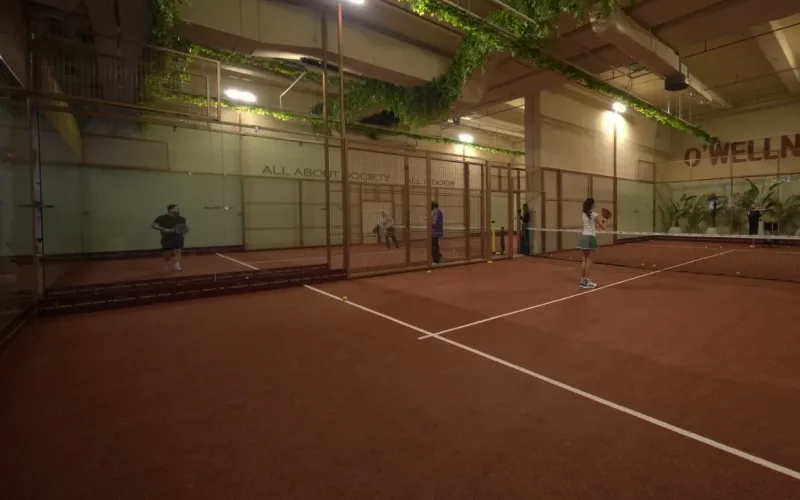
At O’Padel Beytepe's On indoor courts, the fixed surface and lighting conditions make it easier to practise the serve-to-net transition again and again under the same conditions. In training, deliberately count your steps after serving with a partner and check whether you can reach the net line in three or four steps. In lessons with video analysis this transition can be seen and corrected clearly; in our one-to-one or semi-private lessons this detail is specifically focused on.
If you want to test this transition under tournament pressure, you can practise at real match tempo by joining the monthly Americano tournaments and practising at real match tempo.
Run variations for different serve types
Every type of serve changes the rhythm of the net run slightly. After a sliced, low serve, the opponent's return will usually be weak and slow, so you can move up to the net more aggressively and quickly. By contrast, after a deep, hard serve, since you may face the risk of an aggressive return, you may need to take your final steps more cautiously and avoid trying an early volley. Deliberately varying the serve type both makes your opponent unpredictable and lets you vary the rhythm of your own net run.
Role split between pairs: who steps up when?
A good pair builds a system in which not only the serving player but also the partner waiting at the net takes position dynamically. While the serving player moves up to the net, the partner making slight adjustments according to the direction of the serve creates a constant sense of “closing” between the two players. This coordination turns over time into an automatic habit applied without conscious thought and lets the pair protect the net line as a whole.
Fatigue and concentration: why does the net run break down late in a match?
As fatigue rises later in the match, players often start to neglect the net run; not deliberately, but simply staying a little longer on the baseline to conserve energy. This is a performance drop that is hard to notice but has big consequences. Being aware of this tendency and deliberately prioritising the net run even when you feel tired gives you an important advantage over the opponent in long matches.
The value of getting systematic feedback in Beytepe
It is hard to notice this transition on your own because players usually rate their own speed better than it is. The objective feedback of a coach or a video recording lets you see the real step count and timing of your net run. In lessons at O’Padel Beytepe, this kind of video analysis clearly reveals the gap between players' own perceptions and their actual performance and speeds up the development process.
Right court vs left court: small adjustments in the run after the serve
In padel, the angle at which the serving player advances to the net differs slightly between the right (deuce) and left (ad) sides of the court. After a serve from the right side, the net run generally follows a slightly more diagonal line towards the centre, while after a serve from the left side this angle may change. Noticing this small difference increases your positioning precision and lets you make a consistent approach to the net from both sides.
A simplified approach for young and new players
For beginners, it is more effective to teach the net run not as a complex tactic but as a simple rule: “After serving, walk straight to the net and shorten your steps as you watch the ball bounce.” This simple framework can be enriched with finer tactical adjustments over time. In our 7-16 age children's academy, such simplified rules are preferred to settle the basic habit at an early age.
Measuring the net run in training: a simple method
| Indicator | Good level | Level to improve |
|---|---|---|
| Time to reach the net | Just before the opponent's return | Still in mid-court after the opponent's return |
| Alignment with partner | On the same line, no gap | Clearly behind or ahead of the partner |
| Balance on the final step | Small, controlled steps | Still entering the net with fast, unbalanced steps |
Regularly assessing these three indicators with a coach or a video recording lets you track progress in your net run concretely.
The long-term cost of neglecting the net run
Neglecting the net run in a single match may go unnoticed, but over time this habit causes a player's overall level to hit a ceiling. One of the biggest differences in moving from intermediate to advanced level is how consistently and consciously the player makes this transition. So learning the net run correctly early, or at an early level, is an investment for long-term development.
Turning the net run into a subconscious reflex
The final stage of learning this transition is being able to apply it without consciously thinking about it. In the initial learning period you may need to track every step mentally, but with enough repetition this process becomes automatic and lets the mind focus on higher-level tasks such as reading tactics or observing the opponent. This automation is a process called “motor learning” in sports science, which happens through repeated, correct practice.
You need to be patient to reach this point; some players experience this automation within a few weeks, while for others it can take a few months. What matters is to keep up conscious repetition in every training session and not to rush the process.
The place of the serve-to-net transition in pair strategy
A good pair treats the serve-to-net transition not as an individual task but as a shared strategy. Briefly discussing with your partner before the match how this transition should work (who goes to the net when, which signals will be used) creates a clear plan before stepping on court. This kind of preparation greatly reduces confusion that can arise during the match.
The relationship between the net run and overall match tempo
How quickly and consistently a pair makes the net run actually also shapes the overall tempo of the match. A pair that takes the net quickly can keep the opponent constantly on the defensive and steer the match at its own rhythm. So the net run is not just an individual technical detail but a strategic element that determines the pair's dominance across the match.
The relationship between the net run and short-ball tactics
A player who reaches the net quickly is also better prepared for the opponent's possible short ball (drop shot) attempt. These two techniques feed each other: a good net run lets you spot the opponent's drop shot earlier, while when you try your own drop shot you can keep the advantage by moving quickly towards the net. We covered this topic in detail in when to use the drop shot in padel our article.
Keeping the net run going regardless of weather conditions
One advantage of the indoor courts in Beytepe is that you can work on this technical transition without interruption even in the cold of winter or on extremely hot summer days. Given Ankara's changeable climate, year-round consistent training is an important advantage in making techniques that need repetition, such as the net run, permanent.
Conclusion: how you reach the net matters as much as reaching it
The net run after the serve is an invisible but decisive detail in padel. Correct timing, a split step rhythm and synchronisation with your partner let your pair take the net line early. If you want to work on this transition systematically with a coach, for a trial lesson on our courts in Beytepe, via our WhatsApp line get in touch with us.
Frequently Asked Questions
Generally, it is ideal to approach mid-court in 3-4 quick steps and settle on the net line with small, balanced final steps. The step count may vary with your height, but the rhythm logic is the same.
No-man's-land is the mid-court zone between the net and the back line. If you stand here, you benefit from neither the defensive nor the attacking advantage, and you struggle with low balls.
Your partner should be ready for short returns until you reach the net, and the two of you should stand level so that you leave no gap between you.
Yes, after a slow, short serve the opponent's return is usually weaker, so you can move up to the net more comfortably; after a strong serve, you should take your last steps more cautiously.
Yes, in private and semi-private lessons at O'Padel Beytepe, the serve-to-net transition can be worked on together with video analysis. For details, you can check out our padel lessons page.




 Padel Courts
