
Bandejais considered one of the most important shots in padel, because it is a controlled, low-risk alternative to the smash with both defensive and attacking character. By playing a high ball with a bandeja instead of smashing it at full power, you both keep the ball in play and hold the net position. In this article we explain the bandeja technique step by step, when to use it and how to improve it.
What is the bandeja and why is it so important?
Bandeja literally means “tray” in Spanish, and comes from the racket carrying the ball in a controlled way during the shot, almost as if on a tray. Technically, an overhead ball is answered not with full power but with a controlled, sliced shot. The aim is to send the ball, powerfully but at low risk, into the opponent’s court, usually deep.
The bandeja’s importance comes from this: although every high ball in padel looks like a smash opportunity, the smash is usually a risky shot and can cost you your net position. The bandeja keeps you in the net area, leaving you both safe and in position for the next point.
Bandeja technique step by step
1. Positioning
When the ball rises, position yourself slightly behind the ball’s landing point to meet it at shoulder height. Your feet should be slightly open and balanced so you can quickly return to the net after the shot.
2. Racket preparation
Prepare the racket not straight up as in the smash, but angled slightly back and to the side. This angle lets you put slice on the ball during the shot.
3. Contact
Hit the ball not at full power but with a controlled motion, keeping the racket face slightly open. The wrist should stay firm; the power of the movement should come from shoulder and arm rotation.
4. Direction and depth
The bandeja’s target is usually the back area of the opponent’s court, i.e. depth. Sending the ball behind the opponent’s feet makes it hard for them to go on the attack and keeps you in the net advantage.
5. Recovery
Right after the shot, take a step towards the net to be ready for the next ball. The bandeja’s real strength lies not in a single shot but in keeping you in an advantageous position.
When is the bandeja used?
The bandeja is preferred especially on medium-height balls where the opponent’s lob is not very high but does not offer a clear smash opportunity either. It is also the right choice when you do not want to lose the net position and are looking for safe continuity instead of a risky smash. When the opponent is close to the net and could return a flat smash, the bandeja reduces this risk by sending the ball deep.
If you want to see the types of smash and how they differ from the bandeja in more detail, types of padel smash article.
The difference between the bandeja and the víbora
The bandeja and víbora are often confused because both answer high balls with a sliced shot. The basic difference is that the víbora focuses more on sidespin and is usually played at a sharper angle; the bandeja is flatter and depth-focused. The technical differences between the two and which to prefer in which situation, in our víbora shot article you can find in detail.
Drill suggestions for improving the bandeja
- Wall repetition: Repeatedly answering high balls fed by your coach or partner with the bandeja.
- Target zone work: Placing a cone in the back corner of the court and aiming to send the bandeja to a specific target.
- Smash-bandeja distinction: Developing the reflex of choosing the right moment by answering balls of the same height sometimes with a smash and sometimes with a bandeja.
How do you improve your bandeja at Beytepe?
The bandeja is a shot learned not by reading from a book but through repetition and the right feedback. In our lessons in Beytepe, bandeja technical work is regularly included for intermediate and advanced players; with the video analysis option, you can clearly see your racket angle and contact point.
Once you have consolidated the technique, in our monthly Americano tournaments testing the bandeja under real match pressure is the most effective step for making the learning permanent.
Conclusion: a patient shot, a reliable result
The most common technical mistakes when hitting the bandeja
The mistake new learners make most often is trying to hit the bandeja at full power like a smash; this completely removes the shot’s purpose of control. Another common mistake is flattening the racket angle too early and putting the ball in the net. Keeping the racket slightly open is the key element that gives the bandeja its characteristic slice.
Trying to add power with the wrist is also a common mistake; this both lowers accuracy and, over time, puts unnecessary load on the elbow and wrist.
The bandeja’s role in doubles dynamics
The bandeja is not just an individual shot but also part of the pair’s strategy for keeping the net position. When one player hits a bandeja, their partner also needs to position according to this shot; usually the partner slides slightly back to prepare for a possible counter-attack after the bandeja. This synchronisation ensures the pair does not lose control after the bandeja.
Bandeja variations at advanced level
Experienced players can use the bandeja not just for depth but also to change direction. For example, a cross-court bandeja the opponent does not expect can create more surprise than a straight one. These variations are advanced details to try once you have fully mastered the basic technique.
Bandeja and physical preparation
Because the bandeja relies on shoulder and trunk rotation, regular shoulder mobility work increases the quality of the shot and injury resistance. For those who want to protect shoulder health, our shoulder health guide may be useful.
Bandeja and match statistics: why is it used so often?
When you watch professional padel matches, you notice that players often answer high balls with a bandeja instead of a smash. The reason is that the bandeja has a lower error rate than the smash and offers a guarantee of keeping the net position. At competitive level, reliability is often a more valuable quality than raw power.
Why is patience important when learning the bandeja?
In the first attempts, the bandeja usually comes out either too weak or too hard; finding the right balance takes repetition. A common mistake in this process is giving up on the shot completely after a few failed attempts and going back to smashing every high ball. Yet at least a few weeks of regular practice are needed to see the benefits of the bandeja.
A simple yardstick you can use when practising the bandeja
A simple way to tell whether the bandeja is being done correctly is to watch the ball’s landing point. If the ball keeps landing in the middle of the court or too short, the racket angle or contact point should be reviewed. If you can regularly reach the back area of the opponent’s court, your technique is on the right track.
Learning the bandeja by watching: what to take from professional matches
Watching matches from professional tours such as Premier Padel is a valuable resource for seeing how the bandeja is used at real match tempo. Paying attention to which position top players move into after the bandeja lets you understand the technique not just as the moment of the shot but as a whole sequence.
Which court zone should you use when practising the bandeja?
When practising the bandeja, you usually position yourself close to the net and work with high balls fed by your partner or coach from behind the net. This setup provides the practice environment closest to a real match scenario. Over time, the speed and height of the ball are gradually increased so that the player learns to cope with balls of different difficulty levels.
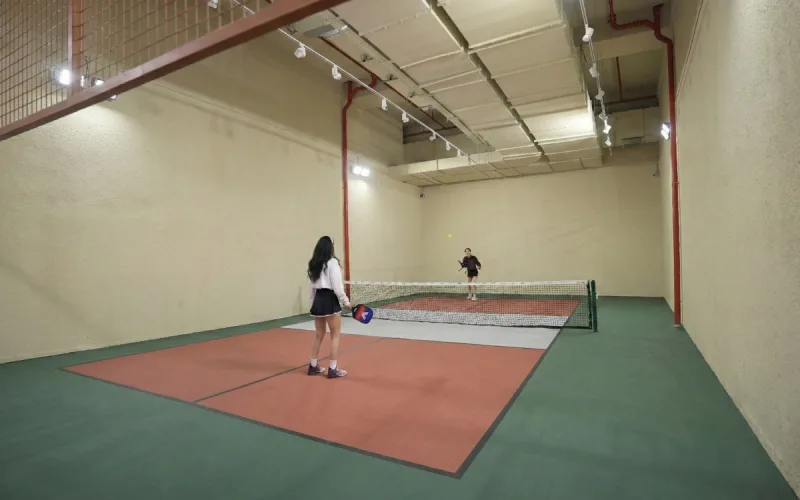
Structured repetitions like these, On our indoor courts at Beytepe, can be kept up all year round regardless of weather; this is a big advantage, especially in winter for players without an indoor court.
The bandeja’s relationship with other shots
The bandeja is not an isolated technique but a shot linked to other basic skills such as running to the net after the serve and the volley. A good bandeja is ineffective without taking the right net position; so while improving the bandeja, working in parallel on volley technique also strengthens your overall net game as a whole.
The importance of the partner’s role when practising the bandeja
In bandeja training, the partner or coach feeding the ball providing consistent height and speed directly affects the quality of the learning process. Instead of working with randomly thrown balls, starting at a fixed height first and then gradually adding variability lets the technique settle on a solid foundation. That is why, in lessons at Beytepe, coaches progress bandeja work in a set order.
Adapting the bandeja for age and experience groups
While young and physically strong players sometimes tend to add more power to the bandeja than necessary, more experienced and mature players usually prioritise control. For both groups, the right balance comes from understanding that timing and racket angle, not power, are decisive. For training approaches aimed at different age groups, to our padel at every age guide .
Bandeja and mental decision speed
The time you have to decide between a bandeja or a smash is usually less than half a second; so the ability to decide quickly matters as much as technique. The way to develop this reflex is to experience balls of different heights and speeds again and again and, over time, make the distinction “this ball is a bandeja, this one is a smash” almost automatic. In lessons at Beytepe, special drills aimed at developing this decision speed are also applied.
A simple weekly plan you can use when practising the bandeja
For a player who wants to improve the bandeja, two short focused sessions a week can make a noticeable difference within a few months. In the first session, only technical repetition (racket angle, contact point); in the second, working with balls of variable height and speed close to a real match scenario is recommended. This two-stage approach develops both the basic technique and in-match application together.
If you want to build a structured plan like this, with our coaches you can design a programme suited to your own goals together.
Final word: make the bandeja the backbone of your game
Over time, the bandeja stops being a technique applied by thinking and becomes almost a reflex. When you reach this point, you no longer hesitate against high balls and automatically make the right decision. This is one of the clearest signs of technical mastery in padel and becomes one of the basic building blocks that carry you to the next level.
One last note
The bandeja is one of the shots that most concretely rewards patient work; over time it will become a reliable part of your game.
Adding the bandeja to your everyday training
Adding the bandeja technique to your weekly training routine as a fixed item steadily increases the quality of this shot over time. Regular but short repetitions rather than one-off intensive sessions allow muscle memory to form more solidly.
By following these steps when you start practising on court, you will feel the progress quickly.
Every repetition will make you a little more confident and consistent in this technique; be patient and trust the process.
Being patient with yourself while working on this technique will be the approach that gives the most lasting improvement in the long run.
The bandeja is one of the clearest signs of patience and control in padel. When you resist the instinct to smash every high ball and learn to use the bandeja at the right moment, both your error rate falls and you hold net dominance for longer. If you want to work on this technique with a coach on our courts at Beytepe, you can reach us via our WhatsApp line.
Frequently Asked Questions
While the smash aims to hit the ball at full power, the bandeja aims to send the ball deep with a controlled, sliced shot; this way the net position is kept.
The bandeja should be preferred on medium-height balls that do not offer a clear smash opportunity and at moments when you do not want to lose the net position.
It is possible to grasp the basic mechanics within a few lessons, but being able to choose the right moment in a match develops over time with regular practice.
No, a standard padel racket is enough; the technique depends more on racket angle and contact point than on equipment.
It is ideal for intermediate players who have mastered the basic strokes, but with the right guidance beginners can also learn the basic form.




 Padel Courts
