

The padel court surfaceis the most decisive element in how the game feels, yet most players do not notice it. How much the ball bounces, how far your foot slides, how much load goes through your knee and how fast your racket wears: all of it comes down to the surface. The reason a player who plays on an indoor court at Beytepe feels strange at a different facility is usually the surface difference. In this guide we cover padel court surface types, the function of sand fill and the effect of maintenance on play.
Surface Types Used on Padel Courts
Several different surface solutions are used on padel courts, but the most common is the artificial turf family.
- Sand-filled artificial turf: The most common solution. Silica sand is spread between the turf fibres. It allows foot sliding in a controlled way and reduces joint load.
- Unfilled (monofilament) artificial turf: Tighter-woven surfaces with no sand. It gives faster play but reduces slip tolerance.
- Synthetic hard surfaces: Some facilities may have acrylic or similar hard surfaces. The ball bounces faster and higher, and joint load increases.
Facilities in Turkey mainly use sand-filled artificial turf. This choice is no accident: it is a balanced solution for both player comfort and ease of maintenance.
Why Is There Sand Fill?
Sand is the element that makes artificial turf work, and it has several jobs:
- Keeping the fibres upright: The sand settles between the turf fibres and keeps them standing. If the fibres lie down, the surface becomes slippery.
- Slip control: In padel, controlled sliding is part of the game. Sand turns this slide into smooth transitions instead of abrupt stops and reduces the load on the knee and ankle.
- Balancing ball behaviour: The amount of sand affects the ball's bounce height. Too much sand reduces the bounce and slows the game.
- Extending surface life: Sand reduces friction between the turf fibres, slowing wear.
Too Little Sand, Too Much Sand
The sand balance is felt by the player immediately. When there is little sand, the surface hardens, the ball bounces faster and the slip risk rises. When there is too much or it is unevenly distributed, the foot slides more than it should, the ball bounces less than expected and rallies slow down. On a court with regular maintenance this balance is kept and the player never thinks about the surface; a good surface is one you do not notice.
How the Surface Affects Your Game
The surface type directly shapes your playing style:
- Bounce height: On low-bounce surfaces you need to get down from the knees and be ready for low shots. On high-bounce surfaces, shoulder-height shots like the bandeja and víbora come into play more often.
- Footwork: On a sand-filled surface, small steps and controlled slides work. Stopping abruptly is both inefficient and a habit that raises injury risk.
- Shoe choice: Soles designed for artificial turf strike the balance between grip on sand and slide. Flat-soled running shoes cannot strike this balance.
- Racket wear: On a sand-filled surface the tip of the racket rubs on the floor. A protective tape is therefore not a luxury but a standard precaution.
Court Maintenance: What Is Done?
The surface's performance depends on regular maintenance. Typical maintenance steps facilities carry out are:
- Raking and brushing: Periodic brushing is done so the sand is spread evenly over the surface and the fibres stand upright.
- Sand top-up: Sand lost over time is replenished at set intervals.
- Surface cleaning: Removing leaves, dust and organic debris protects drainage and surface friction.
- Drainage check: On outdoor courts, proper water drainage is critical for the surface's life.
- Seam and joint check: Joins between turf sections are monitored for any opening.
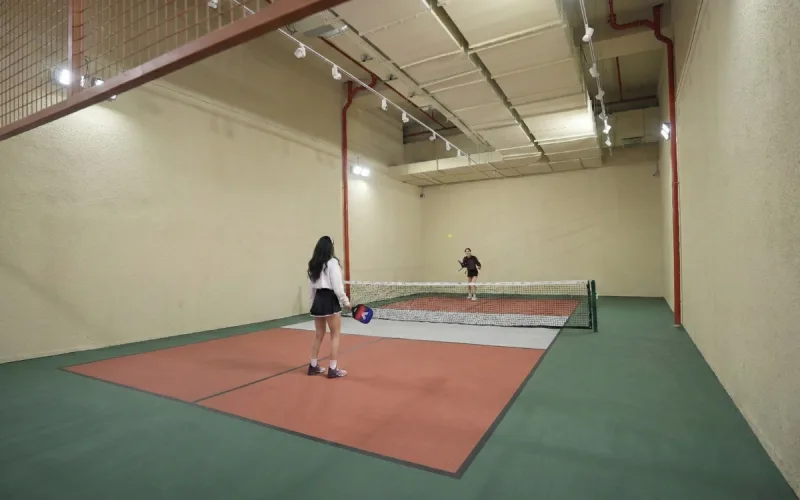
Indoor courts have a lighter maintenance load because there is no leaf or rain problem; on the other hand, dust build-up and sand being carried off by feet become noticeable. That is why regular brushing is needed on indoor courts too.
Your Contribution as a Player
Although court maintenance is the facility's job, players' simple habits contribute to the surface's life:
- Do not enter the court in street shoes; grit and soil from outside wear the fibres.
- Avoid eating food and drinking sugary drinks on court.
- Do not hit the racket on the floor; the fibres get damaged by these blows.
- Collect the balls and equipment at the end of the session; objects left on the surface make the maintenance team's job harder.
Adapting to Different Surfaces
For players who enter tournaments or play at different facilities, adapting to the surface is a skill. On a new court, pay attention to these in the first five minutes: how high the ball bounces, how far your foot slides and how lively the return off the back glass is. These three observations are enough to adjust your game plan in a few minutes. As a general rule, meeting the ball earlier on a harder, faster surface and adding depth on a slower one works.
Frequently Asked Questions
Sand gets into my shoes and socks; is that normal? Yes, it is expected on sand-filled surfaces. Shaking out your shoes at the end of the session is enough.
Is an indoor court surface different from an outdoor one? The material may be similar, but differences in humidity and temperature change the feel of the surface. Conditions are more consistent on indoor courts.
Can you play if the surface is wet? Wet artificial turf is slippery and the slip risk rises. For safety, you should wait for the surface to dry.
On which surface is the ball faster? In general, play is faster on surfaces with little sand and a tight surface.
Result
The padel court surface is a silent factor that determines the feel of the game and the load on your body. Sand-filled artificial turf is the most common solution for its balance of controlled sliding and joint comfort, and its performance depends directly on maintenance quality. Learning to read the surface as a player lets you adapt quickly on different courts and choose your equipment correctly. Shoes suited to the surface and a protective tape on your racket: these two solve most surface-related problems from the start.
The Relationship Between Surface and Injury Risk
A more important dimension of the surface than the feel of the game is the load on your body. Because sand-filled artificial turf lets the foot slide in a controlled way, the peak forces on the knee and ankle in abrupt stops are distributed more softly. On hard surfaces, the same movement creates a more sudden braking effect.
For this reason, choosing shoes to suit the surface is a matter of safety, not comfort. Soles made for artificial turf usually have a tread pattern that provides grip on sand. Aggressive soles that stop sliding completely, on the other hand, can backfire in padel, because controlled sliding is a natural part of the game.
- Playing in shoes with worn soles increases the slip risk on wet areas or areas where the sand has thinned.
- Skipping the warm-up leaves the muscle groups that come into play during sliding unprepared.
- If you see a noticeable pit, ripple or opened seam in the surface, the right approach is to report it to the facility team.
The Effect of Season and Humidity
Ankara's dry air makes dust build-up noticeable on indoor courts and can contribute to the surface hardening over time. In humid periods, the sand compacts a little and the ball bounces less. Although these changes look small, sensitive players feel them. When starting a new session, watching the ball's bounce in the first rallies and adjusting your tempo accordingly is the most practical way to adapt without needing any technical intervention.



 Padel Courts
