
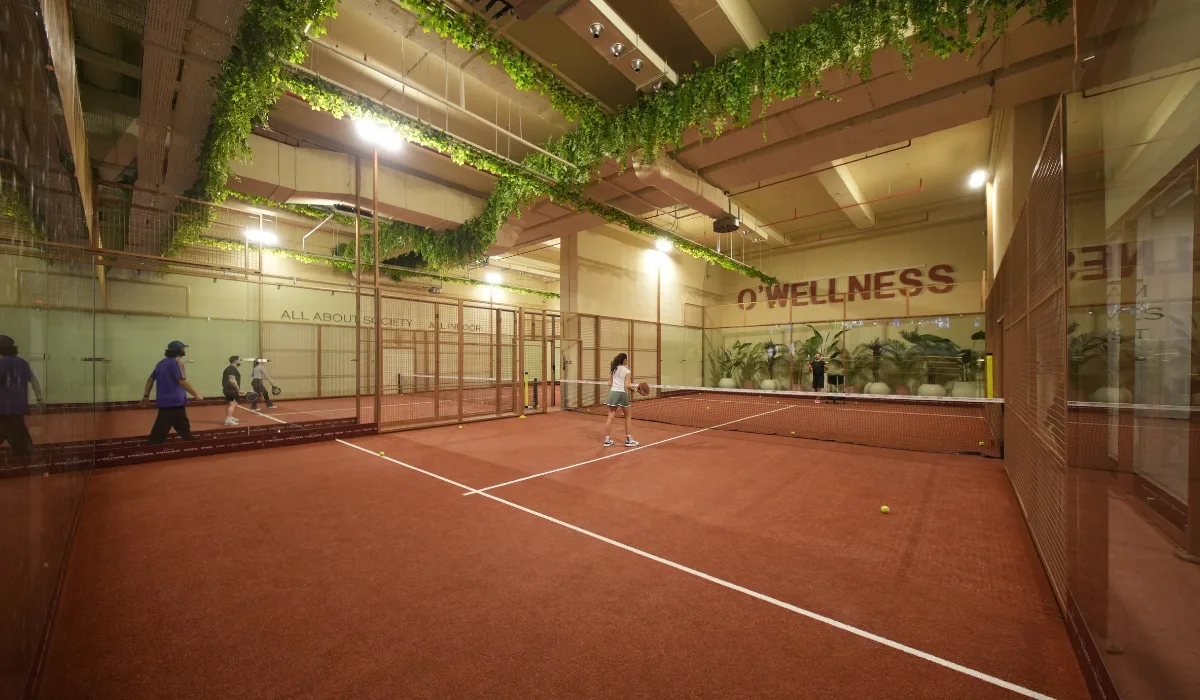
A padel league is a long-running competition format in which fixed pairs play one match a week over a set period, results are entered in a standings table, and promotion and relegation are decided by ranking at the end of the term. The O’Padel family’s level league model runs for 8 weeks; you can think of O’Padel Beytepe within this framework too (ask on WhatsApp for the current season calendar and rules): players are split into four level groups according to the 1.0-7.0 level system, each plays one match per week, and at the end of the season those at the top move up a group while those at the bottom move down a group.
Americano and Mexicano offer single-evening experiences; the league brings the discipline of playing with the same partner for two months towards a planned goal. In this article, as the O’Padel Beytepe coaching team, we explain the structure of the league, the scoring and ranking rules, the promotion-relegation mechanism and ways to make the most of the eight weeks.
Summary
- The O’Padel level league model lasts 8 weeks; each pair plays one match a week, 7-8 matches in total.
- There are four level groups, formed according to the 1.0–7.0 level system.
- Matches are played as 2 sets plus a tie-break if needed; wins, set difference and game difference determine the standings.
- At the end of the season, the top two in each group move up and the bottom two move down; the rest stay in their group.
- Registration is by pair; partner-matching support and a flexible match-time rule are available.
Why Is the League Format a Different Experience?
In matches you play with friends after booking a court, the score is forgotten an hour later. In a league, every match goes into a table, and every set changes the meaning of the following week. This fundamentally changes motivation and training discipline: players improve faster during their eight weeks in the league than they did in the previous six months. The reason is repetition with a goal.
The second difference is a fixed partner. Playing with the same person for eight weeks builds real chemistry on things like the middle-ball rule, serve formation and moving forward after a lob. That chemistry is the most solid step on the road to the monthly club tournament.
The third difference is level consistency. Because everyone in your group is close to your level, you experience neither crushing wins nor hopeless losses; every match can be won or lost. That is exactly the zone where improvement happens.
Structure of the 8-Week Level League
The league's framework is simple and its rules are clear. The basic structure:
- Duration: 8 weeks. Season start and end dates are announced during the registration period. Four seasons are planned each year, with a one-to-two-week break between seasons.
- Unit of participation: Pair. You register with your partner; if you do not have one, the club matches individual registrations in the same level band.
- Group size: 8 pairs per group. This means 7 matches are played in round robin format (everyone plays everyone); week 8 is reserved for postponed matches and the season finale.
- Match format: 2 sets, golden point at 6 games; if sets are 1-1, a 7-point tie-break replaces the third set. The average match lasts 60–75 minutes.
- Court and time: Each group has a fixed league night (for example, Tuesday at 8:00 PM). Pairs can move a match to another time that week by mutual agreement; the court fee is included in the league registration.
- Balls: The club provides new balls for every match.
Four level groups
The groups are defined by the level system. The bands may shift slightly from season to season based on the registration profile, but the typical breakdown is:
| Group | Level band | Player profile |
|---|---|---|
| Group D | 1.5 – 2.5 | Beginners; know the rules and can sustain a rally |
| Group C | 2.5 – 3.5 | Regular player; bandeja and lob developing |
| Group B | 3.5 – 4.5 | Advanced club player; high tactical awareness |
| Group A | 4.5 + | Competitive player; tournament experience |
A pair's group is determined by the average level of the two players; however, if there is a gap of more than 1.0 between them, the pair is placed in the group closer to the higher level. If you are not sure of your level, we recommend going through the From the O’Padel level assessment process before registering; the wrong group spoils the season for both you and your opponents.
Scoring and Ranking Rules
The league table standings are built on the following points:
- Win: 3 points
- Win via tie-break (after 1-1): 2 points; the losing pair gets 1 point
- Loss (2-0): 0 points
- Forfeit (no-show): 0 points; the opponents get 3 points and a 6-0 6-0 score is recorded
In case of a tie, the ranking criteria are, in order: head-to-head result, set difference, game difference and finally a draw. By giving one point to the pair that loses a tie-break, this system reflects the difference between a “close loss” and a “blowout” in the table. For details on the ranking math, see league ranking system article.
Promotion and Relegation: What Happens at the End of the Season?
The most exciting part of the league is the promotion–relegation mechanism. When the season ends, in each group:
- The top 2 pairs move up a group (since there is no higher group than Group A, the champion and runner-up take the season trophy and earn direct entry to the monthly club tournament).
- The bottom 2 pairs move down a group (since there is no lower group than Group D, they stay where they are).
- Pairs in 3rd–6th place stay in their group.
If a pair splits up for the new season (if one player does not continue), the remaining player keeps their group and registers with a new partner in the same level band. If the new partner is at a noticeably different level, the club reviews the group. This flexibility makes the eight-week commitment far less intimidating.
It is not possible to move up two groups in one season; the system rewards steady progress. Getting from Group D to Group A takes at least three seasons, or about a year. This journey is also a realistic timeline for progressing from level 2.0 to 4.5.
Would you like to train with your partner before a league match? Reserve a fixed weekly slot on WhatsApp on the climate-controlled courts at Beytepe.
Making the Most of Eight Weeks: The Weekly Rhythm
Unlike a one-day tournament, a league requires a sustainable rhythm. The 14-day taper model we described in In our tournament prep guide does not work here; instead, you build a repeating weekly cycle:
- Match day (for example, Tuesday): 15-minute warm-up, match, 10-minute cool-down. After the match, two sentences with your partner: what worked and what did not.
- Day after the match: Recovery. Light walking, mobility work, and a sauna if possible. O’Spa Beytepe is just right for this day.
- Midweek: One technical session; focus on a single area that was weak in the match. A 30-minute focused lesson with a coachis the highest-return investment over the eight weeks.
- Weekend: An Americano or a casual match; playing different opponents breaks the predictability of league matches.
- Day before the match: Light court time or none at all. Note what you know about the opposing pair; write your tactical plan in two sentences.
Pairs who keep up this rhythm for eight weeks are noticeably fresher than their opponents in the second half of the season. Weeks 5–7 of the league are usually when fatigue and dips in motivation set in; this is exactly where the weekly rhythm makes the difference.
The Three Phases of a Season: Opening, Middle and Final Weeks
Psychologically, an eight-week season unfolds in three phases. Weeks 1–3 are the getting-to-know-you phase: you do not know your opponents, chemistry with your partner has not settled in, and the table does not mean much yet. In these weeks, the goal is few errors and solid positioning; one lost match does not end the season. Weeks 4–6 are the standings phase: it is now clear who is fighting for promotion and who is fighting relegation. Motivation fluctuates, and some pairs get tired. Pairs that keep their weekly rhythm and focus on a single area midweek stand out here.
Weeks 7–8 are the final phase. In most groups, promotion and relegation are decided in the last matches; a single tie-break point can change your group for the next season. In these weeks, you should play the patterns that worked all season rather than try something new. Pairs that kept notes on which shots the opposing pair lost points with throughout the season reap the rewards in the final weeks. Opening a notebook at the start of the season and writing two lines after every match is the least talked-about but most effective habit in the league.
League Etiquette and Practical Rules
The league is played without referees, so fair play culture is what carries the system. Practical rules applied in the league model:
- Matches must be played by the last day of the league week at the latest; if the two pairs cannot agree, the time set by the club applies.
- Each pair may postpone up to two matches during the season; a third postponement counts as a forfeit.
- The score is entered into the app at the end of the match with the approval of both pairs. In a dispute, the point is replayed; in unresolved cases, the club coordinator decides.
- In case of injury, a pair may use a temporary substitute from the same level band with the club's approval; a substitute may play no more than two matches.
- Arriving more than 10 minutes late for the match time gives the opponents the right to take the first set 6-0; arriving more than 20 minutes late is a forfeit.
These rules may seem strict, but they are what hold the schedule of 32 pairs together for eight weeks. Experience shows that the most enjoyable seasons are the ones where the rules are applied most clearly.
What Level Do You Need to Join the League?
The short answer: if you know the rules, can serve and can sustain a rally for 4–5 shots, you are ready for Group D. This usually comes after 8–10 lessons or 2–3 months of regular play. For those who want to join earlier, we recommend a few Americano nights first; Americano teaches you to play with different partners and keep score in a relaxed setting.
For the upper groups, consistency matters as much as experience. Most pairs playing in Groups B and A’ have played at least one season in a lower group, taken part in monthly club tournaments and train regularly. For a step-by-step walkthrough of league registration, take a look at the registration guide.
Beyond the League: The Club Tournament and the Community
The league is the base of the club's competitive pyramid. The top two pairs in Group A earn direct entry to the monthly club tournament; pairs from other groups can also apply. Because each month's club tournament is played in women's, men's and mixed categories, you can enter the mixed category with your league partner or a same-gender category with a different partner. We explained the details of this pyramid in our monthly club tournament .
Another by-product of the league is community. The 16 pairs who are on court on the same night for eight weeks become a group who know each other by the end of the season. Season closing night is spent in the club lounge with a trophy ceremony and the search for partners for the next season. O’Padel Beytepe community events keep these bonds going between seasons too.
Result
A padel league is the only format that goes beyond weekly matches and makes your progress measurable: a fixed partner, a uniform level group, every set recorded in the table, and the chance of promotion at the end of the season. The level league model at O’Padel Beytepe, in the O’Wellness Beytepe complex in Çankaya, offers a structure with four groups and a promotion-relegation system that can take a player at level 2.0 up to the 4.0 band within a year. Follow the registration dates for the next season tournaments and leagues page ; if you don't have a partner, register individually and you will be paired with another player in your level band. To take your place in the Ankara padel community, which stretches from around Hacettepe, METU (ODTÜ) and Bilkent to Çayyolu and Ümitköy, just write on WhatsApp (+90 536 908 08 00); membership is not required.
Frequently Asked Questions
Yes. You register individually, and the club matches you with another individual registration in the same level band. A short get-to-know-you practice session is recommended for matched pairs before the season starts.
You can move it to another time in the same week by agreement with the opposing pair; the court fee is included in the league registration. Each pair has up to two postponements per season; the third counts as a forfeit.
With 8 pairs in each group, 7 matches are played in round robin format. Week 8 is reserved for postponed matches and the season finale. Matches are 2 sets, with a tie-break if needed, and last 60–75 minutes.
The group is determined by the average level of the two players. If there is a gap of more than 1.0 between them, the pair is placed in the group closer to the higher-level player, so the matchup is not unfair for opponents.
Yes. The level rating of players in a pair that finishes in the top two of their group and moves up automatically increases by 0.5. This update is also reflected in the Americano and Mexicano bands.



 Padel Courts
