

Padel racket care means significantly extending your racket’s lifespan by protecting its core, hitting surface and frame with a few regular habits. The short answer: wipe the racket with a damp cloth after every session, never leave it in a hot or freezing car, replace the frame protector and overgrip on time, and hit the ball with the center of the face, not the frame. These four habits form the basic framework that keeps most rackets from dying before their time.
As the O’Padel Beytepe coaching team, we see hundreds of rackets on our courts every week. Most rackets that go before their time don’t fail because of bad materials but because of three or four preventable habits: a racket left in a car boot, a frame scraping against the wall, a slipped grip that hasn’t been changed in years. Below we explain nine points that reverse these habits, with the reasons behind them.
Summary
- After every session, wipe the face with a damp cloth and let it dry; sweat and sand dust wear down the surface texture.
- Don’t leave the racket in a car, in the sun or in the cold; EVA and FOAM cores are damaged by heat and humidity cycles.
- Frame protector tape is cheap insurance; replace it as soon as it wears.
- Change your overgrip regularly; a slippery handle hurts both your game and your arm health.
- Cracks, a hollow sound, bubbling and permanent softening can’t be repaired; they are signs to replace, not maintain.
Why Does Padel Racket Care Make Such a Difference?
A padel racket is a completely different piece of engineering from a tennis racket. Instead of a strung structure, it’s a closed sandwich structure made by bonding woven layers with resin onto a foam core. Its performance depends on three things: the flexibility of the core, the stiffness of the face and the integrity of the bond between them.
Care serves precisely to protect these three variables. When the surface texture wears down, the spin you put on the ball decreases. When the core fatigues from hot-cold cycles, the racket goes dead; it absorbs the ball instead of pushing it. When the bond breaks down, the racket starts producing vibration, and that goes straight to your elbow.
There is also an invisible effect: a racket in poor condition slows your technical development. Learning the feel of a shot becomes harder with a face that gives inconsistent feedback, because you see the same motion produce a different result each time. If you’re curious about your racket’s material structure in more detail, our padel racket materials guide explains it layer by layer.
Cleaning: 60 Seconds After Every Session
When you play on silica-sand artificial turf on an indoor court, a fine mix of sand and dust sticks to the racket face. Add sweat and skin oils, and the rough texture on the face gradually becomes glossy; a glossy face grips less, and a face that grips less gives less spin.
The right method: at the end of the session, wipe the face in two directions with a slightly damp, soft cloth, then dry it with the dry side. Don’t use detergent, alcohol-based cleaners or acetone; they react with the surface finish and damage the texture. Don’t put it in the bag before it’s dry, or you’ll lock the moisture inside the racket.
Check the holes from time to time too. Sand that builds up in the holes changes the weight distribution and the airflow slightly but noticeably; it also holds moisture. Cleaning with a soft toothbrush is enough; don’t insert a sharp metal object, because you’ll scratch the coating around the hole edges.
Heat, Humidity and Proper Storage
Heat weakens the bonding strength of the resin that joins the core to the face. Cold hardens the foam core and makes it brittle; it’s no coincidence that players who hit hard with a racket left in the cold come in with frame cracks. Here are the practical rules:
- In summer, don’t leave the racket in the car trunk; the inside of a closed car gets far hotter than the outside air.
- In winter, don’t hit hard right away with a racket that’s been in the cold; wait 20–30 minutes for it to reach room temperature and keep your first shots soft.
- Heaters, radiators and window sills in direct sunlight are not storage spots.
- Dry a wet racket at room temperature in a ventilated place, not with a heat source.
- If you won’t be playing for a long time, store the racket loosely rather than squeezed in a bag.
Humidity is talked about less than heat but matters at least as much. A racket kept in a constantly humid environment develops odor and mold around the handle, and the wrap layers loosen. Leaving the racket in a closed bag with a sweaty overgrip is the fastest route there. A simple fix: after the session, leave the bag unzipped and air out the racket and shoes in separate compartments.
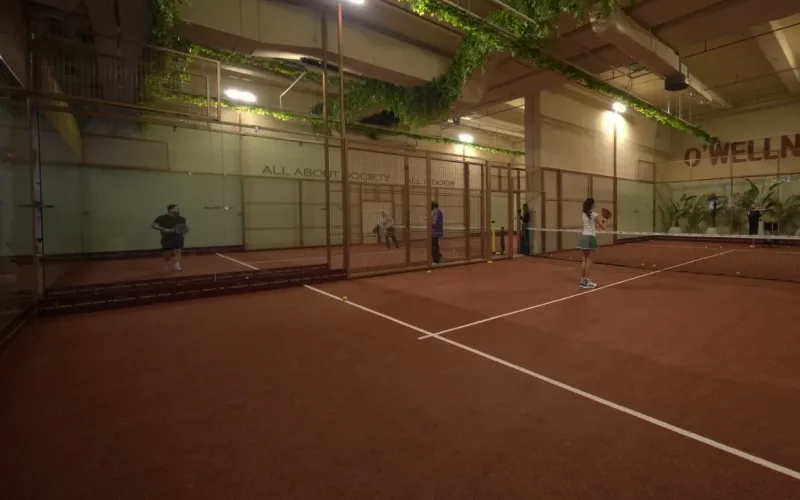
Because our courts at Beytepe are indoors and climate-controlled, the racket is played in a stable environment all year round. In Ankara the real risk isn’t the court itself; it’s the transport and storage time spent in a car that freezes on a snowy winter night or heats up in the midday summer sun. For court conditions, with their technical headings on our padel courts page see.
Consumables: Frame Protector and Grip
Frame protector tape
The most fragile part of a padel racket is the top of the frame. It’s the first point to make contact with the wall, the glass or the ground. Frame protector tape is the only buffer that absorbs these impacts before they reach the woven layer, and it costs next to nothing compared with the racket itself.
Replace the tape as soon as you see it worn and thin. When applying it, clean the frame, apply the tape taut so it covers the upper half, and don’t end it at a corner. Once the surface cracks, a real repair is not possible; that’s why protector tape is the highest-return step in racket care.
Overgrip and base grip
An overgrip is a consumable; it needs replacing as soon as it starts to feel slippery. Playing with a slippery handle creates two problems: without realizing it, you squeeze the racket harder, which increases the load on your wrist and elbow; and the racket turns slightly in your hand, making the hitting face inconsistent.
Check the base grip under the overgrip once a year as well. If its cushioning has collapsed or hardened, it needs replacing. For wrap direction, overlap and how thickness affects arm health, our padel grip and overgrip article offers a step-by-step guide.
The Invisible Effect of Technique on Racket Care
The least discussed truth about racket care: what wears a racket out most is hitting with poor technique. Hitting the ball with the frame, scraping the racket on the glass during wall recoveries and smacking the racket on the ground after a point shorten its life faster than all other factors combined.
Learning to play balls coming off the wall with the right timing is, in particular, a direct investment in racket care. A player who is late reaches out with the racket close to the glass at a vulnerable angle; a player who gets into position on time hits cleanly with the center of the face. In our padel lessons we train wall reading and recovery angles away from the glass as core topics.
A second technical detail: controlling the racket’s follow-through after smashes and bandejas. An uncontrolled finish can end with the racket hitting the side glass or the net post. In a busy doubles game, contact with your partner’s racket is also a common source of damage; the discipline of calling and sharing space is both a safety and an equipment issue here.
Shoe choice belongs in this picture too. A sole pattern suited to sand turf helps you stay balanced; when you stay balanced, you make fewer forced shots and less frame contact. On the topic of surface compatibility, choosing padel shoes article.
Monthly Checklist and Equipment Rotation
A five-minute check once a month catches most problems before they grow. You can use the table below as a reference.
| Checkpoint | What you’re looking for | Frequency | Action |
|---|---|---|---|
| Hitting face | Scratches, glossiness, bubbling | Every session | Clean with a damp cloth |
| Frame protector | Thinning, peeling | Once a month | Replace if worn |
| Holes | Clogging with sand and dust | Once a month | Clear with a soft brush |
| Overgrip | Slipperiness, hardening, odor | Regularly | Replace |
| Sound | Hollow or rattling sound | Every session | Suspected delamination; have an expert check it |
| Wrist strap | Tears, loosening | Once a month | Replace |
| Handle cone | Deformation, loose feel | Once a year | Replace the base grip |
A hollow sound is the most critical item on this list. If you gently shake the racket and hear something moving inside, delamination between the core and the face may have started; continuing to play in that case makes the damage worse.
If you play more than three sessions a week, rotating between two rackets makes sense. The reason isn’t just having a spare: a foam core keeps its flexibility better with a short rest after heavy use. The same logic applies to balls; a dead ball that has lost pressure forces you to hit harder, and that load goes onto the racket. For ball selection on indoor courts, choosing a padel ball our article.
Want to see care habits applied on court? On our indoor courts at Beytepe you can ask about equipment options on WhatsApp (+90 536 908 08 00), and consult our coaches while trying equipment.
The Line Between Repairable and Unrepairable
Care has its limits. Some damage is fixed by replacing consumables; some is never fixed. Knowing the difference eliminates wasted time and false expectations.
- Fixable: worn overgrip, torn wrist strap, old frame protector, superficial scratches on the face, clogged holes.
- Partly fixable: collapsed base grip, slightly deformed handle cone, small shifts in weight balance.
- Not fixable: frame cracks, spreading bubbles on the face, delamination between the core and the face, a permanently softened core.
If you see any of the signs in the third group, you are no longer at the maintenance stage but at the decision stage. At that point, the list of fatigue signs in our when to replace a padel racket article will make things easier. If you are buying a new racket, you can find all the selection criteria in our how to choose a padel racket guide. If you are considering renting instead of buying, our rent or buy comparison will also be helpful.
One last note: think of your equipment as a whole. Racket, balls, grip, shoes and bag form a system that affects each other; neglecting one shortens the life of another. Even choosing the right bag improves your racket’s storage conditions, because a thermal compartment both absorbs impact and smooths out temperature swings. We listed the items you should carry in our padel bag and accessories article.
Conclusion: Care Is a Club Habit at Beytepe
Padel racket care isn’t complicated; it is the sum of regular, small actions. At the O’Padel Beytepe courts in the O’Wellness Beytepe complex in Çankaya, we handle equipment care on exactly these principles: cleaning after every session, regular overgrip replacement and frame checks. We recommend the same routine to our players who come weekly from Çayyolu, Ümitköy, Konutkent or Bilkent; because a racket that feels good is, in fact, a racket that has been cared for. Your time planning on our court reservation page and explore post-session recovery options on our recovery and wellness page you can take a look. Membership is not required at O’Padel Beytepe; just write on WhatsApp.
Frequently Asked Questions
Holding the racket under running water or submerging it is not a good idea; water can get in through the holes and reach the bonding area between the core and the face. The right method is to wipe it with a slightly damp cloth and let it dry at room temperature. Avoid detergents, alcohol and solvents.
For a short time it’s fine, but lay it on the handle rather than the face and don’t drag it on the sand. The safest option is to put it in your bag or on the courtside rack; a racket left on the floor is exposed to being kicked and to sand abrasion.
No. A rattling or hollow sound from inside is usually a sign of delamination between the core and the face, and this damage is irreversible. You need to plan a replacement rather than maintenance; loss of control and increased vibration usually come with it.
For rental equipment options at O'Padel Beytepe you can get information via WhatsApp; cleaning and checking rental equipment is our club team's job. All we ask of you is to handle the racket carefully on court and hand it back at the end of the session.
No. A soft microfiber cloth, a soft brush, a spare overgrip and spare frame protector tape are enough. There’s no need for the special cleaning sprays on the market; chemical products risk harming the surface coating rather than helping it.


 Padel Courts
