
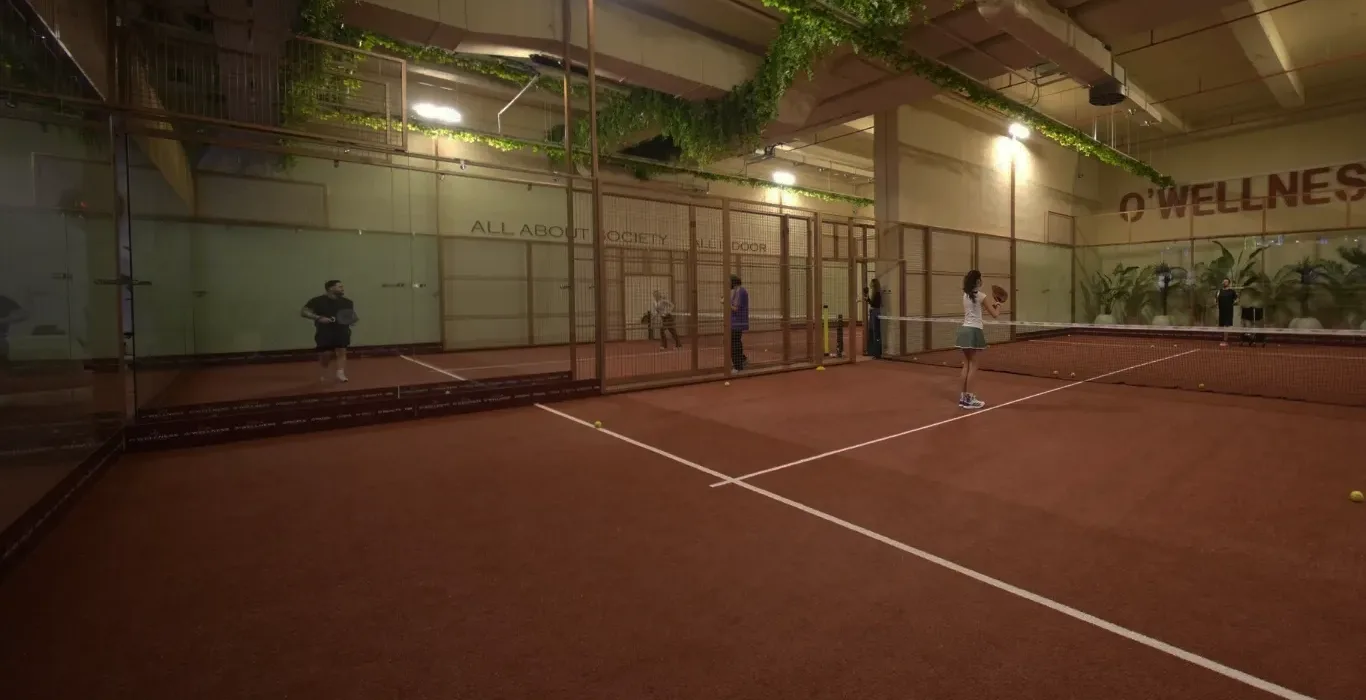
A padel ball may look like a tennis ball, but it is a different product: slightly smaller in diameter, with lower internal pressure and a lower bounce. The short answer: if you play on an indoor, climate-controlled court, a medium-to-low pressure match ball with tight felt is the most balanced choice; for training, you'll want thicker-felt practice balls that hold up better against pressure loss.
In this article, as the O’Padel Beytepe coaching team, we explain the ball's pressure, its felt structure, its relationship with the court surface and storage conditions. We do not give a brand list, because different series of the same brand behave completely differently. Instead, we will teach you to read how the ball in your hand will behave. Since balls are included in the court fee on our courts, you can test what you read here at no extra cost.
Summary
- A padel ball must be 6.35–6.77 cm in diameter and weigh 56–59.4 grams; when dropped from 2.54 m, it is expected to bounce 135–145 cm.
- High pressure = fast, lively play; low pressure = longer rallies, more control and less strain on the arm.
- On an indoor, climate-controlled court, conditions are constant, so medium-pressure match balls behave predictably.
- Felt texture determines how well the ball holds spin; tight felt gives more slice and víbora effect.
- An opened tube of balls loses pressure within weeks even if unused; store the tube cool and upright, and retire match balls to training.
How Is a Padel Ball Different from a Tennis Ball?
The two balls come from the same family, but their dimensions and internal pressure differ. A padel ball is slightly smaller in diameter and has noticeably lower internal pressure. This lower pressure keeps the ball at a controllable speed after it hits the glass and comes back; that is what makes padel's long rallies possible.
The practical result: if you play padel with a tennis ball, the ball is too lively, rises higher off the back glass than you expect, and control shots like the bandeja become nearly impossible. Likewise, if you play tennis with a padel ball, it feels dead. We compared the other structural differences between the two sports in our differences between padel and tennis article.
| Feature | The padel ball | Tennis ball |
|---|---|---|
| Diameter | About 6.35–6.77 cm | About 6.54–6.86 cm |
| Weight | About 56–59.4 g | About 56–59.4 g |
| Internal pressure | Lower | Higher |
| Bounce (from 2.54 m) | Approx. 135–145 cm | Approx. 135–147 cm |
| Style of play | Controlled, long rallies | Fast, short rallies |
Pressure: The One Variable That Sets the Pace of Play
A ball's internal pressure determines how lively it comes off the floor and the glass. Padel balls on the market generally fall into two categories.
- High-pressure (fast) balls: More bounce, faster play, shorter rallies. Attacking players and those with a powerful smash love them. In return, the margin for error shrinks, the load on the arm increases and the ball wears out faster.
- Medium- and low-pressure (control) balls: Less bounce, longer rallies, more room for tactics. They make learning easier for beginners and intermediate players and increase the number of repetitions in training.
The information on the tube isn't always enough; most manufacturers use general terms like “match”, “training” or “control”. The most reliable method is to squeeze the ball in your hand and bounce it on the floor. A ball that clearly resists finger pressure and bounces above waist height when dropped from shoulder height is considered lively.
Pressure choice is directly tied to your level. If you're in the 1.0–3.0 range, a control-type ball lengthens rallies and lets you hit more shots, which speeds up learning. Above 4.5, fast balls are better for keeping match rhythm. To define your level, see padel level assessment article.
Which Is Best for Indoor Courts?
Indoor, climate-controlled courts offer the biggest advantage in ball selection: conditions are constant. On an outdoor court, temperature, humidity and wind change the ball's behavior throughout the day; indoors, the character of the ball you choose stays the same from start to finish. That's why a medium-pressure match ball is the most predictable option on an indoor court.
The second deciding factor is the surface. Silica-sand synthetic turf gradually wears down the ball's felt, and sand particles get into the felt texture. This natural process changes the ball's friction profile, which is why the same ball feels slicker after a while and stops holding slice.
The amount of sand also matters. On freshly laid or newly topped-up sand, the surface is a bit more slippery; the ball skids a little further after the bounce. As the sand settles, the bounce becomes steeper. Because the surface is maintained regularly at the club, you largely won't notice this change, but it's usually why the same ball behaves differently when you play at different clubs.
The third factor is climate control. In a heated environment, the gas inside the ball expands slightly and the ball becomes a bit livelier. A ball that feels dead on a cold outdoor court in winter behaves much livelier on an indoor court the same day. For the technical specifications of our courts, see padel courts page.
On our climate-controlled indoor courts at Beytepe there is a ball and racket rental option (for current terms, WhatsApp: +90 536 908 08 00). You can try different pressure characters in the same session and see for yourself which suits your game.
Felt Texture and Spin
The felt on the ball's outer surface determines contact time and friction with the racket face. Balls with tight, short felt grip the racket face better, boosting the effect of spin-focused shots such as the sliced serve, slice and víbora. Balls with fluffy, long felt slow down a bit more in the air, which makes control easier but reduces spin.
On match balls, the felt is generally tighter and more uniform; on training balls, thick felt is preferred for durability. If you're working on spin, the felt character becomes as important as pressure. We explained the mechanics of these shots in our padel shot techniques guide article.
Ball and Racket Work Together
Thinking about ball choice independently of your racket is a common mistake. The two behave as a single system: a racket with a hard core and rigid face combined with a fast ball produces a combination that's very hard to control. The same racket is balanced out by a control-type ball.
The reverse is also true. If you use a soft-core, round racket and the balls are dead too, play gets heavy and generating depth becomes difficult. In that case, a livelier ball opens up your game. If you don't know your racket's character, our padel racket materials and padel racket shapes articles will help.
The practical pairing logic works like this:
- Control racket + fast ball: A good balance for beginners and intermediates; makes it easier to generate depth.
- Power racket + control ball: The combination favored at advanced level; smash power is preserved and rallies stay manageable.
- Power racket + fast ball: Only for very experienced players; the error rate rises noticeably.
- Control racket + dead ball: Can be used in training to increase repetitions; not recommended for matches.
Your racket's weight and balance are also part of this equation; we covered how they affect play numerically in our racket weight and balance article. If you haven't chosen your first racket yet, we recommend starting with our padel rackets for beginners and how to choose a padel racket articles.
Ball Lifespan: When Should You Replace It?
A padel ball wears out in two ways: pressure loss and felt wear. The two progress at different rates, so there's no single answer to “how many matches”. Instead, look at four indicators.
- Bounce test: Drop the ball from shoulder height. If it doesn't come close to waist height, the pressure has dropped.
- Felt appearance: If the surface has started to shine and the felt has flattened and disappeared, the ball no longer holds spin.
- Squeeze feel: Squeeze the ball with your fingers. If it compresses easily, internal pressure has dropped.
- On-court behavior: If it doesn't rise off the back glass as much as you expect and deep balls are landing short, the problem may be the ball, not your technique.
A word of caution: felt wear and pressure loss don't happen at the same time. Some balls are completely bald while still bouncing well; in that case the ball comes fast but holds no spin at all and skids unexpectedly off the glass. If your opponent's slice serve suddenly stops working, this may be why.
A practical rule: open a new tube for competitive matches and tournaments, and use balls retired from matches for training. Making this distinction matters when preparing for a tournament; for details, see tournament preparation we explained in our article.
Storage: How to Slow Down Pressure Loss
From the moment a pressurized tube is opened, the balls start losing gas. The process continues even if you don't play, so not opening more tubes than you need is the most effective way to save.
- Store the tube in a cool, shaded place; a car trunk and a sunny windowsill are the two worst spots.
- Rapid swings between extreme heat and extreme cold accelerate pressure loss.
- Put the cap back on an opened tube; it won't maintain full pressure, but it reduces dirt and moisture getting into the felt.
- Dry wet balls before playing; damp felt gets heavier and wears out the racket face.
- Keep match balls, training balls and warm-up balls in separate bags; mixing them up is the most common mistake.
Pressure-preserving storage containers can slow this process but won't stop it completely. If you play regularly, buying only what you need rather than stockpiling is smarter for both performance and budget. For how to allocate your equipment budget, see padel racket prices .
Conclusion: The Right Ball Brings Out Your Game
Choosing a padel ball is a detail most players notice late, yet it determines the pace of play, rally length and spin effect as much as the racket does. Choose the pressure according to your level and the felt texture according to the shots you are working on; store an opened tube cool and upright, and keep match and training balls separate. On our climate-controlled indoor courts at Beytepe, conditions stay constant even in Ankara’s cold winter and hot dry summer, so it is possible to compare different balls fairly; our players from Çayyolu, Ümitköy and Bilkent usually find their own preference within two sessions. With a ball and racket rental option, trying them out is easy too. If you want to hear the difference with a coach's ear, our padel lessons, and if you want to play regularly, our tournaments and leagues is a good starting point.
Frequently Asked Questions
As a rule, no. Padel balls are mandatory in official matches. Using tennis balls in training is possible but not recommended: because of their higher internal pressure, the ball rises too high off the glass and leads you to learn the mechanics of control shots incorrectly.
In competitive play, a noticeable drop in performance usually begins after one to three matches; in training, the same balls last much longer. Looking at bounce height and felt shine is a more accurate measure than time.
In a climate-controlled environment, the temperature is higher and more stable than outside; the gas inside the ball expands slightly and the felt doesn't absorb moisture. As a result, the ball behaves more predictably and a touch livelier.
They help slow pressure loss, but they have no effect on felt wear and don't stop the process completely. For someone who plays regularly, the real savings come from not opening more tubes than needed.
No. We have ball and racket rental options (you can message us on WhatsApp for current terms), so you can come and play with no equipment at all. If you prefer to play with your own balls, that is fine too.


 Padel Courts
