

Footwork in padel, is the skill area that gets the least attention but makes the most difference. While most amateur players spend hours on stroke technique, they never work on footwork; yet it is impossible to play a perfect shot from a bad position. Padel’s small court, wall play and doubles dynamics require a different movement pattern compared with tennis. In this article we cover footwork specific to padel, from the split step to the crossover step, from the wall approach to the net transition, along with drills to develop it.
Why Is Movement Different in Padel?
- Small court: 20×10 metres; distances are short, so short, quick adjustments are needed rather than long runs.
- Wall factor: You need to move back and sideways to wait for the ball to come off the wall. Tennis instinct misleads you here.
- Doubles play: Moving in line with your partner is a must; moving independently creates gaps.
- Vertical transitions: The transition between the back court and the net is padel’s basic movement pattern.
- Sand surface: The sand on the artificial turf allows sliding movement and affects shoe choice.
Basic Stance (Ready Position)
Every movement starts from this position.
- Feet: Shoulder-width or slightly wider.
- Weight: On the balls of the feet; the heels do not fully touch the ground.
- Knees: Slightly bent.
- Trunk: Leaning slightly forward.
- Racket: In front, at centre height, supported with both hands.
- Head: Up, eyes on the ball.
Common mistake: standing upright and putting your weight on your heels. Taking the first step from this position is noticeably slow.
Split Step: The Most Critical Technical Detail
The split step is a small hop made just before the opponent hits the ball. It consists of both feet lifting slightly off the ground at the same time and landing.
Why does it work?
- At the moment of landing, the muscles are loaded; this creates a state ready for fast movement in any direction.
- Taking the first step from feet planted on the ground is noticeably slower.
- Timing also optimises the time available to read the direction of the ball.
Timing
The split step starts just before the opponent’s racket makes contact with the ball, and the landing happens at the moment of contact. If done too early, its effect is lost; if done too late, the movement is delayed.
How to practise?
- Dedicate a training session to the split step alone; ignore shot quality and focus only on timing.
- Ask your partner to say “now” on every shot.
- Record a video and check your timing.
- Make it a habit on every point, even when returning serve.
Crossover Step
The most efficient way to cover distance sideways. It is done by one foot crossing in front of the other.
- Use: In medium and long lateral movements.
- Advantage: Covers distance faster than the side step (shuffle).
- Note: Body balance must be kept at the moment of the shot.
Side Step (Shuffle / Side Step)
- Use: For short-distance adjustments and in the net position.
- Advantage: Keeps the torso facing the net; maintains the ready position.
- Note: The feet must not touch each other; there is a risk of tripping.
Backpedal and Wall Approach
The most commonly mishandled movement pattern in padel. What do you do when a lob or deep ball comes?
The right approach
- Turn sideways and go back, do not try to backpedal with your face toward the net. The sideways position is both faster and safer.
- Go all the way to the wall. A common mistake is to stand beside the ball; you need to leave enough room to wait for the rebound off the wall.
- Get in front of the ball. Do not leave the ball coming off the wall behind you.
- Step forward at the last moment. The shot is made with a forward movement, not a backward one.
Distance error
The most common mistake for beginners is standing too close to the wall. When the ball comes off the wall, there is no room left to hit it. The fix: take your position at least one to two arm lengths away from the wall and let the ball come to you.
Net Transition (From the Back Court to the Net)
In padel, points are largely won at the net. The net transition is therefore a basic movement pattern.
- Trigger: After a bandeja or a good deep ball.
- Movement: Stepping forward without stopping after the shot.
- In line with your partner: Move up together; if one is ahead and one stays behind, a gap opens.
- Split step at the intermediate stop: Stop and split step before the opponent hits; being caught while running is the worst scenario.
- Wrong timing: Going up too early gets punished with a lob; going up too late loses the initiative.
Retreating (From the Net to the Back Court)
When the opponent hits a good lob, you need to retreat.
- Turn sideways and go back with a crossover step.
- Retreat together with your partner; if one stays at the net, the defence breaks down.
- Keep your head position so as not to lose sight of the ball while running backwards.
- If the ball is heading to the wall, switch to the wall approach pattern.
Padel-Specific Movement Drills
1. Split step timing drill
Your partner feeds balls at random intervals; you focus only on split step timing. 3 sets x 2 minutes.
2. Four-corner drill
Place cones in the four corners of the court. From the centre position, go to a random corner and return. Use the correct step pattern each time you go to a corner. 4 sets x 30 seconds.
3. Wall approach drill
Your partner lobs to the back wall; you apply the wall approach pattern. Focus on positioning rather than shot quality. 20 repetitions.
4. Net transition drill
Start from the back court, move up to the net after a bandeja-like shot, play two volleys at the net, then retreat when a lob comes. A full cycle. 10 repetitions.
5. Ladder work
Foot speed and coordination work with a speed ladder off court. 2 times a week, 10 minutes.
6. Lateral shuffle
Side-step back and forth between two cones. 4 sets x 20 seconds.
7. Shadow play
Repeating movement patterns on court without a ball. An effective method for correcting technical errors that does not create fatigue.
Off-Court Strength and Mobility
Land-based work that supports footwork:
- Lateral lunge: Lateral movement strength. 3 x 10 each side.
- Split squat: Single-leg strength and balance.
- Hip abductor work: Banded side walks, clamshell.
- Calf raises: Ankle strength and push-off power.
- Ankle mobility: Dorsiflexion range affects squat depth.
- Hip mobility: To be able to move in a low position.
- Plyometric work: Box jumps and lateral jumps; with gradual progression.
Choosing Shoes
A technical prerequisite for footwork is the right shoe.
- Sole pattern: A herringbone pattern gives the best grip on a sand surface.
- Lateral support: Lateral movement is intense in padel; lateral support must be solid.
- Cushioning: Enough cushioning for sudden stops and jumps.
- Do not use running shoes. They are designed for forward movement, give no lateral support and raise the risk of sprains.
- Fit: There should be no sliding of the foot; leave a little room at the toe.
Fatigue and Footwork
In the later stages of a match, footwork is the first thing to deteriorate. Signs:
- The split step disappears.
- Reaching with the arm instead of stepping to the ball.
- The ready stance breaks down, standing upright on the feet.
- Net transitions slow down.
- Wall distance is misjudged.
Solution: conditioning work and technical practice under fatigue. Footwork drills done tired at the end of training are the practice closest to match conditions.
Result
Footwork in padel is a foundation that comes before stroke technique: if you cannot get into the right position, it does not matter which technique you know. There are three priority areas: the split step applied on every point, the wall approach done sideways, and the net transition in line with your partner. When these three settle, there is a noticeable leap in the quality of your game. Shadow play and corner drills on court, and lateral strength and ankle mobility work off court, support this progress. The right shoe is a technical prerequisite; playing padel in running shoes both lowers performance and raises risk.
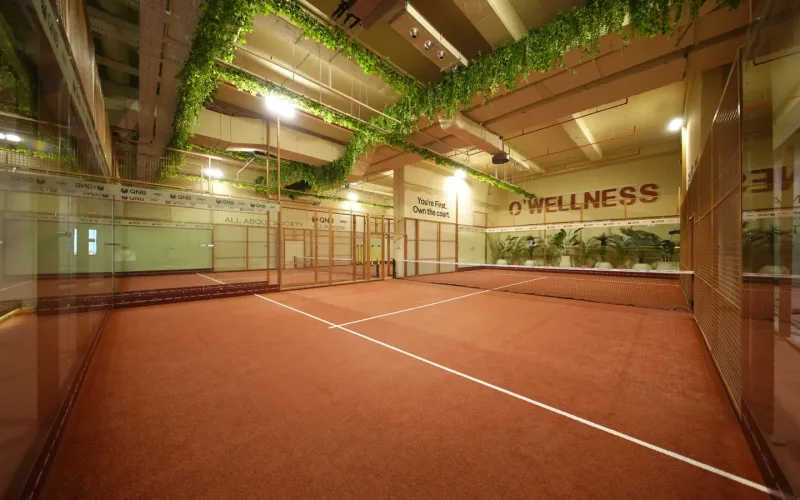
If you want to improve your footwork with a coach in Ankara, you can work on the split step and wall approach with certified coaches on the indoor, climate-controlled courts of O’Padel Beytepe in the O’Wellness Beytepe complex. Membership is not required; for bookings, WhatsApp: +90 536 908 08 00.



 Padel Courts
