
Mental resilience in padelbecomes more decisive as your technical level rises. Between two players of a similar technical level, a single thing usually decides the difference: how they go into the next point after making a mistake. In this article we cover post-mistake recovery routines, how to use the 20 seconds between points, keeping focus on critical points and the mental side of communicating with your partner.
Where Does Padel's Mental Difficulty Come From?
Padel is a sport in which making mistakes is a natural part of the game. Hundreds of balls are hit in a match, and a significant share end in errors. The difficulty comes from mistakes being able to arrive back to back.
- Doubles play: Your mistake affects your partner too; this creates added pressure of responsibility.
- Small court, fast tempo: There is little time to think.
- Matches without a referee: At amateur level, disputes over points add mental load.
- Scoring system: Single-point critical moments such as 40-40 and the golden point.
- Wall factor: Reading the rebound of the ball requires mental load; this reading breaks down with fatigue.
The After-Mistake Cycle: Why Does It Get Worse?
After making a mistake, the following chain typically forms:
- A mistake is made.
- The mind stays on the mistake (looking backwards).
- By the time you reach the next point, your attention is divided.
- You either play too cautiously (a passive error) or take too much risk to make up for it (an aggressive error).
- A second mistake comes; the cycle strengthens.
Mental resilience means breaking this chain at the second step. Not making mistakes is impossible; regathering your attention after a mistake is a learnable skill.
Between-Point Routine: The 20-Second Protocol
There are on average 15-25 seconds between points. Structuring this time is the most effective mental tool. A four-stage protocol:
Stage 1: Physical reset (3-5 seconds)
- Turn your back on your opponent and walk back a few steps.
- Consciously drop your shoulders.
- Switch the racket to your other hand and loosen your hitting hand.
A bodily reset triggers a mental reset. It is hard to calm down with your shoulders up and your jaw clenched.
Stage 2: Breath (3-5 seconds)
- Take one deep breath in, let it out slowly.
- Making the exhale long supports calming down (4 seconds in, 6 out).
Stage 3: Quick assessment (3-5 seconds)
A single question: “What will I do on this point?” A forward-looking, not backward-looking, thought.
- Wrong: “Why did I miss such an easy ball?”
- Right: “I'll serve to the left side and move up to the net.”
Stage 4: Partner communication and preparation (3-5 seconds)
- A brief eye contact or racket tap.
- If needed, a one-sentence plan: “Let's try crosscourt.”
- Take your position and ready stance.
When this routine is applied on every point, it becomes a habit and works automatically in pressure moments.
Approach by Type of Mistake
Unforced error
The type that is most annoying. Approach: label the technical cause of the mistake with a single word (“late preparation”, “feet stopped”) and let it go. Long analysis isn't done during the match; it's written in a notebook after the match.
Forced error
The opponent played well. This is normal and blaming yourself is unnecessary. Saying “good ball” and moving on is the right reaction.
Tactical error
You made the wrong decision (for example, you tried a smash at the wrong time). Approach: make a note to choose differently in the next similar situation.
Partner's mistake
The most critical moment. Approach: a brief encouraging gesture (“keep going, we're doing well”). Criticism, analysis or sighing damages the pair dynamic and affects your own game too.
Critical Points: 30-30, 40-40 and the Golden Point
On critical points most players slide to one of two extremes: too cautious or too risky. Both raise the error rate.
Practical strategies
- Apply the routine more carefully. Under pressure the routine gets shortened or skipped; the opposite is needed.
- Use your most reliable option. A critical point is not the time to try something new.
- Agree with your partner in advance. A simple plan such as “On the golden point, serve to the left side, then go to the net.”
- Focus on the first shot rather than the outcome of the point. Keeping your attention on the process reduces pressure.
- Lengthen your exhale. A physiological calming tool.
- Maintain your body language. Don't let your shoulders drop; keep your head up. This gives information to the opponent too.
Scoreline Psychology
- Being ahead: The riskiest situation. Players switch to protecting, become passive and lose momentum. Solution: ignore the score and keep playing the same game.
- Being behind: The pressure to catch up creates excessive risk. Solution: focus on a single point, trying to win that point rather than close the gap.
- Losing a set: The new set starts from zero. You need to do a brief tactical assessment and open a clean page.
- Losing a long point: The most tiring moment physically and mentally. If there is a changeover or a break, use it.
Partner Communication: The Mental Dimension
Padel is a doubles game; your partner's mental state directly affects your game.
- Use positive language. Phrases like “No problem, keep going” work.
- Don’t make technical corrections during the match. Reminders like “get your racket ready earlier” don’t help mid-match; they just create pressure.
- Talk tactics, not technique. “Let’s try the crosscourt” is fine; “your backhand is off” is not.
- Watch your body language. Shrugging or sighing affects your partner negatively.
- Apply the same standard to your own mistakes. Being harsh on yourself damages the team atmosphere.
- Review after the match. Constructive feedback belongs after the match.
Managing Distractions
- Score disputes: They happen in matches without a referee. A quick, courteous resolution (replaying the point if necessary) reduces mental load.
- Opponent behaviour: An opponent who plays slowly or talks unnecessarily. Solution: stick to your own routine.
- Noise from neighbouring courts: Common in indoor facilities. Directing your attention to the ball improves with practice.
- Your own inner voice: The biggest distraction. Developing neutral, task-focused self-talk is effective.
- External conditions: Lighting, court sand, ball condition. Accepting what you can’t control saves energy.
Training Mental Resilience
Mental skills improve with practice, just like technical skills.
- Apply the routine in training. It takes practice for it to work automatically in a match.
- Set up pressure scenarios. Start a practice match at 4-4 or play every point as a golden point.
- Error quota drills: Play with the goal of “no more than 3 easy errors this set”.
- Playing under fatigue: Playing a match after a conditioning session improves decision-making when tired.
- Playing with a weaker partner: Practice in patience and positive communication.
- Breathing work: Five minutes of daily diaphragmatic breathing off court makes it easier to use under pressure.
Pre-Match Mental Preparation
- Set a concrete goal. A process goal, not a result goal: “apply my routine on every point”.
- Take the warm-up seriously. Physical preparation supports mental preparation.
- Make a short plan with your partner. Who plays which side, and what is the basic tactic?
- Manage expectations. The goal of winning every match is unrealistic; the goal of playing well is within your control.
- Sleep and nutrition: The physiological basis of mental resilience.
Result
In padel, mental resilience is not about never making mistakes, but about quickly regaining focus after one. The most practical tool for this is the between-point routine: a physical reset, breathing, a short forward-looking plan and communication with your partner. When this four-step protocol is applied on every point, it becomes a habit and works automatically in critical moments. Other core rules are not trying new things on critical points, not switching into protection mode when you’re ahead, and talking only tactics with your partner during the match. These skills improve with practice just like technical skills; applying the routine in training is the precondition for it to work in a match.
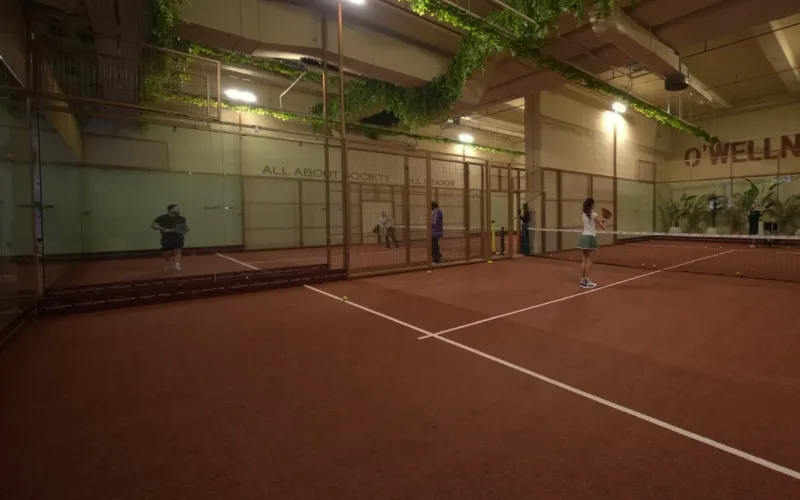
If you want to test these routines under real match pressure, you can plan a padel lesson or match in Ankara on the indoor courts at O’Padel Beytepe; our certified coaches set up work suited to your level, and no membership is required. For bookings, WhatsApp: +90 536 908 08 00. After the match you can also complete your recovery at O’Spa Beytepe within the same complex.



 Padel Courts
