

Choosing a padel partner, in short, means weighing criteria such as level balance, playing style compatibility, which side of the court each of you prefers and personality fit together. Because padel is almost always played as doubles, your partner affects the result of a match at least as much as your own technique. Two good players side by side don't always make a good pair, while two players who complement each other often form a much stronger duo than expected.
In this article, as the O’Padel Beytepe coaching team, we explain what to look for in a partner, the differences in choosing a partner for social matches versus leagues and tournaments, and how to sustain a good partnership. The aim is not to find the “perfect partner”; it is to help you choose someone who can grow with you and whom you will enjoy playing with.
Summary
- A good partner is someone at a similar level to you who complements your playing style.
- Compatible right (drive) and left (revés) side preferences are critical.
- Personality fit shapes communication under pressure and the result of the match.
- A shared goal and schedule are the foundation of a lasting partnership.
- Social formats and community events are the easiest way to find a partner.
Why Does Choosing a Partner Matter So Much?
In padel, you share half the court with your partner. Every point requires the two players to move together in terms of positioning, decisions and communication. Situations like one player moving up to the net while the other stays back, both going for the same ball, or nobody going for a ball down the middle cost you points; most of these stem not from technique but from a lack of chemistry.
Padel is also a social sport. Being on court with the same person once or several times a week means you need to get along well. A partnership you don't enjoy won't last long, even if it's technically successful. That's why you need to consider both performance and the relationship when choosing a partner.
Choosing a partner is also a learning process. You may not find the ideal partnership on your first try; that's perfectly normal. Every new partner teaches you something about your own game too: which role you're comfortable in, what kind of communication you like and what you need under pressure.
For a general framework on how padel pairs move on court, see padel tactics guide is a great place to start.
Level Balance: Similar or Different?
The first question in choosing a partner is usually level. As a general rule, two players of similar level make a more balanced pair. If the level gap is too big, opponents usually direct the ball to the weaker player and the stronger player is left out of the game. This wears both players down, in terms of both results and enjoyment. The weaker player feels the pressure of being constantly targeted, while the stronger player loses motivation from not being involved enough.
However, a small level gap isn't always a bad thing. A slightly more experienced partner can guide you on court and set an example for positioning and decision-making. What matters is that the gap is acceptable to both sides and serves a shared goal.
When assessing level, look not only at technical skill but also at match experience. A player who hits great shots in practice but struggles under match pressure and a player with simpler technique but strong match reading may look the same on paper yet produce very different results on court. Playing a few matches together reveals these differences most clearly.
At O’Padel Beytepe we assess players on a level system from 1.0 to 7.0. Knowing your level makes it easier to find a suitable partner, both in social matches and in leagues and tournaments. How you can find out your level padel level assessment we explained in our article.
Playing Style and Side Preference: Complementing Each Other
Padel has two sides: the right side (drive) and the left side (revés). The right-side player usually takes on a steadier, more controlled, playmaking role, while the left-side player typically hits more overheads and focuses on finishing points. Of course, this is a general framework and every pair finds its own balance. For details on side roles, right and left player roles in padel article.
A good pair usually shares these two roles naturally. If both players want to play the left side, or both prefer to play only with power shots, the pair may struggle to find its balance. The table below summarizes different style combinations:
| Combination | Strength | What to watch out for |
|---|---|---|
| Steady + attacker | Classic balance; one builds the point, the other finishes it | The attacking player shouldn't take excessive risks |
| Two steady players | Few errors, long rallies | Difficulty finishing points |
| Two attacking players | High pressure, quick points | More errors, gaps in defense |
| Left-hander + right-hander | Forehand advantage on both sides | Need for clear communication on middle balls |
Deciding who takes balls coming down the middle is one of the moments that tests style compatibility the most. To learn more about this topic, who takes the middle ball in padel .
When assessing style compatibility, you also need to describe your own game honestly. Are you a patient player who keeps the ball in play, or do you like to attack the moment you see an opening? Are you more comfortable with overheads or with using the back glass? The answers to these questions clarify the partner profile that suits you best. If you're not sure, asking your coach for an assessment is a good place to start.
Character and Communication: The Invisible Factor on Court
Even if two players' technique and style match, the partnership will struggle without character compatibility. How you react under pressure, how you treat each other after mistakes and your attitude toward winning and losing directly affect the result of the match.
Character traits to look for in a partner:
- Supportive attitude: Encouragement instead of criticism after mistakes. A partner who can say “no problem, next point” on court eases the pressure.
- Open communication: Being able to make short, clear calls like “mine,” “yours,” “lob” and “forward.”
- Emotional control: Staying calm after a bad point or a questionable call.
- Openness to feedback: Being able to talk constructively after the match about what worked and what didn't.
- Reliability: Showing up on time for practices and matches and sticking to plans.
The best way to gauge character compatibility is to play a tough match together. How you behave when you're behind, not when you're ahead, is the real test of a partnership. Whether you both want to play together again after such a match is often the most honest indicator.
To improve your on-court communication habits, see partner communication in padel our article, and for the spirit of fair play, see refereeing and fair play in padel article.
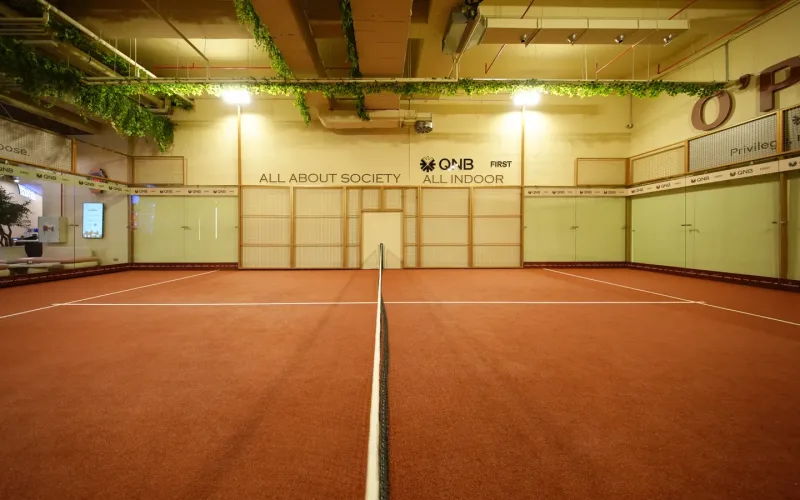
The best way to test chemistry with a new partner is to play together. Book a slot on our indoor courts at Beytepe for a practice match.
Goal and Schedule Compatibility
Beyond technical and character compatibility, there's a practical issue too: shared goals and schedules. If one person wants a social match once a week while the other aims for three practices a week and a monthly tournament, that difference can create tension over time.
We recommend discussing the following topics with your partner in advance:
- Goal: Social play, league or tournament? What level do you want to reach?
- Frequency: How many times a week can you play together? Is a fixed weekly slot possible?
- Training: Will you take lessons? Together or separately?
- Side: Who plays on the right and who on the left? Will you switch when needed?
- Flexibility: Is it a problem to play with other partners when one of you isn't available?
Rather than having this conversation once and forgetting it, it's worth revisiting every few months. Goals and schedules change over time; open communication helps the partnership adapt to these changes.
For pairs who want to play regularly, you can find options such as a fixed weekly slot on our book a court page. For those who want to take lessons together, the options on our padel lessons page are a good fit.
Different Criteria for Social Matches, Leagues and Tournaments
Choosing a partner depends on the format you'll play. In social matches the main criteria are enjoyment and chemistry, while in leagues and tournaments performance and consistency matter more.
- Social matches and Americano: You don't need a fixed partner. Rotating formats are the best way to discover who you click with by playing with different players. For details, see What is Americano article.
- 8-week level league: Continuity matters. You need a partner at a similar level who fits your schedule and can attend regularly. To see how the league works, how a padel league works we explained in our article.
- Monthly club tournament: Here, playing style compatibility and performance under pressure are decisive. Training together before a tournament makes a big difference; padel tournament preparation our article walks you through this process step by step.
Mixed pairs, made up of one female and one male player, have their own tactical dynamics. On this topic, our padel mixed doubles tactics article offers additional insights.
Where to Find a Partner?
Many players' biggest question is where to find the right partner. This can be a real obstacle, especially for padel beginners or those who have moved to a new city or neighborhood. The good news is that a regular club community makes this process much easier.
The most effective ways to find a partner at O’Padel Beytepe are these:
- Newcomers Night: Held on the first Thursday of every month, this meetup is designed to introduce new players to the club community. Details What Is Newcomers Night .
- Americano and Mexicano: Wednesday and Saturday Americanos and Mexicano nights give you the chance to play with lots of players in one go.
- Women's Padel Meetups and Sunrise Padel: Community events aimed at specific groups and time slots make it easier to find partners who play at a similar rhythm.
- Coach recommendation: Our coaches know your level and playing style, so they can recommend a suitable partner.
We covered the first steps for someone starting out alone in our how to start padel on your own article. All community events community on our page.
Result
The right padel partner is a combination of level balance, complementary playing styles, compatible side preferences, solid communication and shared goals. Finding someone who meets all these criteria at once can take time; so playing with different players and building experience is the healthiest path. At O’Padel Beytepe in the O’Wellness Beytepe complex in Çankaya, social formats, leagues and tournaments let you meet different players and test your chemistry with a new partner on our indoor courts. As the O’Padel Beytepe coaching team, we are here to match you with the right partner (WhatsApp: +90 536 908 08 00); details of our courts padel courts on our page.
Frequently Asked Questions
A small level gap can help you improve, as the more experienced partner sets an example. But if the gap is too big, opponents will direct the balls at you and the match becomes difficult for both sides.
Yes, but it requires more planning around side selection and sharing the middle balls. What matters is that both players feel comfortable on their own side.
We recommend first talking about your expectations calmly after a match. If you can't find common ground, playing with different partners can be a healthy solution for both of you.
It may vary depending on the league format and season rules. For current entry requirements, you can follow club announcements or message our WhatsApp line at +90 536 908 08 00.




 Padel Courts
