

Newcomers Night is a padel night reserved entirely for beginners, held by O’Padel Beytepe at regular intervals (for current dates, our WhatsApp line). It has one aim: to turn a complete beginner's first time on court into an easy, well-planned and non-embarrassing experience. The club provides the racket, a coach sets up the line-ups and the burden of finding a partner disappears entirely.
What sets this night apart from an ordinary introductory session is its structure. Newcomers Night is neither a lesson nor a tournament; it's a format that sits between the two, moves along with short explanations and devotes most of the time to real match minutes. On the indoor courts at O’Wellness Beytepe, it works as the entry gate to the O’People Beytepe community programme.
Summary
- Newcomers Night is a padel night held on regular Thursday evenings and open only to beginners.
- No partner needed; foursomes are set up at the club by the coaching team.
- Rackets and balls are available at the club; sports shoes and comfortable clothes are enough.
- The flow: welcome, short technical intro, warm-up, short rotating matches, wrap-up.
- At the end of the night, your level is placed on the 1.0–7.0 scale, and your next program is shaped accordingly.
What exactly is Newcomers Night?
We can describe Newcomers Night in three sentences. First: the level is homogeneous. Participants have all either never played or tried once or twice, so nobody spoils anyone else's game. Second: there is rotation. After every short match, partners and opponents change, so you play with many people in one evening. Third: a coach is on court. Technical corrections come during play; there is no separate block in lesson format.
Together, these three features eliminate the two scenarios beginners fear most: “I don't know anyone” and “I'll be stuck with people much better than me.” The club doesn't leave this to chance; the night's lineup plan is made in advance based on level information.
Who it's for, and who it isn't
- Good fit: people who have never played padel; those who tried once and want to continue; those without a partner; players switching over from tennis, squash or badminton.
- Good fit: people over 40 looking for a low-impact sport — for this profile, our padel over 40 guide offers more information.
- Not a fit: players who play regularly and look for competitive matches. For them there are Americano, Mexicano and level leagues; tournaments and leagues page .
- Not a fit: those who want one-on-one technical work; in that case a private padel lesson is more effective.
The flow of the night: what happens minute by minute?
The program starts in the evening and lasts about two hours. The table below shows a typical flow; timings may shift a little depending on the number of participants.
| Block | Approximate time | What happens | What's expected of you |
|---|---|---|---|
| Welcome and equipment | 10 min | Names, racket handout, court assignment | Just show up |
| Technical intro | 15 min | Serve, walls, how scoring works | Listen, take two practice shots |
| Warm-up | 10 min | Mobility and a short rally | Active participation |
| Rotating matches | 60–70 min | Short matches, partner change every round | Play, don't overthink the score |
| Wrap-up | 15 min | Level feedback, program recommendation | Ask questions |
The rotating match block is the heart of the night. Thanks to the short matches, you usually share a court with twelve to sixteen people in one evening. It's the fastest way to build a community: it compresses weeks of getting to know people into a single night.
Three questions from first-timers on court
“I've never played. Will I look silly?”
The learning curve of padel is deliberately not steep. The court is 20×10 m, the walls are part of the game and the serve is underhand. Combine these three and it's possible to build a rally in the first session; in tennis or squash this usually takes weeks. At Newcomers Night there's also no basis for comparison, because everyone is at the same point. Details of the court structure padel court dimensions and structure .
“What do I need to bring?”
Sports shoes, comfortable clothes, water. Rackets and balls are at the club. The key point when choosing shoes is the sole: since there's a lot of lateral movement on court, a flat, grippy sole is preferable. For the full list, see preparing for your first padel match .
“I don't know the rules. Is that a problem?”
Not at all. In the technical intro block you learn as much as you need: how to serve, how the ball comes off the wall, how to keep score. The rest comes during play. If you'd like a broader introduction, our what is padel and how to play article gives you the basic framework.
Newcomers Night places are limited; reserving your spot in advance on WhatsApp is the safest way.
Why Thursday Evening?
The date wasn't chosen at random. Thursday evening is a window when weekend plans haven't yet been made but the workload has eased. For participants leaving offices on Eskişehir Yolu and in Söğütözü, evening traffic is easier than at the start of the week; for those coming from Çayyolu, Ümitköy and Bilkent, the route is also more predictable. Students and academics from the Hacettepe Beytepe campus generally take a short, direct route.
Holding it on a sparse, regular calendar is also deliberate. A fixed, infrequent date ensures the participant pool is large enough each time. If it were weekly, line-ups would thin out, level homogeneity would break down and the night's most important feature would be lost.
Getting there and arrival
Getting into the area on a Thursday evening is smoother than on early-week evenings. For those coming from Beytepe, Ümitköy and Çayyolu the distance is short anyway; for those coming from Bilkent and Söğütözü, you can expect a reasonable drive that varies with evening traffic. These times vary with traffic and are only estimates. For those coming by public transport, Ankara's M2 Kızılay–Koru metro line stands out as the most predictable option, avoiding evening Eskişehir Yolu traffic.
The club is inside the complex at O’Wellness Beytepe, Beytepe Mah., Çankaya / Ankara. The Beytepe stop on the metro line is also a useful option for getting to the area. For route details and current access information, our transport and parking guide and we suggest you send your questions on WhatsApp (+90 536 908 08 00).
How Newcomers Night differs from other formats
The club has several ways to play, and which one suits you depends on your level. The most common beginner mistake is jumping straight into a competitive format and wearing out on the first evening.
- Newcomers Night: uniform beginner level, instructive tone, short rotating matches. The score is secondary.
- Americano: on regular days; the partner changes every round and points are collected individually. Ideal for players whose basic strokes have settled.
- Mexicano: matches are set by live rankings; balanced but more competitive.
- Level league: fixed calendar, progress tracking, regular player profile.
- Monthly club tournament: the highest-tempo format of the season.
The progression usually goes like this: Newcomers Night, then lessons, then Americano, then the league. Players who skip this path and jump straight into the league show noticeably lower retention. If you're wondering how long it takes to be ready for which format, the how long to learn padel article gives a level-by-level timeline.
The last 24 hours before the night: small but useful prep
The prep list is short. But these items really do change how much you'll enjoy your first night.
- Sleep. The variable that makes the biggest difference in an evening session isn't technique but being well rested. Reaction time and reading the ball are directly affected.
- Food. A light meal two to three hours before the session is enough. Playing right after a heavy dinner makes the first half hour tough.
- Water. Even though the courts are climate-controlled, you'll sweat noticeably over two hours of rotation; keep water with you.
- Shoes. Instead of running shoes, a flat-soled shoe with lateral support is safer for side-to-side movement.
- Arrive early. Arriving fifteen minutes before the session leaves you breathing room for equipment and warm-up.
None of these is mandatory; the night is designed so that someone who arrives completely unprepared can play comfortably. Still, if you had to pick a single item, shoes stand out: padel involves many changes of direction and the wrong sole is the most common comfort problem on the first night.
You don't have to decide right away what to do after the night. Most participants book their second session within a week; in practice, that gap also works best for keeping muscle memory fresh. How the first connections made on court turn into a weekly routine is covered in on the community page we summarised.
What happens at the end of the night: your level and the next step
In the wrap-up block, the coaching team gives each participant brief feedback and sets a starting level on the 1.0–7.0 scale. This rating becomes the basis for matching in future reservations. Typical guidance by level looks like this:
- If it was your first time and you could build a basic rally: one or two lessons, then a second Newcomers Night or a beginner-level group session.
- If you've played a racket sport before: moving straight to a technical lesson is more effective; this is where the bandeja and playing off the wall are learned.
- If you've decided to play regularly: get a fixed weekly slot. It's the single strongest decision for staying consistent. Court reservation page shows available times.
- If you're a woman looking for a regular group: Women's padel meetups are the natural next step.
- If you're a morning person: for early-hour groups Sunrise Padel sessions have the most loyal group.
You can see the whole community and the other regular meetups on the O’People Beytepe community page . How the people you meet on court become a lasting group is described in community stories we explained in our article.
The court conditions that make the night work
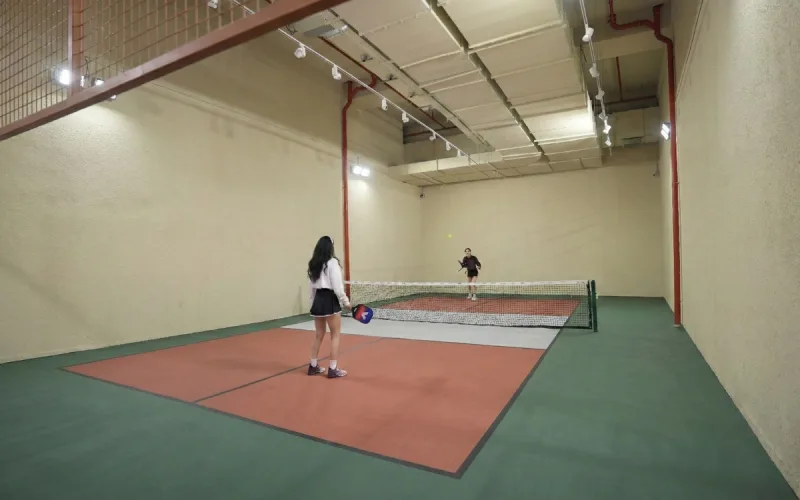
For a beginner, physical conditions determine the quality of the experience more than you'd expect. The courts are indoor and climate-controlled; 20×10 m to FIP dimensions; built with tempered glass, silica-sand synthetic turf and LED lighting.
In practice, this means you don't lose the ball in the evening, the surface doesn't lock your foot, and the ball coming off the glass behaves predictably. The most common reason a beginner feels bad on the first night isn't a lack of technique but poor visibility and a slippery surface. The full court infrastructure on our padel courts page; our article on choosing an indoor court during Ankara's cold, snowy winter months Indoor padel courts in Ankara article. For the overall picture of the area, the the Beytepe padel courts guide and padel at O’Wellness Beytepe articles are a good starting point.
Conclusion: Your First Night in Beytepe Is a Planned Night
Newcomers Night has a single claim: not leaving the start of padel to chance. On the indoor courts of O’Wellness Beytepe, in this corner of Çankaya next to the Hacettepe Beytepe campus and Çayyolu, what awaits you when the night comes is clear: the racket is ready, the line-up is set and your level will be known. Only one decision remains: find out the current date on WhatsApp and put that evening in your calendar. By the end of your first match, you'll most likely be talking about the date of the second.
Frequently Asked Questions
No, the entire night is designed for beginners. The rules and basic shots are explained in a short intro on court, and the rest is learned during play.
Yes. A large share of participants come alone. Foursomes are set up by the coaching team, so you don't have to find a partner.
Spots are limited; because of the number of courts and the rotation setup, participant numbers are kept within a set range. We recommend reserving your place in advance.
The program is planned for adult beginners. There's a separate coaching structure for children; you can check with the club about age and eligibility.
It's not mandatory, but it's recommended. Your level on the 1.0–7.0 scale is the most practical way to ensure balanced matches in future reservations.



 Padel Courts
