
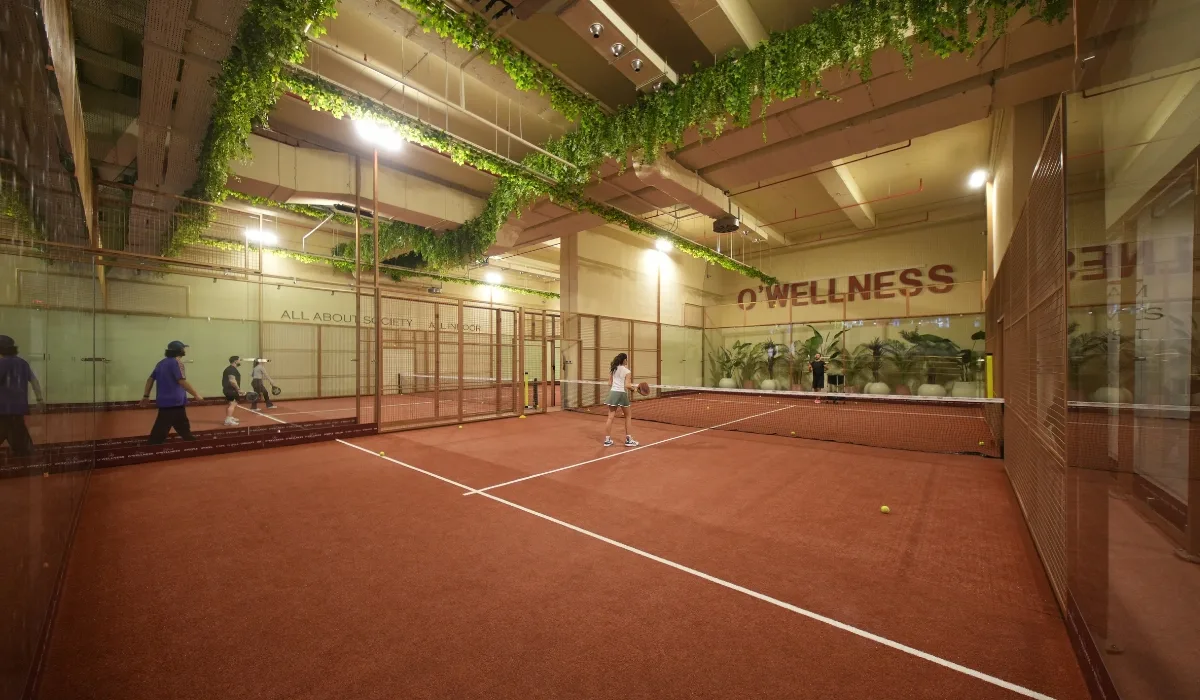
Padel court dimensions are clearly defined by the international federation (FIP) standard: 20 meters long, 10 meters wide, for a total playing area of 200 square meters. The court is split in half by a 10-meter-long net; the net is 88 cm high at the center and 92 cm at the posts. The back walls are 3 meters of glass with 1 meter of fencing on top; the side walls follow a stepped structure. The playing area requires at least 6 meters of unobstructed overhead clearance.
In this article we go through every component of the court one by one: why the glass should be 12 mm thick, what the silica sand on the surface does, why lighting should be above 500 lux, and how these details change your game. Because in padel, the court isn't a stage; it's an active part of the game: the walls set the rules, and the surface sets the rhythm. If you don't know the basics of padel yet, it's best to start with our What Is Padel and How Do You Play? guide first.
Summary
- A standard padel court is 20 × 10 meters, 200 m² in total. A singles court is 20 × 6 meters.
- The net is 10 m long; height is 88 cm at the center and 92 cm at the sides.
- The service lines are 6.95 m from the net; the center service line divides the service area in two.
- The back wall is 3 m of glass + 1 m of fencing = 4 m total height. The glass should be 10–12 mm tempered.
- The surface is artificial turf + silica sand; indoor court lighting targets 500 lux and above.
Basic Court Dimensions: Why Does 20 × 10 Meters Matter So Much?
A padel court is rectangular, with interior dimensions of 20 meters × 10 meters. This is defined as the distance between the inner surfaces of the walls; the outer frame and the walkway around the court aren't included. The tolerance in the federation standard is very small, because even a few centimeters of deviation changes the angle of wall bounces.
The court is split down the middle by the net, so each team defends a 10 × 10 meter square. With four players sharing this area, the space per person is quite small compared to tennis. The result: short running distances, short decision times, and lots of ball contacts. This geometry is exactly why padel is both accessible for beginners and intense at advanced levels.
Singles court
Singles padel has its own dimensions: the 20-meter length stays, and the width drops to 6 meters. So the court gets narrower but not shorter. This means side wall play becomes much more dominant in singles padel.
Lines: The Service Area and Center Line
A padel court has few lines, and all are 5 cm wide. They must be a color that stands out clearly from the surface, such as white, yellow, or blue. There are no sidelines like you're used to in tennis; the walls define the boundaries of the playing area.
- Service lines: Parallel to the net, 6.95 meters from it, spanning the full width of the court. A served ball must land in the area between this line and the net.
- Center service line: Runs perpendicular from the net to the service line and divides the service area into two equal boxes. This defines the cross-court serve target.
- Extension: The center service line extends 20 cm beyond the service line; this small detail clarifies which side to stand on when serving.
If you want to see in detail where, how, and under which rules to serve, and in our padel lessons, the first 20 minutes are usually devoted to exactly this topic.
Walls: The Stepped Architecture of Glass and Fencing
The walls are the most distinctive part of a padel court. But they aren't the same height everywhere; they follow a stepped structure, and these steps directly shape the logic of the game.
| Zone | Glass / wall | Upper fencing | Total |
|---|---|---|---|
| Back wall (short side) | 3 m | 1 m | 4 m |
| Side wall — rear 2 m | 3 m | 1 m | 4 m |
| Side wall — next 2 m | 2 m | 1 m | 3 m |
| Side wall — middle section | None | 3 m fencing | 3 m |
This stepped drop creates a “double glass” zone in the back corners: the ball can bounce off the back glass onto the side glass, or from the side glass onto the back glass. This is the most technical area of the game, and advanced players usually win points by trapping their opponents in these corners.
Glass thickness and quality
The standard is 10 to 12 mm tempered (heat-treated) safety glass. Thickness is critical for two reasons: safety and bounce consistency. Thin or low-quality glass does not send the ball back at the same angle every time; this makes it impossible for the player to learn to read the wall. At the O’Padel Beytepe courts, tempered glass meeting the standards is used, so bounce behaviour stays predictable across the court.
The joints between glass panels also matter. The gaps between panels and the profile thickness should be kept to a minimum, because a ball hitting right at a joint takes an unexpected direction. On a well-built court, these “dead spots” are barely noticeable.
Surface: What Artificial Turf and Silica Sand Do
The most common padel surface is silica sand spread over monofilament or fibrillated artificial turf. Concrete, acrylic, or porous surfaces can also be used, but sand-filled artificial turf is the de facto standard today. The reason is simple: balanced slide.
The sand lets your shoes slide on the surface in a controlled way. This reduces the torsional load on the knees and ankles during sudden changes of direction. On a completely hard surface, your foot stops abruptly and the joint twists; on sand-filled turf, your foot slides a few centimeters and the load is distributed. For joint health, that difference is significant.
- Turf height: Usually around 12 mm; the sand is spread so it settles between the turf fibers.
- Amount of sand: Too much sand slows the ball and increases sliding; too little sand hardens the surface and flattens the fibers.
- Maintenance: Regular brushing and even distribution of the sand are essential. On a poorly maintained court, sand piles up in the corners and thins out around the net.
- Drainage: Outdoor courts need a slope and sub-base drainage; on indoor courts, this issue disappears.
Surface and shoe choice go hand in hand. For sand-filled turf, padel shoes with herringbone or omni soles are recommended; flat-soled models made for tennis courts don't provide enough grip on this surface.
Reading how a court works is a good start, but feeling the bounce of 12 mm glass and the grip of the sandy surface under your feet is something else. Plan your first session on our FIP-sized indoor courts at O’Wellness Beytepe; no membership required.
Lighting and Ceiling Height
In padel, the ball goes up often: lobs, globos, bandeja setups. That's why vertical clearance is a quiet but decisive part of the dimensions. There should be at least 6 meters of unobstructed height above the playing area; at tournament level, 8 meters or more is preferred. A lob that hits the ceiling breaks the tactical backbone of the game.
For lighting, the goal is an even, shadow-free distribution of light across the court surface. At club level, 300 lux is considered the minimum; a good indoor court targets 500 lux and above. But the lux value alone isn't enough:
- Uniformity: The ratio between the darkest and brightest spots on the court should be narrow. Otherwise the ball disappears in shaded areas.
- Glare: Fixtures should be positioned outside the player's upward line of sight. When you look up at the ball for a smash, the light shouldn't hit your eyes.
- Color temperature: A 4000–5700 K range preserves the contrast of the yellow ball against the green surface.
- Flicker: Quality LED drivers reduce flicker, which lowers eye strain during long sessions.
Taken together, these details explain why play is more consistent on a well-lit indoor court: no wind, no humidity changes, no shadows. If you're curious about the tactical effects of indoor courts, our court infrastructure .
Net, Frame, and Doors
The net is 10 meters long and spans the full width of the court. Its height is 88 cm at the center and 92 cm at the side posts, so it sags slightly. That 4 cm difference is no accident: a lower net in the middle encourages balls through the center of the court, keeping play from getting trapped in the cross-court corners.
The net mesh must be fine enough to stop the ball from passing through, and there's a 5 cm wide white band along the top edge. The metal frame and posts are positioned outside the playing area, keeping the risk of players making contact with them to a minimum.
The entry doors are in the middle section of the side walls, on either side of the net line. Doors can be symmetrical on both sides or on one side only. The door opening is where “out-of-court” play becomes possible: once the ball leaves the court after its first bounce on the ground, a player can exit through the door and hit it. This rule only makes sense on courts you can physically exit.
How Does Court Structure Change Your Game?
Knowing the dimensions isn't memorization; it's a tactical advantage. Once you make these four connections, you start reading the court:
- 3-meter back glass: A high, deep lob makes it harder for your opponent to control the ball coming off the back glass. That's because when the ball hits the glass from above, it bounces straight down rather than forward.
- 6.95-meter service line: The service area is relatively small compared to tennis, so in padel the serve isn't a weapon but a way to start the point. It rewards placement over power.
- Side wall step: There's no glass in the middle section, just fencing. A ball coming off the fencing doesn't bounce as cleanly as off glass, so it's easier to catch your opponent out in this area.
- 200 m² area, 4 players: You need to look for angles rather than gaps. In padel, the winning shot is usually not the fastest but the best placed.
Players with a tennis background are the group that feels this difference most clearly. The court is small, the ball is slow, the walls are forgiving; but the reflexes are different. You'll find a comparison of the two sports in the 12 Differences Between Padel and Tennis article. For those coming from squash, the wall logic is familiar but the court geometry is completely new: the Padel or Squash? comparison makes that transition easier.
Knowing the Court Shortens the Learning Curve
Our experience shows that players who understand why the court is designed this way grasp wall play faster. That's because they see a ball coming off the wall not as a “surprise” but as a predictable result of geometry. Stepping behind the glass in your first sessions to watch how the ball bounces is, on its own, a serious learning shortcut.
We lay out a realistic learning timeline, level by level, in the How Long Does It Take to Learn Padel? article. And you'll find what to bring to your first session in the Preparing for Your First Padel Match guide.
Conclusion: Standard Dimensions, Consistent Play
A padel court is not a box, it is a calibrated playing instrument. When a 20 × 10 metre area, an 88-92 cm net, 3 metre tempered glass and sandy synthetic turf come together, the result is a game that leaves no room for chance. The indoor, climate-controlled courts of O’Padel Beytepe in the O’Wellness Beytepe complex are laid out to these standards: a 20×10 m area at FIP dimensions, tempered glass, silica-sand synthetic turf and LED lighting; for exact technical values you can get current information via WhatsApp (+90 536 908 08 00). In Ankara, in Beytepe, a short drive from Çayyolu and Ümitköy, on a surface where snowy winters and dry summers don't change your game, you can learn to turn the geometry of the court to your advantage.
Frequently Asked Questions
The playing area of a standard padel court is 20 meters × 10 meters, or 200 square meters. This measurement refers to the distance between the inner surfaces of the walls; the walkway around the court and the frame aren't included. A singles padel court is 20 × 6 meters, or 120 square meters.
200 m² of playing area alone isn't enough. A footprint of around 22 × 12 meters is usually planned to allow for the frame, installation margins, and a walkway for players to move around the court. Vertically, at least 6 meters of unobstructed height is needed above the playing area; 8 meters or more is preferred for tournament standard.
Yes, courts with concrete or block walls exist and are within the rules. But glass has two advantages: bounce behavior is more consistent, and it doesn't block the view for spectators and players. That's why 10–12 mm tempered glass has become standard on modern club courts.
Silica sand lets your shoes slide in a controlled way, which reduces the twisting load on the knees and ankles during sudden changes of direction. When sand runs low, the surface hardens, grip increases, and joint load goes up; when there's too much sand, sliding increases and the ball slows down. That's why regular brushing and sand leveling are core court maintenance tasks.
Different, and for most players more consistent. Indoors, wind, sun glare, rain, and temperature swings disappear; the ball comes at a similar speed every session and the lighting is constant. This speeds up development, especially during the technical learning phase, because it reduces variables. Outdoors, an extra skill like reading the wind comes into play.



 Padel Courts
