
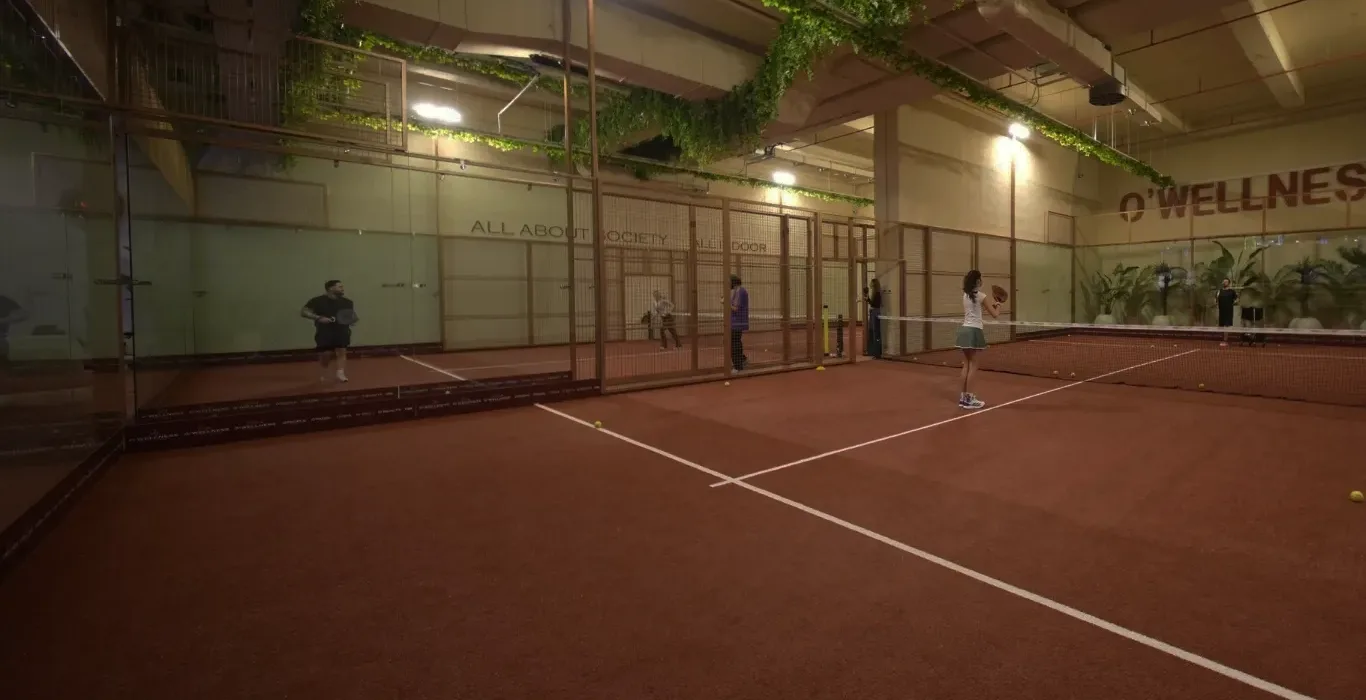
To prepare for your first padel match, you need surprisingly little: comfortable athletic clothes, athletic shoes with soles suited to a sand-filled surface, water and an open mind. You can get a racket and balls from the club, you’ll learn the rules in 10 minutes, and you’ll most likely hit your first rally within the first 15 minutes. Padel is one of the least intimidating racket sports on day one; this post was written to make every step of that first day predictable.
Below we explain what to wear, what to put in your bag, what to know before stepping on court and what awaits you in the first 60 minutes. As the O’Padel Beytepe coaching team, we work with players playing their first match on our courts in the O’Wellness Beytepe complex; this guide covers everything they said “I wish I'd known beforehand” after their match.
Summary
- Clothing: a breathable athletic T-shirt, shorts or leggings, and athletic shoes with soles suited to a sand-filled surface.
- Bag: water, a small towel, a spare T-shirt, a racket with a wrist strap (can be rented from the club) and balls.
- Do a 10-minute dynamic warm-up before the match; spend the first 15 minutes figuring out how the ball comes off the glass.
- Talk to your partner on court, call “mine” for balls down the middle, and give your opponents the benefit of the doubt on disputed points.
- If you don’t have a partner, use the club’s matching events; Newcomers Night exists for exactly this.
What to Wear for Your First Padel Match
There’s no special dress code in padel; athletic clothing that doesn’t restrict movement and wicks away sweat is enough. But a few details will make your first match more comfortable.
Tops and bottoms
A breathable, moisture-wicking sports T-shirt is ideal; a cotton T-shirt gets heavy with sweat and doesn't dry quickly on an indoor court. For bottoms, shorts, a sports skirt or leggings are fine; pockets are handy for carrying a spare ball. Because the air on an indoor, climate-controlled court is constant, you don't need a seasonal layering plan; even if you arrive from Ankara's cold winter in a thick coat, a thin top layer comes off during warm-up. For clothing details by season and court, Padel Clothing Guide article.
Shoes: the most important item
A padel surface is synthetic turf filled with silica sand. On this surface, the smooth sole of a running shoe slips, while soccer cleats or basketball shoes catch. The right sole has a herringbone or omni pattern; it grips the sand while allowing controlled sliding. You may not have dedicated padel shoes for your first match; in that case, clay-court tennis shoes are a good alternative. A shoe with strong lateral support protects your ankle. For selection criteria, our post How to Choose Padel Shoes our article guides you.
What Should Be in Your Bag?
A minimalist list is enough for your first match. Your bag will grow over time; for now, bring these:
- Racket: You can rent one from the club; get current rental terms on WhatsApp. If you're buying your own racket, choose a round or teardrop-shaped, lightweight model with its balance close to the hand. A wrist strap is mandatory.
- Ball: One can of padel balls (three balls). Most clubs have them too; don’t hesitate to ask.
- Water: At least 750 ml (25 oz). On an indoor court, you sweat more than you notice.
- Small towel: For drying the racket handle and your hands. A slippery handle ruins control.
- Spare T-shirt: A lifesaver if you’re heading to the lounge after the match.
- Light snack: A banana or a bar; especially for energy between matches in the Americano format.
- Wristband or sweatband: Optional; useful if sweat makes your hand slip.
For the full equipment list and advanced accessories, check out our post Padel Bags and Accessories . Before buying equipment, it makes sense to play a few sessions with a rental racket to get to know your preferences.
5 Rules to Know Before You Step on Court
You don’t need to know every padel rule; the five points below are enough to play your entire first match comfortably. For details, our guide What Is Padel and How Do You Play? has you covered.
- The serve is underarm: Bounce the ball once and hit it below waist height into the diagonally opposite box. You get two tries.
- The ball must hit the ground first: If the ball you send into your opponents’ side hits the glass or fence before touching the ground, you lose the point.
- Your own wall is your friend: A ball that gets past you bounces off the glass and comes back; wait instead of chasing it.
- Scoring is like tennis: 15-30-40, game, set. At 40-40, a single golden point is usually played.
- If the ball bounces twice, the point is over: Even a ball coming off the wall must be hit before it touches the ground a second time.
Mental preparation: set the right expectations
The most overlooked preparation for your first match happens in your head. On day one in padel, the score doesn’t matter; the real goal is learning to read how the ball behaves. Every point you lose is a data point about the speed and angle of the ball coming off the glass. A player who steps on court with this mindset gets through the first 15 minutes without getting frustrated, and after the 20th minute notices the game opening up on its own.
The second mental adjustment is about your partner: in padel, your partner is your teammate, not your opponent. Focusing on the next point instead of commenting on their mistake builds a sense of teamwork even on day one. The third adjustment is physical: fatigue sets in after the 40th minute, and that’s normal. Lower the pace, play the ball with more control, use the lob. Padel is a sport of patience, not power; the player who accepts this on day one is ready for the second session much sooner.
Pre-Match Warm-Up: 10 Minutes Is Enough
The biggest surprise of your first match usually comes the next day: calf, shoulder and forearm soreness. A short warm-up significantly reduces this and gets rid of the stiffness in the first 15 minutes.
| Duration | Movement | Purpose |
|---|---|---|
| 2 min | Light jogging, side steps | Raise your heart rate |
| 2 min | Arm circles, shoulder rotations | Prepare the shoulder for volleys and the bandeja |
| 2 min | Leg swings, hip openers, trunk rotations | Lower body and rotational mobility |
| 2 min | Short lateral hops, split step practice | Reaction and footwork prep |
| 2 min | A short, controlled rally with your partner | Get a feel for the ball with the racket |
For a detailed warm-up routine, see our post Padel Warm-Up . A 5-minute stretch after the match makes the next day noticeably more comfortable.
What Awaits You in the First 60 Minutes?
A court reservation is usually 60 or 90 minutes. Your first session will go roughly like this:
Minutes 0-15: Exploration
Spent figuring out how the ball comes off the glass, how the racket holds the ball and your spacing with your partner. You’ll lose a lot of points during this time, and that’s completely normal. The goal is to be able to rally, not the score.
Minutes 15-40: Your first real game
The rules start to sink in and the first long rallies arrive. Serving and returning now happen without thinking. The most common mistake at this stage is the urge to hit hard; the team that plays the ball with control usually wins.
Minutes 40-60: Fatigue and fun
Your calves and shoulders get tired, but you’ve figured out the game. Most new players feel why padel is so addictive during this stretch: every point feels unfinished because the wall brings the ball back. Right about now, you start thinking about your next reservation.
Looking for a court for your first match? Book a single session on our indoor courts in the O’Wellness Beytepe complex and borrow a racket from the club. No membership required; for bookings and current hours, WhatsApp: +90 536 908 08 00.
Court Etiquette: The Unwritten Rules
Padel is a social sport, and a few etiquette rules on court make the experience better for everyone. None of them are complicated, but knowing them in your first match will put you at ease.
- Show up on time. Court time starts exactly on time; arriving 5-10 minutes early to warm up is best.
- If your ball goes onto the next court, ask for it when the rally ends. Instead of shouting “ball!” in the middle of the next court’s rally, wait for the point to end.
- Give your opponents the benefit of the doubt on close calls. Padel is played without an umpire; if you’re not sure whether the ball hit the glass or the fence, give the point to your opponents or replay it.
- Talk to your partner, not your opponents. Calling “mine” or “yours” for a ball down the middle helps your partner; comments aimed at your opponents are unnecessary.
- Don’t bang your racket against your hand or the ground. Slamming your racket on the ground in frustrated moments damages both the racket and the surface.
- Tap rackets at the end of the match. In padel, touching the tips of your rackets instead of shaking hands is a common tradition.
We've gathered all the etiquette rules in our Padel Court Etiquette article.
What Should You Do If You Don’t Have a Partner?
This is the most common obstacle before a first match: “Who will I play with?” Padel requires four people, and a beginner usually doesn’t have three padel players around them. The solution is the club community.
In our O’Padel Beytepe community, Newcomers Night-style meetups for beginners can be organised: beginners meet players of the same level, a short technical introduction is given with a coach and the first matches are played. Weekday and weekend Americano tournaments are also ideal for coming on your own and playing with four different partners; thanks to the level system (1.0-7.0), you won't face opponents far stronger than you. For current event days, you can message our WhatsApp line. Alternatively, doing your first session with a coach is the shortest way to learn both the rules and the basic strokes safely. For details, community and padel lessons pages; we cover ways to find a partner in our post I Don’t Have a Partner. How Do I Start Padel? our article.
After the match: recovery and the next step
After your first match, stretch for 5 minutes, drink plenty of water and, if possible, take a warm shower. Your shoulder, forearm and calf may ache slightly the next day; that's the natural result of a new movement pattern and usually passes in a day or two. O’Spa Beytepe inside the O’Wellness Beytepe complex is a practical option for post-match recovery; for details, recovery and wellness on our page.
Make a realistic plan for the next step: one lesson and one social match a week brings visible progress within a few weeks for most new players. We explain how the learning process unfolds, level by level, in our post How Long Does It Take to Learn Padel? .
Result
A first padel match is far easier and far more enjoyable than most people expect: the right shoes, a little water, a 10-minute warm-up and five basic rules are enough. The walls, your partner and the rhythm of the game itself teach you the rest. The O’Padel Beytepe courts in Beytepe were designed for exactly this first step: indoor, climate-controlled courts, certified coaches, single-session bookings with no membership requirement and post-match recovery at O’Spa Beytepe. After work on Eskişehir Yolu or on a weekend morning from Çayyolu; for your first match, all you need to do is set aside an hour and message us on WhatsApp.
Frequently Asked Questions
Not necessary. Most clubs, including O'Padel Beytepe, offer racket rental; get current terms on WhatsApp. Playing the first few sessions with a rental racket and buying once you've worked out which weight and shape suit you is the better decision.
It's not recommended. On sand-filled synthetic turf, the smooth sole of a running shoe slips, and the lack of lateral support puts your ankle at risk. If you don't have padel shoes, clay-court tennis shoes are the best alternative.
That almost never happens. The court is small, the ball is slow and the walls forgive mistakes; most people start rallying within the first 15 minutes. Still, if you're worried, doing your first session with a coach is the safest start.
A standard court reservation is 60 or 90 minutes. For beginners, 60 minutes is ideal for both learning and finishing without getting exhausted. In the Americano format, short 12-15 minute matches are played back to back.


 Padel Courts
