
Finding a padel partner is the only obstacle for most people who want to start playing. The answer is clear: you can start padel on your own, and you don’t need to gather a group of four to do it. Clubs run formats built around matching new players; you tell them your level and when you’re available, and the club fills the court. Americano tournaments, group lessons, newcomers nights and player pools exist for exactly this.
In this guide, we explain five different ways to start on your own, which suits which profile, and how to feel at ease on court with three people you’ve never met in your first session. If you don’t know the rules of the game at all, it helps to first What Is Padel and How Do You Play? look at our guide.
Summary
- Padel is a four-player game, but filling the court is the club’s job, not the player’s.
- The fastest way to start on your own is a group lesson; the most social way is the Americano format.
- In Americano, your partner and opponents change every round, so with a single registration you play with four or five people.
- The level system runs from 1.0 to 7.0; an accurately reported level means a balanced match.
- The most solid way to build a regular playing group is a fixed weekly slot or an 8-week league.
Why You Shouldn’t Waste Time Looking for a Partner
Padel is played in pairs, and at first glance this looks like “I need to find three more people.” In reality, padel culture developed the other way: clubs took on matchmaking themselves so players wouldn’t have to wait, because leaving three of a court’s four spots empty is inefficient for both players and the club.
What this means for you: signing up solo isn’t the exception in padel, it’s the norm. When you come to a session alone, being matched with players you don’t know is expected, and nobody finds it odd. On the contrary, the players who improve fastest are the ones who play with different partners every week, because different playing styles put you in more situations.
The second effect is time. Trying to gather a group of friends usually means weeks of delay. Signing up for a format with matchmaking gets you on court at the next available session.
A third effect is psychological. Playing with people you don’t know seems daunting in the first session, but it happens so often in padel that the court’s own etiquette has formed around it: levels are shared up front, mistakes aren’t held against anyone, and when the match ends the four usually sit down together. After a session or two, playing with strangers stops being a hurdle.
Five Ways to Start on Your Own
They all work, but they suit different profiles. Choose based on where you are.
1. Group lesson
If you’ve never played, this is the most sensible start. You play with three people at the same level under a coach’s supervision; you learn technique and naturally become part of a playing group. Since group lessons usually repeat on a fixed day and time, after a few weeks those three people become your first padel circle.
2. Newcomers night
A session reserved entirely for beginners. In an environment where everyone is in their first months, making mistakes is expected, which removes first-session nerves. For the current day of these meetups at O’Padel Beytepe, you can get information on WhatsApp.
3. Americano
The most efficient format designed for players who come alone. Your partner and opponents change every round, and points are tallied individually. Because you play with four or five different players in one session, the number of people you meet in one evening is more than you’d meet in months of playing in a fixed foursome. How the format works tournaments and leagues page.
4. Private lesson + player pool
For those who want to build the basics fast: take two or three private lessons, then sign up for the club’s player pool with your level. You’ll be notified when a suitable match comes up. Lesson options padel lessons can be compared on this page.
5. Fixed weekly slot
You set aside a specific day and time; when a player is missing, the club fills the spot. It’s the most reliable way to guarantee regular play, and after a while that slot forms its own group.
One point is worth stating separately: these five routes aren’t alternatives to each other but steps you can take in order. A beginner can technically jump straight into an Americano, but it won’t be satisfying; a rotation session played without knowing the serve rule and the basic stance is spent getting tired more than learning. The reverse is also true: taking lessons for months without playing matches doesn’t develop the ability to apply technique under pressure. The balance between the two determines how fast you progress.
Tell us your level and when you’re available; we’ll place you in a suitable group or Americano session.
Which Route Suits You?
| Format | Who it’s for | Chance to meet people | Technical development |
|---|---|---|---|
| Group lesson | Never played | Medium (fixed group) | High |
| Newcomers night | 1–2 sessions of experience | High | Low-medium |
| Americano | Familiar with the rules | Very high | Medium |
| Private lesson | Wants fast fundamentals | Low | Very high |
| Fixed slot | Wants to play regularly | Medium-high | Medium |
The combination that works best in practice: two weeks of group lessons, then your first Americano, then a fixed slot. That way your technical foundation settles in and the problem of finding people to play with is solved for good.
Why Is Reporting Your Level Accurately So Important?
The quality of matchmaking depends on one piece of information: the level you report. Padel commonly uses a scale from 1.0 to 7.0. 1.0–2.0 describes a player in their first months, 3.0–4.0 an intermediate player who plays scored matches and can play balls off the wall, and 5.0 and above a player with tournament experience.
Overstating your level makes the match harder for you and slows your progress; understating it makes the game stagnant for your partners. Both mean a bad session. It’s best to make an honest estimate and trust the coach’s observation: after one session, our team will pin down your level.
- 1.0–2.0: Still learning the serve and basic shots; rallies are short.
- 2.5–3.0: Can play scored matches and sometimes uses the ball coming off the wall.
- 3.5–4.0: Holds the net position, starts trying the bandeja, has developed tactical awareness.
- 4.5+: Makes deliberate shot choices, plays at league and tournament level.
If you’re curious how long it takes to reach which level, how long to learn padel this article offers a realistic timeline.
Playing with Strangers in Your First Session
For most people, the social side of the first session is more daunting than the technical side. A few practical habits make it easier.
- Come early. Being on court fifteen minutes early leaves enough time to meet everyone and warm up.
- State your level up front. Saying “it’s my second session” sets expectations correctly and lets your partner adjust their game.
- Settle the middle ball. A simple agreement at the start like “you take the middle” prevents the most common mix-up.
- Own your mistakes, don’t brush them off. Mistakes are normal in padel; not turning a missed ball into an argument is the most valuable quality in a partner.
- Keep communication short and audible. “Mine,” “yours,” “leave”: three words take care of half the match.
For the full set of on-court etiquette, see our padel etiquette article. What you need to bring to your first match preparing for your first padel match is listed in this guide.
What these habits have in common: in padel, the partner relationship comes before technique. If, of two players at the same level, one keeps talking and settling the middle, that pair wins most matches. So in your first sessions, improving your communication rather than your shots gets faster results.
One more detail makes it easier to find your way on court: choose your side up front. The right side is generally the position that sees more balls and relies on flat strokes; the left side carries responsibility for finishing shots and middle balls. If you’re a beginner, playing on the right makes learning easier because the decision load is lighter. If you’re curious how the roles are divided, right and left player roles this article gives the details.
What Should You Bring When Coming Alone?
There’s no special prep list for joining a matchmaking session, but three things noticeably improve the experience.
The first is shoes. Running shoes don’t support the ankle during lateral movement, so you need flat-soled court shoes for both comfort and safety. This is the only real investment you need to make first. Don’t rush the racket: the club has rental rackets, and it’s hard to know which weight and shape suit your hand without playing a few sessions. A round-head, medium-weight, flexible racket is the right direction for beginners; heavy teardrop rackets give power but increase the load on the wrist and elbow.
The second is a time buffer. In matchmaking sessions the foursome meets on court, so any delay comes directly out of playing time. Arriving fifteen minutes early leaves enough buffer for both introductions and a warm-up.
The third is the warm-up. Eight to ten minutes of dynamic warm-up prepares the three areas padel stresses most: shoulder, elbow and calf-Achilles. Count the cool-down and stretching after the session as part of the program too; recovery options recovery and wellness page. For a practical list of what to wear, padel clothing guide is enough.
From Temporary Pairings to a Regular Group
Most players who start on their own have a regular group by the third month. It doesn’t happen by itself; two habits speed it up.
The first is consistency. Playing on the same day and time multiplies the chance of running into the same people. The second is stepping up the format: joining the 8-week level league with players you met at Americano turns a temporary pairing into a team relationship.
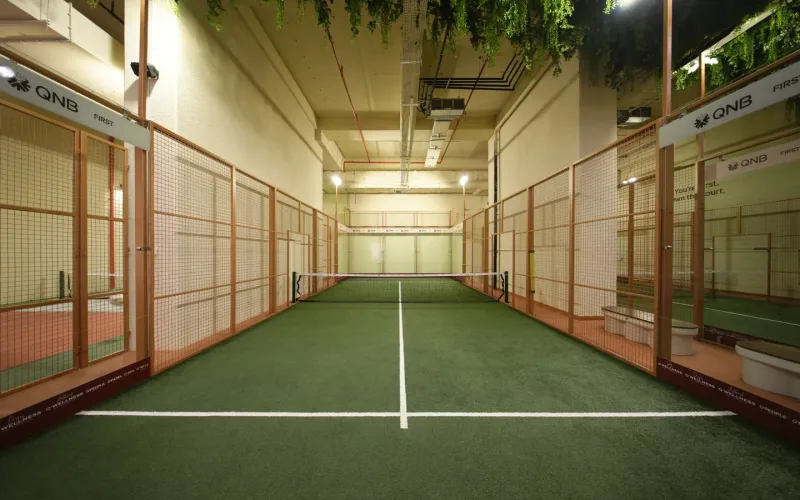
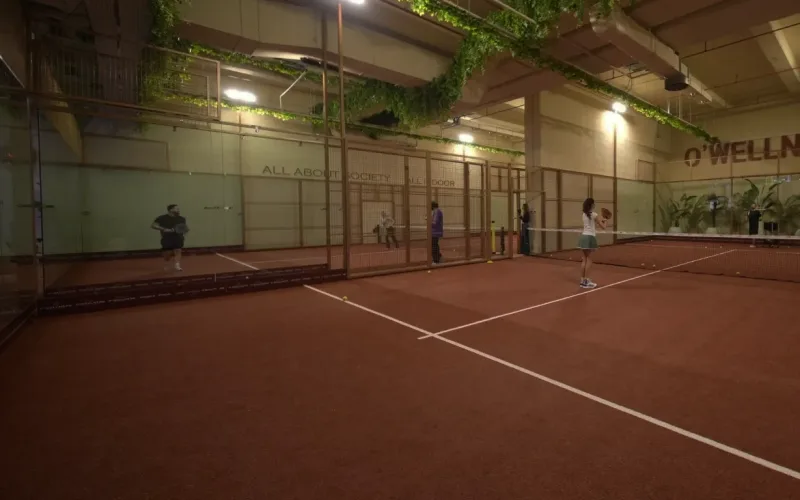
At this stage, the court itself also makes a difference; since there are no session cancellations on indoor, climate-controlled courts, the group doesn’t fall apart. Court features padel courts are on this page, and community programs community page.
Finally, set your expectations right. The goal of matchmaking sessions isn’t a perfect match but a playable, balanced one. In some sessions the foursome clicks perfectly; in others there’s a level gap. Even in the second case nothing is lost: playing with a better player improves your pace, and playing with a newer player improves your patience and placement. It’s the shared view of regular players: what speeds up progress isn’t playing with the same person every week but being exposed to different playing styles.
Conclusion: Starting on Your Own at Beytepe
You do not need to wait for a partner to start padel; all you need is an hour and the right format. On the indoor courts of O’Padel Beytepe in the O’Wellness Beytepe complex, Americano sessions and meetups for beginners are organised; you can find out the current days and times on WhatsApp. For those coming from Çayyolu, Ümitköy, Bilkent or Eskişehir Yolu, playing before or after work is possible. Membership is not required, and you can try it with a single session. Tell us your level, and we will fill the court: book a court one step.
Frequently Asked Questions
Yes, the Americano format is designed exactly for that. Your partner and opponents change every round, and points are tallied individually. All you need is a single registration; the organizers handle the matchmaking.
It wouldn’t be a mistake, but it wouldn’t be efficient either. Starting with an intro lesson or a session reserved for beginners gives a better experience; your first social match is much more fun when you go in knowing the serve rule and the basic stance.
In padel, a level gap is manageable, because the court is small and points are won through placement. The more experienced player usually takes the left side and responsibility for the middle balls. In club matchmaking, the total level of the foursome is also balanced.
For matches made through the player pool, the court is only confirmed once the foursome is complete; if it isn’t, the session can be moved to another time. Our team clarifies the details during registration.
For players who play two sessions a week, a regular group they play with usually forms within eight to twelve weeks. Two things speed this up: playing at the same day and time, and entering a league or tournament together with players you’ve met.



 Padel Courts
