
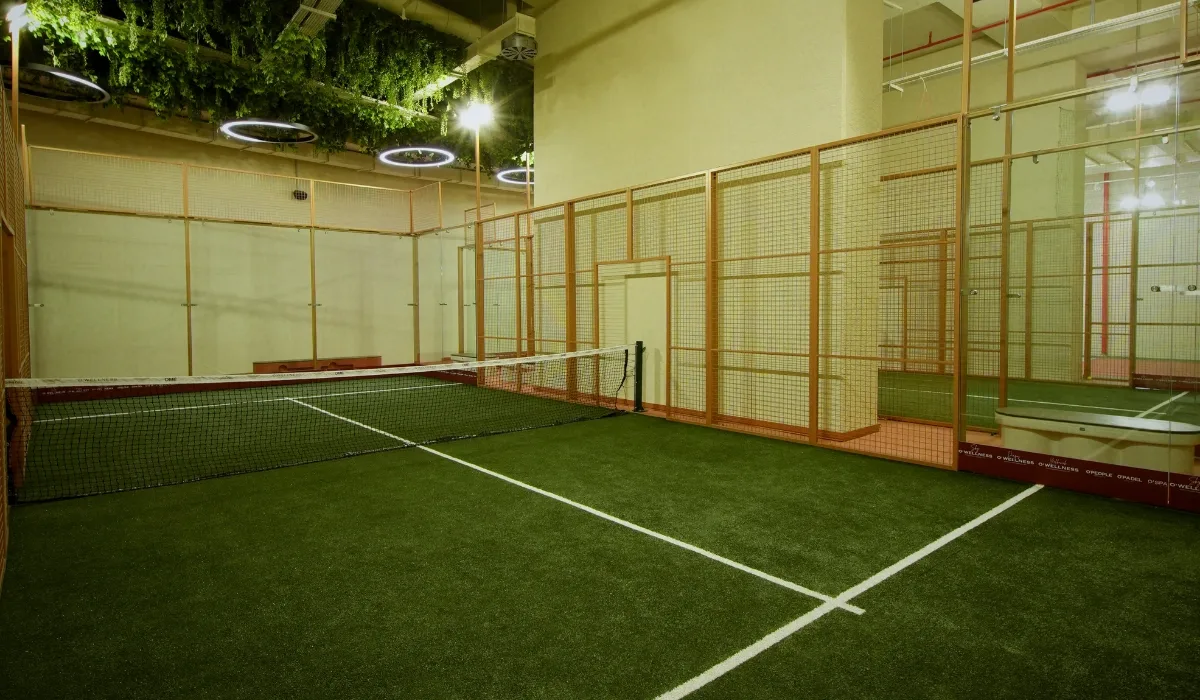
The difference between padel and squash can be summed up in one sentence: squash is a fast-paced singles sport in which two players take turns hitting the same ball against the front wall in an enclosed room surrounded by four walls; padel is a doubles game in which two teams send the ball back and forth over a net on an open-roofed court divided in half and surrounded by glass and fencing. In both, the walls are part of the game, but the logic of how they are used is completely different.
In this article we compare the two sports in terms of court, rules, equipment, fitness and social structure. If you play squash, we'll also make clear what will help you in the switch to padel and what will trip you up. As the O’Padel Beytepe coaching team, we often work with players with a squash and tennis background on the O’Wellness Beytepe courts; their experience in the first weeks forms the backbone of this article.
Summary
- In squash, two players share the same space and hit the ball against the front wall; in padel, there is a net and the ball is sent into the opponents’ half.
- A padel court is 20×10 m and open on top; a squash court is an enclosed box of about 9.75×6.4 m.
- A squash ball is small, soft and has a very low bounce; a padel ball is similar to a tennis ball.
- Squash demands higher-intensity cardio; padel is played for longer at a lower intensity.
- Padel is always played 2 vs. 2 and has a much stronger social side.
Court Design: Box or Cage?
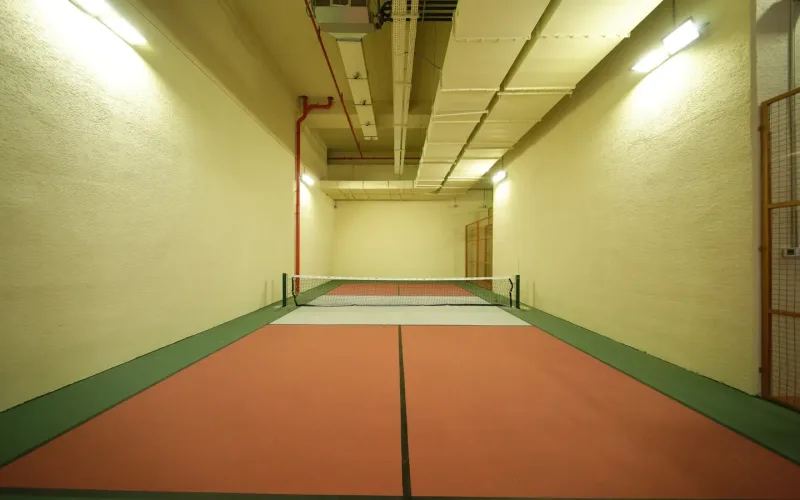
A squash court is a room about 9.75 meters long and 6.4 meters wide, enclosed on all four sides and on top. The front wall has a service line and a lower boundary (the tin); players share the same space and the ball must reach the front wall. A padel court, on the other hand, is a 20 × 10-meter open-roofed area with an 88 cm net in the middle. The back walls are tempered glass, and the side walls are a mix of glass and metal fencing.
The most fundamental structural difference is the net. In squash, you stand on the same side as your opponent and the ball always goes to the same wall; in padel, your opponent is on the other side and the ball has to clear the net. This single difference radically changes movement patterns, tactical thinking and physical load. You can find the technical details of the padel court in our Padel Court Dimensions and Construction in the post, and the features of the O'Padel Beytepe courts in padel courts page.
Use of the Walls: The Biggest Difference That Looks Like a Similarity
In both sports, the walls are part of the game, but their roles are opposite. In squash, the wall is the target: every shot must reach the front wall, while the side and back walls are used to create angles. The ball hits the wall without touching the floor first, and that is normal.
In padel, the wall is not a target but a second chance. The ball must first bounce on the floor in the opponents’ half; if it hits the wall without bouncing first, the point is lost. The walls on your own side are a defensive tool: a ball your opponent hits hard bounces off the back glass and comes back to you, giving you a comfortable shot. This transition is very hard for a squash player, because the squash reflex is to direct the ball at the wall, while the padel reflex is to wait for the ball coming off the wall.
Climate and setting
By definition, a squash court is an enclosed room; temperature and humidity are always the same, but air circulation is limited and the room heats up quickly in intense matches. A padel court can also be built outdoors; in that case wind, sun and rain directly affect the game. Indoor, climate-controlled padel courts combine the best of both worlds: play regardless of the weather, a spacious volume and consistent ball behaviour. That is why, in a city like Ankara with a continental climate, cold and snowy winters and hot, dry summers, choosing an indoor court is decisive for people who want to play regularly.
The fence factor
Padel also has an element that squash does not: the metal fence. Part of the side walls and the upper section of the back wall are fencing, and the ball bounces off the fence unpredictably. A ball that hits the fence in the opponents’ half without bouncing first ends the point; a ball coming back off the fence on your own side is almost unplayable. This means that when padel players say “wall,” telling glass from fence is a skill you need to learn from the very first days.
| Feature | Padel | Squash |
|---|---|---|
| Court size | 20 × 10 m, open on top | ~9.75 × 6.4 m, enclosed box |
| Net | Yes (88 cm) | None |
| Role of the wall | Rebound after the ball bounces on the floor | Direct target (front wall) |
| Ball | Similar to a tennis ball, lower pressure | Small, soft rubber, very low bounce |
| Racket | Short, solid, perforated | Long, strung, narrow head |
| Number of players | 2 vs. 2 | 1 vs. 1 (doubles is rare) |
| Scoring | 15-30-40, golden point | To 11, point-a-rally |
| Typical session | 60-90 min | 30-45 min |
Equipment: Ball and Racket Differences
A squash ball is small, hollow and made of soft rubber; it barely bounces until it warms up. Different dot colors (double yellow, single yellow, red, blue) determine the ball’s bounce speed and are chosen according to level. A padel ball looks like a tennis ball, but its internal pressure is slightly lower; it bounces in a controlled way and comes off the wall predictably.
On the racket side, a squash racket is long (about 68 cm), light and has a narrow head strung with strings; it is designed for wrist action and generating speed. A padel racket is at most 45.5 cm long, solid-faced, perforated and stringless; it is built for control and placement, and a wrist strap is mandatory. Players coming from squash find the weight and short handle of a padel racket unfamiliar at first, but they adapt within a few sessions. To choose the right racket, check out our How to Choose a Padel Racket our guide.
Rules and Scoring
In squash, the serve is hit from the service box onto the front wall above the service line, and the ball must land in the opponent’s back quarter. Every rally wins a point (PAR scoring); games are usually played to 11 points and matches are best of five games. Because both players share the same space, “let” and “stroke” calls for interference are an integral part of the game.
In padel, the serve is hit underhand, below waist height, into the diagonally opposite service box. Scoring is the same as in tennis: 15-30-40, game, set; at 40-40 the golden point is usually played. Since you do not share the same space with your opponent, there are almost no interference calls; instead, calls such as whether the ball bounced or whether it hit the glass or the fence take center stage. For the complete rules, our Complete Guide to Padel Rules article is ready for you.
- In squash, a rally ends: when the ball bounces twice, hits the tin or goes over the out line.
- In padel, a rally ends: when the ball bounces twice, gets caught in the net, hits the glass or fence in the opponents’ half without bouncing first, or leaves the court.
- What they have in common: in both, rebounds off the wall are part of play, and good players gain time by reading the wall.
Fitness and Physical Load
Squash is one of the most intense racket sports. Constant movement in a small space, deep lunges and explosive changes of direction push your heart rate close to maximum quickly. That is why a squash match usually lasts 30-45 minutes and requires a solid cardiovascular base. The load on the knees and lower back is high; playing without warming up significantly increases the risk of injury.
Padel represents a longer and more moderate effort. Because the court is split among four people, running distances are short, the ball is slower and, although rallies can be long, the pace is manageable. Your heart rate rises but does not stay at its peak as constantly as in squash; this opens padel up to a wider range of ages and fitness levels. On the other hand, in padel the shoulder and forearm take more load than in squash because of constant volleys and bandejas. For the physical benefits of padel, see The Science-Backed Benefits of Padel .
Which burns more calories?
Per minute, squash is far ahead; over a whole session, the gap closes because padel is usually played twice as long. Both are effective for weight management, but padel is more sustainable, because a less exhausting session gets repeated more often. We looked at the topic with numbers in our How Many Calories Does Padel Burn? article.
If you have a squash background, your ability to read the walls is pure gold in padel. Book a single session on our indoor courts at O’Wellness Beytepe, pick up a racket from the club and measure the difference yourself.
Social Side and Accessibility
Squash is largely a two-person sport; finding an opponent at the same level and playing regularly takes personal organization. Because the courts are enclosed rooms, spectators and social interaction are limited. Padel, by nature, is played by four people and can be watched fully from outside the court; in formats like the Americano, you can come alone and play with four different partners in an hour.
This difference is one of the main reasons padel has spread so fast in recent years. In squash you find an “opponent”; in padel you find a “community”. The community programme at O’Padel Beytepe, Newcomers Night and the regular Americano tournaments exist for exactly this need; for details, community page.
What Happens When a Squash Player Switches to Padel?
A squash background comes with a serious advantage in padel: the ability to read a ball coming off the wall, quick footwork and control of low balls are already there. These players learn back-court defense in padel much faster than average.
However, three habits get in the way in the first few weeks:
- Wrist-driven strokes. In squash, the wrist generates speed; in padel, hitting from the wrist with a solid racket ruins control and tires the elbow. The stroke should be generated by shoulder and trunk rotation.
- The reflex of directing the ball at the wall. In padel, the ball must bounce first in the opponents’ half; a ball hit straight into the glass out of squash reflex loses the point.
- The habit of playing alone. Padel is a doubles game; you learn to talk to your partner, share balls down the middle and move up to the net together.
Squash players who consciously work on these three points leave beginners at the same level behind within a few weeks. To learn the fundamentals of padel from scratch, our What Is Padel and How Do You Play? guide will help, and if you have a tennis background, our 12 Differences Between Padel and Tennis article will point the way. Padel lessons page shows transition-focused lesson options for players with a squash or tennis background.
Conclusion: Which One Is Right for You?
If you want a high-intensity, short, individual cardio challenge, squash is for you; if you want a longer, more tactical and social game, padel is closer to you. The two are not mutually exclusive; in fact, squash players rise quickly in padel thanks to their wall-reading advantage. If you live in Ankara around Beytepe, Çayyolu, Ümitköy, Bilkent or the Eskişehir Yolu corridor, the O’Padel Beytepe courts in the O’Wellness Beytepe complex in Çankaya are an ideal place to try this switch: indoor, climate-controlled courts, booking via WhatsApp (+90 536 908 08 00) without any membership requirement, and racket rental. Stepping from a squash room onto a padel court is like moving from a closed box into a spacious playing area.
Frequently Asked Questions
Usually, yes. Reading the ball coming off the wall and quick footwork carry over directly to padel. However, the wrist-driven stroke habit and the reflex of hitting the ball straight at the wall are two things that need correcting in the first few weeks.
Per minute, squash is significantly more intense; your heart rate stays high for longer. Padel, on the other hand, is played for longer at a more moderate pace. Over a whole session, total energy expenditure can end up being similar.
No. Padel rules require a solid, perforated racket no longer than 45.5 cm and a pressurized ball similar to a tennis ball. A squash ball barely bounces on a padel court, and a squash racket is not allowed under the rules.
No. The walls of a padel court are made of glass and mesh, but the top is open; "indoor court" means the court is inside a building or under a roof. In that sense, the O'Padel Beytepe courts are indoor and climate-controlled.




 Padel Courts
