
The ideal setup for padel strength training is two (three at an advanced level) gym sessions a week: one focused on the lower body and hips, the other on the upper body, back and rotation; core work is spread across both days. The goal is not bodybuilding; it is a faster first step, a more stable trunk and a sturdier shoulder on the smash and bandeja. The program below is designed to be done alongside your court sessions.
Why is strength training for padel necessary?
Padel is a sport of short, explosive movements. A point lasts on average from a few seconds to ten or fifteen seconds; in that time you are constantly doing split steps, side steps, squats and sudden changes of direction. The quality of these movements depends largely on the force your leg and hip muscles can produce and how quickly they produce it.
In the upper body the picture is different. In padel most of the power comes not from the arm muscles but from the kinetic chain that starts in the legs and is passed to the shoulder through hip and trunk rotation. If one link in the chain is weak, the load falls on the next link. Usually this link is the shoulder or elbow. Regular padel strength training both increases performance and is the most effective way of preventing common padel injuries is the most effective way.
Strength, power or endurance?
- Maximal strength: the highest force a muscle can produce. It develops with basic movements like the squat and deadlift, low reps (4–6) and heavy load.
- Power: producing force quickly. It develops with jumps, medicine ball throws and fast concentric reps. In padel, the first step and the smash are products of this.
- Strength endurance: a muscle's ability to maintain performance under repeated load. It develops with sets of 12–15 reps and circuit work; it keeps your legs lifting in the third set too.
A good program looks after all three but shifts the emphasis according to the period of the season. We cover this logic in a wider framework in our periodisation guide we explained.
The core principles of the program
- Unilateral work: padel is an asymmetric sport. Movements like lunges, split squats and one-arm rows reduce left-right imbalance.
- Rotation and anti-rotation: the trunk needs both to produce rotation and to resist unwanted rotation.
- Shoulder health first: at least one movement for the rotator cuff and shoulder blade (scapula) muscles in every session.
- Quality before load: a rep whose technique breaks down doesn't count. Increase the load only when the movement is clean.
- Gradual progression: increase load or reps in small steps from week to week; sudden jumps raise injury risk.
Day A: lower body, hips and power
This session targets a fast first step on court and the ability to get down to low balls. Do an 8–10 minute dynamic warm-up before starting; hip openers, leg swings and light jumps are enough.
| Movement | Sets × Reps | Note |
|---|---|---|
| Box jump or squat jump | 3 × 5 | Maximum intent on every rep; soft landing |
| Goblet squat or back squat | 4 × 6 | Controlled descent, explosive rise |
| Romanian deadlift | 3 × 8 | Hip hinge, neutral back |
| Bulgarian split squat | 3 × 8 (each leg) | Front knee in line with toes |
| Lateral lunge | 3 × 8 (each direction) | Strengthens the side-step pattern |
| Single-leg calf raise | 3 × 12 | Achilles and calf endurance |
| Copenhagen plank | 3 × 20 sec (each side) | Inner thigh (adductor) health |
Always put jumping movements at the start of the session; power work is more effective when the nervous system is not tired. The Copenhagen plank is especially valuable against the groin strains common in padel; you can start with the knee-supported version at first.
Day B: upper body, back and rotation
This session targets healthy transfer of power from the trunk to the shoulder in strokes and the long-term protection of the shoulder. Keeping pushing and pulling movements in balance is important; in most racket players the front shoulder muscles dominate while the back muscles lag behind.
| Movement | Sets × Reps | Note |
|---|---|---|
| Medicine ball rotational wall throw | 3 × 6 (each direction) | Power starts at the hips |
| One-arm dumbbell row | 4 × 8 (each arm) | Pull the shoulder blade back and down |
| Half-kneeling landmine press | 3 × 8 (each arm) | Shoulder-friendly pressing variation |
| Pull-up or lat pulldown | 3 × 6–8 | Full range of motion |
| Pallof press | 3 × 10 (each side) | Anti-rotation; trunk stays still |
| Cable external rotation | 3 × 12–15 | Rotator cuff; light load |
| Face pull | 3 × 15 | Rear shoulder and scapula control |
| Wrist flexion / extension | 2 × 15 | Forearm and elbow protection |
For medicine ball throws, stand side-on to the wall, start the ball at hip height, rotate your hips and trunk and throw it at the wall. The feel of the movement should resemble a sped-up version of a forehand or backhand. For more variations, medicine ball workouts article.
Core: a block spread across two days
Core training is not just sit-ups. In padel the trunk's job is to transfer force from the legs to the upper body without losing it and to protect the spine in quick changes of direction. So add a 10-minute core block to both days:
- End of Day A: dead bug 3 × 10, side plank 3 × 30 sec, bird dog 3 × 8.
- End of Day B: plank shoulder tap 3 × 16, cable woodchop 3 × 10 each direction, hollow hold 3 × 20 sec.
If you want to go deeper into the core, our core training for padel our guide covers anti-rotation and rotational power work in detail.
Fitting it into your weekly schedule
Strength sessions should not clash with court sessions and should leave room for recovery. General rule: do the heavy leg session at least 48 hours before an important match. The example below is for an intermediate player who plays two lessons or matches a week:
| Day | Plan |
|---|---|
| Monday | Day A: lower body + core |
| Tuesday | Padel lesson or technical training |
| Wednesday | Active rest: walking, mobility, optional sauna |
| Thursday | Day B: upper body + rotation + core |
| Friday | Rest or light fitness |
| Saturday | Match or Americano |
| Sunday | Rest, recovery |
Advanced players can add a third session: a power day with fast reps at light loads, focused on jumping and agility. Beginners should start with a single full-body session a week for the first 4–6 weeks; learning the movements comes before adding load.
Adjusting by season
The program doesn't have to stay the same all year. In the off-season, that is, when the tournament calendar is quiet, you can emphasise maximal strength: fewer reps, higher load. In the pre-season, power and speed come to the fore: jumps, medicine ball and fast concentric reps. In-season, the goal is to maintain what you've gained; you cut the number of sets, keep the intensity and shorten the session so it doesn't exceed 40 minutes.
For players with a regular match rhythm, such as in the Beytepe Padel League, the in-season maintenance program is usually two short sessions a week. In tournament week, either drop the leg session entirely or reduce it to light power movements only.
How do you do it in Beytepe?
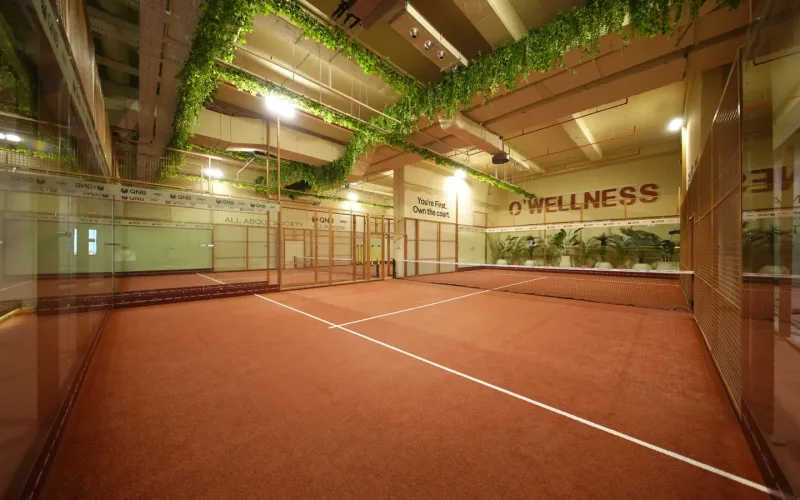
The advantage of the O’Wellness Beytepe complex is that all parts of this program are in the same building. You can do your Day A and Day B sessions in the fitness area and, in the same week, indoor padel courts take to the court for your match. Even in Ankara’s cold winter months your schedule isn't disrupted.
- Morning session: Strength training before work at the facility, which opens at 07:00, leaves the evening free for the court.
- Combined day: 45 minutes of strength, then a light technical court session. Prefer this only on upper-body days.
- Recovery: after a heavy leg day, at O’Spa Beytepe a sauna or contrast therapy can help reduce muscle stiffness the next day.
- Combine it with technique: to transfer the strength you gain in the gym into your strokes on court, padel lessons, tell your coach about your program; the lesson content can be adjusted accordingly.
Common mistakes
- Training only the upper body: in padel the real engine is the legs.
- Heavy leg training on match day: a guaranteed way to feel heavy and slow on court.
- Neglecting the shoulders: the smash and bandeja are high-load movements repeated many times; rotator cuff work is not optional.
- Loading without warming up: especially on cold winter mornings, don't shorten the warm-up. 12-minute warm-up routine is suitable for the gym too.
- Not tracking progress: if you don't note which movement you did with which load, you can't know whether the program is really progressing.
Sample 4-week progression plan
Loading progressively in four-week blocks rather than keeping the program fixed both speeds up progress and keeps you from hitting a plateau.
| Week | Focus | Load | Note |
|---|---|---|---|
| 1 | Movement quality | Low-medium | Focus on learning technique, don't increase the weight |
| 2 | Strength | Medium | Keep the rep count fixed, increase the load gradually |
| 3 | Strength + power | Medium-high | Add explosive movements (jumps, sprints) |
| 4 | Recovery | Low | Reduce the load by 40-50%, focus on mobility |
Do a short review at the end of the fourth week: which movements feel more comfortable, which weights have gone up. With this information you can build the next four-week block more accurately.
Equipment and alternatives
A dedicated gym isn't essential for the program. A similar structure can be set up at home with dumbbells, resistance bands and bodyweight. Alternatives like single-leg sit-to-stand from a chair instead of the squat, and a banded hip bridge instead of the deadlift, work the same muscle groups if equipment is limited. What matters is keeping movement quality; weight and equipment come second.
Returning to the program after an injury
If you are returning to a strength program after a minor injury, it is safer to start from a point close to zero rather than where you left off. Cut the load to half of normal in the first week and, after confirming there is no pain or discomfort, gradually return to your old level.
If you have had a wrist, elbow or shoulder injury in particular, getting approval from a physiotherapist or your coach before going back to movements that directly work that area reduces the risk of re-injury. Strength training, when applied correctly, is one of the strongest tools for preventing injury; with the wrong timing it can have the opposite effect.
Is the program different for women and men?
The basic movements (single-leg squat, rotational core, shoulder stabilisation) stay the same regardless of gender; the movement patterns needed in padel are common to everyone. The difference usually shows up in starting load and rate of progression; this depends more on individual strength background than on gender.
For women players, slightly more emphasis on knee and hip stabilisation is sometimes recommended, because various biomechanical differences can raise the risk of knee injury somewhat. But this is not a rule; it is a detail to be determined by a coach or physiotherapist through individual assessment.
Another point not to forget when following the program is nutrition. Getting enough protein and carbohydrate within the first hour or two after strength training speeds muscle repair and lets you go into your next session better prepared. Increasing your water intake on training days also supports performance and recovery; this simple nutrition habit can make even the best-designed program several times more effective.
Short summary
An effective padel strength program spreads unilateral lower-body work, rotation and anti-rotation exercises, shoulder-protective movements and a short core block evenly across two sessions a week. Applied regularly, within 6–8 weeks you feel faster, more stable and less tired on court. If you want to plan your program together with court time at Beytepe, you can book a trial lesson on our WhatsApp line and talk through your goals with our coaches.
Frequently Asked Questions
For most amateur players two sessions a week is ideal: one focused on the lower body, the other on the upper body and rotation. Advanced players can go up to three by adding a light power day.
The heavy leg session should be done at least 48 hours before an important match. Heavy leg work on match day or the day before makes you feel slow and heavy on court.
Yes, in the off-season, medium-to-high loads with low reps develop maximal strength. But technique must be clean and the load increased gradually; in-season, the aim is to maintain what you've gained.
Back and scapula movements such as cable or band external rotation, face pulls and one-arm rows protect the shoulder. Adding these to every upper-body session balances the load of the smash and bandeja.
With regular practice, within 6–8 weeks you generally feel a quicker first step, a more stable trunk and less fatigue at the end of a match.



 Padel Courts
