
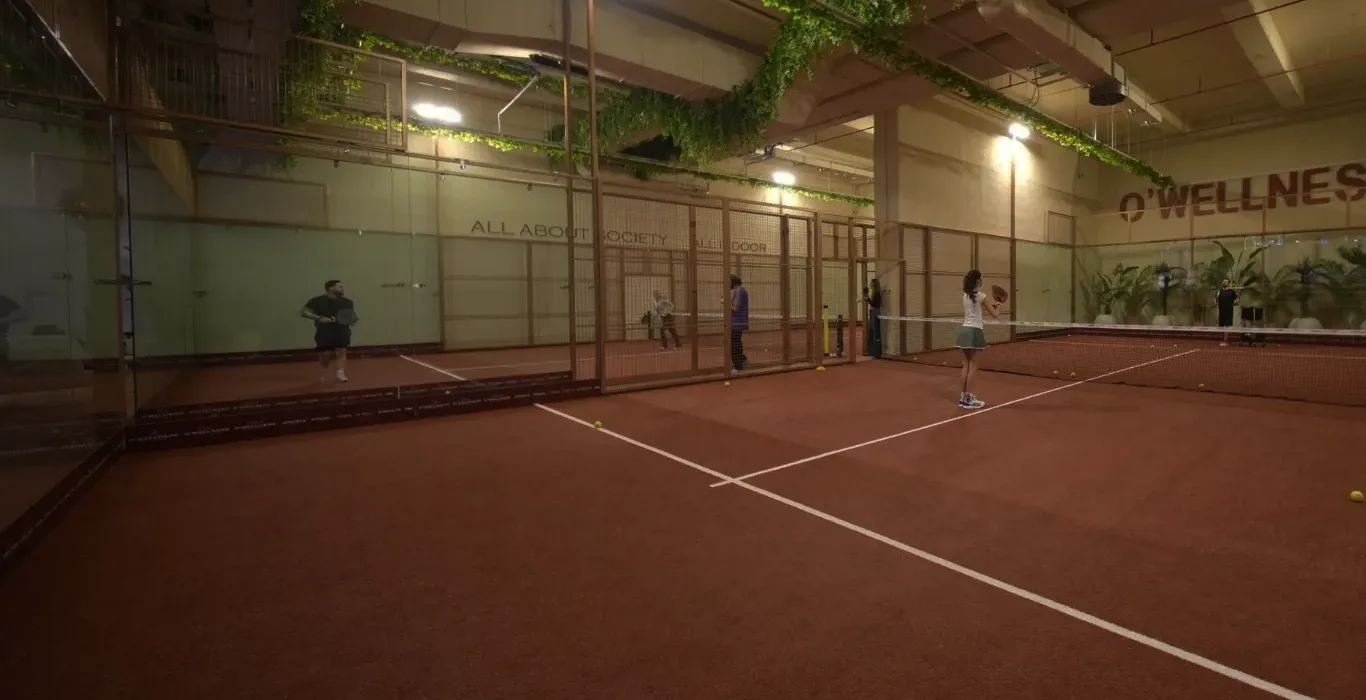
In padel, the lob is a defensive and position-changing shot that sends the ball high and deep over the opposing pair, pushing them from the net back to the back court. The short answer to when to lob: under pressure, to buy time; when balanced, to drive the opponent off the net and take over the position. In padel, the lob isn't an escape shot; it's a tool for rebuilding the point.
In this article, as the O’Padel Beytepe coaching team, we turn the lob into a decision tree: when to lob, when to use an alternative shot, what the right depth for a lob is, where the difference between a good and a bad lob lies, and what to do after the lob. For the full defensive context, padel defense tactics article; for the overall tactical framework, take a look at padel tactics guide.
Summary
- The lob has two purposes: buying time under pressure, and driving the opponent off the net to take over the position.
- A good lob has two criteria: enough height and depth close to the back glass. If either is missing, the lob becomes a gift.
- If the opponent is standing very close to the net, a lob has a higher payoff than a chiquita to their feet.
- After lobbing, the pair moves forward together; lobbing and staying put is the most common mistake.
- On windless indoor courts with a consistent ceiling height, lob accuracy increases noticeably.
Why the lob is such a central shot in padel
In padel, points are mostly won from the net position. So whoever holds the net has the advantage. The lob is the only shot that can switch this advantage. It pushes the opponent back to the back court with a ball over their heads and clears the net.
That's why the lob is used much more often than in tennis. Players coming from tennis see the lob as a “last resort”; in padel, however, the lob can be an opening move. A lob played comfortably from the back court forces the opponent to hit a bandeja and extends the rally.
It also has a psychological effect: two well-hit lobs in a row make the opposing pair hesitant to come to the net. Hesitant net play creates your opportunity to go on the attack.
The lob also has an economic side. In padel, rallies are long and energy management is as decisive as the score. Every lob that sends the opponent to the back court makes them pay the cost of running the length of the court, while you catch your breath. Accumulated over a set, this difference determines who makes clearer decisions in the third set.
Decision tree: lob or another shot?
The lob decision comes down to three questions. If you go through them in order, the decision almost makes itself.
- Are you balanced? If not, the lob is the default option; lift it, send it deep, buy time. If yes, move on to the second question.
- How close is the opponent to the net? If very close, the lob has a high payoff. If they're waiting back around the service line, the lob becomes risky; a low ball to their feet is more effective.
- Is the ball low enough? The lob requires lifting the ball from below with control. If the ball is above shoulder height, the lob becomes technically difficult; on that ball, a block volley or a deep reply is safer.
Getting through these three questions in seconds during a match takes repetition. Over time, the decision stops being a conscious calculation and becomes a reflex.
If you want to add a fourth check to the decision tree, look at your partner's position. If your partner is further forward than you, lobbing splits the two of you onto different lines; in that case, call them back with a verbal signal first, then hit the lob. The lob isn't one player's decision; it's the pair's.
| Situation | Right decision | Why |
|---|---|---|
| Ball coming off the glass after a smash, you're off balance | High, deep lob | Buy time and rebuild your alignment |
| Opposing pair glued to the net | Lob | The space over their heads is the biggest gap |
| Opponent waiting back around the service line | Chiquita / low ball to the feet | There is no depth margin for a lob |
| The ball is coming above shoulder height | Block volley or deep reply | Lob mechanics require an underhand stroke |
| The score is critical and you want to keep the rally going | Safe lob | Holding position with the lowest risk |
| Opponent handles lobs comfortably with a bandeja | Mix of lobs and low balls | Keeping them from settling into one pattern |
The two measures of a good lob: height and depth
A lob succeeds on one condition: your opponent must not be able to play the ball near the net. Two things have to happen together for that.
The first is height. A lob that doesn’t rise enough lets the opponent jump and smash. The second is depth. A lob that doesn’t go deep enough lets the opponent take the ball out of the air between the net and the service line and finish the point. A short, high lob is the most generous gift you can give an opponent in padel.
The target zone is just in front of the back glass. Even a ball that hits the back glass and comes back works in your favor, because your opponent has to play it off the glass, far from the net.
- Generate power from your knees; don’t push with your arm. A lob is not a power shot; it’s a controlled lifting motion.
- Keep the racket face open and follow through. A cut-short motion produces a short lob.
- Meet the ball in front of your body. A ball met late automatically drops short.
- Set your target as the back glass, not the net. Putting your mental target deep improves accuracy.
One more technical detail: generating the lob through body rotation gives far more consistent results than lifting with the arm alone. When your shoulders turn toward the target, the racket traces a natural arc and the ball’s launch angle is similar every time. With arm-only lobs, the launch angle changes from shot to shot, which is why two lobs hit with the same intent land in completely different places.
Don’t neglect your footwork either. When you get behind the ball and shift your weight from the back foot to the front foot, depth comes almost on its own. When your weight stays back, the lob rises but doesn’t travel, and that is exactly the short, high ball your opponent wants.
The lob is a shot that needs stable conditions to be accurate. On our indoor, climate-controlled courts in the O’Wellness Beytepe complex, ceiling height and light are the same every session; ideal for repetition even on Ankara’s windy and dry days.
What to do after hitting a lob
Half of a lob is the shot; the other half is your movement afterward. If you hit a good lob, your opponent has to retreat to the back court, and that gives you the right to move forward. Not using that right makes the lob pointless.
After the lob, the pair moves forward two or three steps together and waits for the opponent’s reply at mid-court. If the opponent hits a bandeja, you stop advancing and return to your defensive line; if the opponent is under pressure and produces a shallow ball, you take over the net.
Conversely, if the lob landed short, the right decision is to retreat immediately rather than move forward. Advancing after a bad lob means walking right into the smash. The details of these transitions transition from defense to attack .
When you should not hit a lob
The lob is a powerful tool, but it doesn’t suit every situation. Turning the lob into a habit means becoming predictable against good opponents.
- If your opponent uses the bandeja well every lob gives them a chance to hold position; reduce how often you lob and mix in low balls.
- If the ball is very low and close to your body it’s hard to produce a controlled lob; a deep, flat reply is safer.
- If your opponent is already standing back a lob only sends them where they want to be.
- From a position outside the court the lob usually lands short; regain your balance first.
Adjusting how often you lob based on your opponent’s reaction is part of tempo management. When you want to slow down or speed up a rally, the lob is the most direct button you have; how to use that button tempo control is covered in our article. To read your opponent’s habits against the lob, opponent analysis you can use this method.
A word about patience, too. Hitting four or five lobs in a row is common in club matches and is often correct; the side that loses the lob battle is usually the one that runs out of patience first. Ending the lob exchange early and trying a risky shot is the fastest way to hand your opponent free points.
How court conditions affect lob accuracy
The lob is the padel shot most sensitive to court conditions. On an outdoor court, wind either leaves the ball short or carries it out, which pushes players to lob with a safety margin, meaning shorter than they should. The sun makes it hard for a player looking up to see the ball.
On indoor, climate-controlled courts, these variables are taken out of the equation. The same motion sends the ball to the same place every time, so repetition becomes more instructive. For learning a shot that demands millimeter-precise depth like the lob, this consistency is decisive.
The same logic carries over to match decisions. In stable conditions you can make a plan; in changing conditions you have to keep adapting instead. What this difference means under scoreboard pressure match management article.
Three drills to practice the lob
The lob is one of the shots that improves fastest with targeted repetition. You can fit the drills below into a 45-minute session.
- Back glass target. Mark an imaginary one-meter strip in front of the back glass and hit 20 lobs. Write down your success rate and compare it week to week.
- Lobbing under pressure. Have your partner hit bandejas at you while you reply only with lobs. The goal is to keep your depth even when tired.
- Decision game. Have your partner sometimes crowd the net and sometimes stay back. On every ball, you choose between a lob and a low ball. This drill turns the decision tree into a reflex.
These drills are more effective with a coach. Padel lessons In our program, the lob and decision-making are worked on together; court features padel courts page and see available times on the book a court you can plan through this page.
Conclusion: the lob is a decision, not a reflex
The lob is the most misunderstood shot in padel: it is seen as an escape, yet it is the move that rebuilds the game. A lob played at the right time, at sufficient height and with depth close to the back glass, changes who holds the net and changes who owns the rally. The way to learn it is targeted repetition. On the indoor, climate-controlled courts at O’Padel Beytepe, wind and sun are taken out of the equation; players coming from Çayyolu, Ümitköy, Bilkent and Eskişehir Yolu can calibrate lob depth under the same ceiling height and the same light. Constant conditions produce consistent decisions. For court times, WhatsApp: +90 536 908 08 00.
Frequently Asked Questions
Rather than a fixed number, the measure is this: the opponent must not be able to reach the ball by jumping and must not be able to play it between the net and the service line. In practice, that means an arc that clearly passes above the height your opponent’s racket can reach. If the height is sufficient, the opponent has to run back to play the ball.
They solve different problems. The lob pushes the opponent off the net and buys you time; the chiquita pressures the opponent where they stand with a low ball. If the opponent is glued to the net, the lob pays off more; if they are standing slightly back, the chiquita does. Mixing both in the same match breaks predictability.
Because on the backhand side there is usually less room to get the racket under the ball, and when body rotation is insufficient the motion gets cut off halfway. The fix is not more power but turning earlier toward the ball, pointing your shoulders at the target and completing the follow-through.
Try adding depth to your lob; lobs that can be met with a bandeja are usually one or two meters short. If your depth is enough, lob less often and mix in low balls aimed at their feet. The goal is to keep your opponent from settling into a single reply pattern.
Because the lob is the shot where depth is most sensitive, and on an outdoor court the wind changes the result of the same motion every time. On an indoor, climate-controlled court, the same shot goes to the same place, so repetition is truly instructive and you can tell whether a mistake comes from your technique or from the conditions.


 Padel Courts
