

Padel defense tactics are the positioning, shot selection, and time management rules you use to avoid losing the point and win back the net while under pressure in the back court. The core logic of padel defense is simple: in the back court your goal isn't to win the point, it's to keep it alive. By sending every ball high and deep and giving your opponent the chance to make a mistake, you buy time; when the opportunity comes, you turn that time into attack. In padel, good defense isn't about not losing; it's the first step to coming back.
In this post, as the O’Padel Beytepe coaching team, we cover defence under four headings: the right stance in the back court, reading the ball coming off the glass, shot selection in defence and defensive alignment as a pair. At the end you will find the signals for getting out of defence and drills you can work on court. The moment of switching to attack, which we cover in detail transition from defense to attack article, which covers the transition to attack in detail, is the natural follow-up to this guide.
Summary
- The basic defensive stance is about two steps in front of the back glass, knees bent and weight on the balls of your feet; sticking to the glass kills your options.
- The default defensive shot is a deep, high ball; a low, fast reply makes your opponent's job easier.
- Learning to wait for the ball off the glass is the single biggest skill you can gain on defense.
- As a pair, stand on the same line; if one of you stays back and the other in the middle, the gap between you ends the point.
- The signal to get out of defense is a weak or short ball from your opponent; an impatient exit is the most common defensive mistake.
The right stance in the back court
The foundation of defense is position, not technique. Two mistakes are common in the back court: sticking to the glass and staying in the middle of the court. When you're stuck to the glass, the ball coming off it jams you and you have no room to swing. When you stay in mid-court, deep balls bounce up behind you and you're forced to take the ball before it rises.
The right reference point is about two steps in front of the back glass. From there you can move forward or back, and when a deep ball comes you can take one step back and wait for it to come off the glass.
- Knees bent, weight on the balls of your feet. On defense, your first move is always down, not back.
- Racket in front and up. Dropping your racket adds to your prep time for low balls.
- Split step on every opponent shot. On defense, footwork preparation matters more than shot quality.
- Eyes on your opponent's racket, not the ball. The angle of the racket tells you where the ball is going before the ball does.
Using the glass as a tool, not an obstacle
The biggest difference between padel and tennis is the glass game, and that's where most points are lost on defense. A player with tennis habits tries to hit the ball before it comes off the glass, yet a ball coming off the glass is both slower and easier to read.
Playing the ball off the glass takes three steps:
- Let the ball go and let the glass do its job. To do that, you position yourself not between the ball and the glass, but at the point where the ball will come off the glass.
- Set up one step in front of where the ball will come back. Standing too close to the ball locks up your arm; a step of space gives your swing room.
- Send it high and deep. At club level, attacking shots off a ball coming off the glass are among the most error-prone shots.
If you want to clarify the rules around the glass and the fence, our glass and mesh rules article will help, and to drop habits from tennis, our differences between padel and tennis is a guide.
Defence is the area that improves fastest with coach feeding. Book your court at O’Padel Beytepe for back-court and glass-play work; WhatsApp: +90 536 908 08 00.
Shot selection on defense: what's the answer to each ball?
| Incoming ball | Right answer | Purpose | Avoid |
|---|---|---|---|
| Deep bandeja | High crosscourt lob | Push the opponent back | Fast, flat reply |
| Smash, off the glass | Wait for the glass, then a deep ball | Buy time | Going for the ball early |
| Low volley at your feet | Short, low chiquita | Force the opponent to bend low | Easy ball lifted up |
| Short, weak ball | Deep ball + move to the net | Go on the attack | Staying in the back court |
| Ball down the middle between two players | Pre-agreed player, high ball | Prevent hesitation | Staying silent |
| Ball hugging the side glass | Wait, read the angle off the glass | Controlled return | Forced shot |
The main idea of the table: on defense, shot selection is based on probability, not courage. An attacking shot tried under pressure usually works once and fails four times. To clarify who plays balls down the middle, see our center ball decision rules .
Defending as a pair: alignment and spacing
Defense may look like an individual skill, but most lost points come from alignment. When your opponents lob, you both need to drop back; if one stays back and the other in the middle, a crosscourt ball will go right between you.
Three alignment rules
- Same line: On defense, both players stand at roughly the same depth. If one drops back, so does the other.
- 3–4 meters apart: Standing closer covers the middle lane but opens the sidelines; standing farther apart gifts the dead center.
- Move together: When the opponent plays crosscourt, you both shift half a step that way. On defense, the court is a single block that two players slide across in sync.
The most practical tool for keeping alignment is verbal communication: “back,” “together,” “mine.” How to set up these calls is covered in our partner communication article, and which player covers which zone in our right and left player roles we explained in our article.
The five most common defensive mistakes
The same mistakes keep coming up when we work on the back court in our club lessons. The good news: they're all decision errors, not technical ones, so you can fix them in your very next match.
- Running to the ball, not the spot. On defense, the player who chases the ball is always late. The right move is to predict where the ball will come off the glass and set up there.
- Hitting hard when you're under pressure. Adding pace under pressure all but guarantees a mistake. When you're stretched, hit the ball higher; height, not speed, buys you time.
- Breaking alignment. Staying in the middle while your partner drops back opens a corridor between the two of you.
- Dropping the racket. In long defensive rallies, your arm tires and your racket drops; a dropped racket costs you half a second on low balls.
- Trying to end the point too early. On defense, the shot you go for because you've “had enough” accounts for a large share of lost points. Patience is worth more than technique here.
Return of serve: the first moment of defense
Defense often starts with the return of serve. If your opponent serves and comes to the net, how you return sets your role for that point: a short return keeps you in the back court for the whole rally, while a deep return puts the net up for grabs.
- Stand half a step forward. Because the padel serve is underhand, standing back on the return gives you no advantage; it only narrows your angle.
- Make your default reply deep and at medium height. The goal isn't to end the point; it's to delay your opponent's move to the net.
- Watch your opponent's approach. An opponent who doesn't come to the net after serving is handing you the net from the first ball.
How the serve rules shape the return is covered in our service rules article, and the core shot repertoire in our stroke technique guide article. To read which defensive weakness your opponent is targeting, our opponent analysis article will come in handy.
Getting out of defense: recognizing the right moment
The point of defense isn't to stay on defense. But choosing the wrong moment to get out is costlier than staying put, because an exit that stalls halfway loses you both the ball and your position. There are three clear signals for getting out:
- Your opponent's ball landed short. A ball that doesn't get past the service line is an open invitation to move forward.
- Your opponent lost their balance. An opponent hitting while moving backward or jammed in a corner can't control the next ball.
- Your lob landed really deep. If your opponent has been pushed back from the net, you've earned the right to move forward.
If none of these three signals is present, staying in the back court is the right call. On defense, patience isn't a personality trait; it's a tactical choice. How to manage tempo on defense is covered in our tempo control article, and how to make this decision under scoreboard pressure in our match management article. For positioning adjustments once you're at the net, see our net position we have a guide.
The mental side of defense
Long back-court rallies tire not only your legs but also your concentration. On defense, instead of asking yourself “when will this end,” give yourself one task: send this ball deep and high. Reducing the task to a single shot takes patience out of the realm of willpower and makes it automatic. Experienced defenders look calm not because they suppress their emotions, but because they repeat the same simple task.
In your first match you'll notice how tiring this role is; we've pulled the preparation side together in our preparing for your first padel match article. Not skipping your warm-up also makes a difference on defense, because a low stance is where cold muscles struggle most: pre-match warm-up routine takes 10 minutes.
Defensive drills you can practice on court
- Glass reading (10 minutes): A coach or partner feeds deep balls; your only job is to play the ball after it comes off the glass. Every ball hit early counts as an error.
- Lobs only (10 minutes): You can only play lobs from the back court. The goal is to make your lob depth consistent; every short lob is counted and noted.
- Two defenders, two attackers (15 minutes): One pair starts at the net, the other fixed at the back. The back pair's job is to win the net; the net pair's job is to hold position. Roles switch every three points.
- Alignment under pressure (10 minutes): The pair at the net plays nonstop smashes and bandejas; the back pair focuses only on holding alignment and sending the ball up.
Defense is the most physically demanding role, because it requires lots of direction changes and a low stance. That's why it makes sense to plan defensive work alongside conditioning: our conditioning program article lays out the weekly framework, and our cool-down and stretching article covers recovery. A low stance and repetitive movements can tire your shoulder and elbow; for preventive approaches, see shoulder injuries article.
Conclusion: Working on Defence in Consistent Conditions in Beytepe
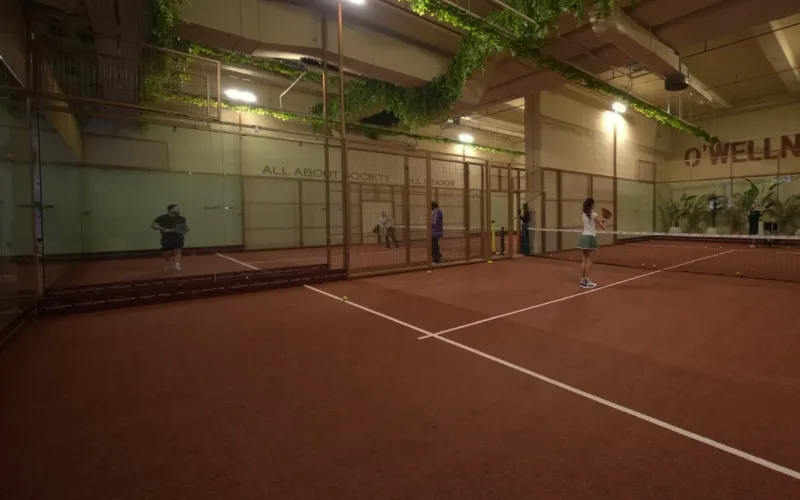
Defence requires knowing in advance how the ball will come off the glass and bounce off the floor; this is an instinct that is only gained on courts where conditions are repeatable. The O’Padel Beytepe courts in the O’Wellness Beytepe complex in Çankaya are indoor and climate-controlled; even in Ankara’s snowy winter or hot, dry summer, glass rebounds and bounce heights behave the same in every session, so your glass-reading reflex truly settles in. For players coming from Çayyolu, Ümitköy, Bilkent and the Hacettepe Beytepe campus, current slot information is easy to get on WhatsApp; to plan defence work with a coach padel lessonspage, for court features our padel courts page, and to book your spot our book a court page, and after intense defensive sessions you can recover with our recovery and wellness with our services you can recover at O’Spa Beytepe.
Frequently Asked Questions
The lob is the default option, but not the only one. If your opponent is standing very close to the net, a low chiquita at their feet is more effective. The rule: if you're under pressure, go high; if your opponent is unprepared, go low.
About two steps in front. Sticking to the glass leaves you no room to swing, while standing too far forward leaves the space behind you exposed on deep balls. Use this distance as your reference point and adjust half a step depending on the height of your opponent's shot.
Most smashes come off the back glass. Instead of running at the ball, predicting where it will come off the glass and waiting one step in front of that spot is the habit that most increases the number of balls you retrieve.
One rule is enough: if one drops back, so does the other. When the opponent lobs, both players drop back together; when they play crosscourt, both shift sideways together. You can sync this with one-word calls like 'back' and 'together.'
Staying on defense all the time, yes, but planned defense doesn't. Defense is an active role that gives your opponent chances to make mistakes; what really loses matches is going on the attack before you're ready and giving away both the ball and your position.



 Padel Courts
