
Summer heat in Ankara can become oppressive in the afternoon; Ankara summer sport the way to keep your routine going is to choose the right time, hydrate well and be able to control your environment. Training on an air-conditioned indoor padel court removes the risk of sun and heatwaves; all that's left is managing fluids and pace.
Below you'll find what to watch for when exercising in the Ankara summer, choosing a time, a hydration strategy and how to train effectively while staying cool at Beytepe.
Ankara summer: dry heat and high altitude
Ankara's summer is dry and sunny. Because humidity is lower than in coastal cities, sweat evaporates quickly; while this seems like an advantage for cooling down, it makes it harder to notice how much fluid your body is losing. The altitude of about 850 metres also increases the daytime temperature swing: air that heats sharply in the day can cool noticeably at night.
Exercising outdoors at midday, when the sun's rays are strongest, raises the risk of heat stress. At high altitude the effect of ultraviolet rays also increases. So when planning Ankara summer sport throughout the season, the ambient temperature and sun exposure need to come first. For air quality and the advantages of indoor spaces, you can also look at our article Air quality and indoor sports in Ankara .
What is heat stress when exercising in the Ankara summer, and what are its symptoms?
The body produces heat during exercise and gets rid of it through sweat. If the ambient temperature is high and fluids are insufficient, core body temperature rises. Symptoms start mildly: headache, excessive fatigue, dizziness, nausea, cramps and palpitations. In more serious cases weakness, confusion and heavy sweating, or sweating stopping, may be seen. At these symptoms you need to stop exercising, move somewhere cool and take fluids.
Since the temperature is kept controlled on indoor, air-conditioned courts, this risk is greatly reduced, but not completely eliminated. In an intense 90 minute match the body still produces heat and you still lose fluid. For more information, see heat management in padel: sun, heat and the indoor court is worth a look.
Why does an indoor, air-conditioned court make a difference in summer?
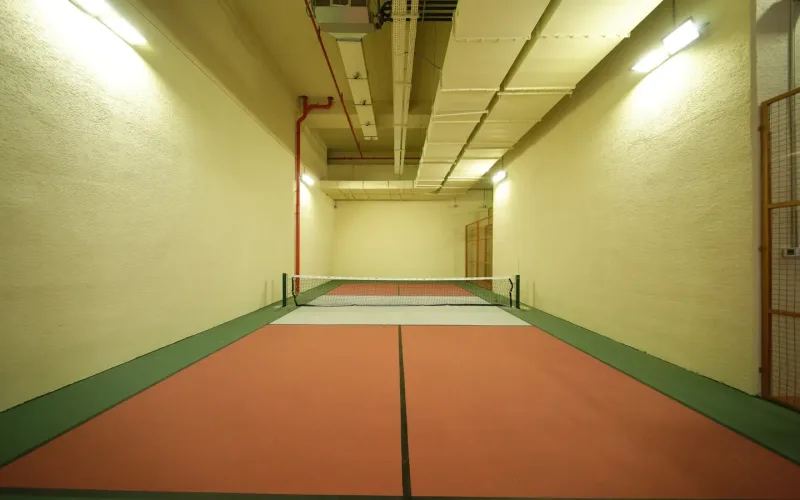
Even if there's a heatwave outside, Beytepe's indoor padel courts the playing environment stays balanced thanks to air conditioning. Wind doesn't disturb the ball's path, the sun doesn't blind you, ground heat doesn't wear down your rubber soles. On a glass-walled 20×10 metre court with standard FIP dimensions, the game flows continuously as the ball rebounds off the glass and walls; that means a high heart rate. Air conditioning lets you experience this intensity in a cool environment.
Another advantage of the indoor court in summer is freedom of time. You don't have to squeeze into the early morning or late night to hide from the sun; it's possible to play even in the afternoon. For the details of climate control on indoor courts, see climate control on an indoor court: winter and summer comfort .
Choosing a time: what time makes sense for training?
Even on an air-conditioned court, different hours of the day offer different experiences. The choice isn't just about heat; it's about body rhythm and schedule.
| Time slot | Advantage | Watch for |
|---|---|---|
| Morning 07:00 – 10:00 | Cool outside air, an energetic start to the day, fewer crowds | The body is stiffer in the morning; extend the warm-up |
| Noon – early afternoon | An escape from the heat on an indoor court; for flexible workers | Moving in from the heat outside can give a quick feeling of warming up |
| Evening 18:00 – 21:00 | After-work social play, body temperature naturally at its peak | Peak hour; book ahead to get a court |
| Night 21:00 – 00:00 | The air cools, calm atmosphere | High tempo late at night can affect sleep |
In general, the body's core temperature and muscle performance approach their peak in the late afternoon; many athletes say they feel their best at this time. Still, this varies individually. For the advantages of a 07:00 session, the article The advantages of morning padel sessions in Ankara is a useful resource. For the peak and off-peak difference, see peak and off-peak hours the guide.
Summer hydration strategy: before, during and after the session
Hydration is the cornerstone of summer training even on a cool court. General recommendations can be summarised in the following framework; personal needs vary with weight, sweat amount and health condition.
Before the session
Drink water at regular intervals in the hours before the match. Going into a session completely dehydrated and then immediately drinking litres of water upsets the stomach. Urine colour is a simple indicator: light yellow generally points to adequate hydration.
During the session
Make it a habit to take a few sips of water at the changeovers between games. In a 90 minute session, if sweating is heavy, a drink containing electrolytes can be useful; sodium loss raises the risk of muscle cramps in heavy sweaters. For the dry-climate side of the topic, see hydration in padel: water and electrolytes in Ankara's dry climate article.
After the session
Replenish the fluid you've lost gradually over the following hours. If you can weigh yourself before and after the session, taking in about 1.5 litres of fluid for each kilogram lost is a generally accepted guideline. If you get cramps, our article on preventing muscle cramps in padel explains the causes and solutions.
Stay cool but stay sharp: adjust training intensity in summer
A cool court doesn't mean you can raise intensity without limit. In summer the body may already experience heat exposure throughout the day; you may have walked in the sun on your way in. So spending the first 15 minutes of the session at a moderate pace is a good rule. Monitoring your heart rate can also help: keeping the pace at a level where you can talk is both an effective and safe approach. For breathing and heart rate management, breathing techniques and heart rate management for padel is a good guide.
Use the rest breaks within the session wisely too. Take deep breaths between points, drink water at changeovers and wait a few extra seconds after very intense long rallies. These small breaks don't reduce overall performance; on the contrary, they let you still play with quality in the second and third sets.
Heat acclimatisation: how do you get your body used to the hot summer?
The body can adapt to heat within a few weeks. This process is called heat acclimatisation: sweating starts earlier, sweat contains less salt and heart rate drops somewhat for the same effort. However, this adaptation is gained gradually. In the first weeks of early summer it makes sense to keep the session length short and raise intensity in stages. For example, you can start with 60 minute sessions in the first week and move up to 90 minutes in the following weeks.
Be similarly careful when returning from a hot trip or holiday. Going into an intense match after a few days in a cool environment can show that the adaptation has partly been lost. Knowing this lets you interpret sudden fatigue in the second set correctly.
Nutrition and daily rhythm for summer training
Appetite can drop in hot weather; but an intense training day shouldn't go by without fuel. A mainly carbohydrate, easily digestible meal two or three hours before the session, and a balance of protein and carbohydrate afterwards, is a good foundation. Fruit, yoghurt, wholegrain bread and light protein sources are easy options for summer. For a detailed framework, you can read our articles on what to eat before padel and nutrition after padel .
Be planned during the day too: avoid long walks in the sun at midday, and don't neglect warm-up time on court. In Ankara's summer, even if the morning is cool, the air heats up quickly towards noon; managing this transition around your work schedule keeps training both safe and consistent.
The right equipment and clothing for summer
Breathable technical fabrics that wick sweat away are your biggest ally in summer. A cotton T-shirt holds sweat, becomes heavy and causes chafing on the skin. Prefer light-coloured, lightweight clothes. Wristbands and a bandana reduce sweat running into your eyes and onto the racket handle; a slipping handle both lowers shot quality and creates unnecessary tension in the wrist. On using an overgrip, our padel overgrip guide tells you when to replace it. For choosing clothes for the indoor court, padel clothing: what to wear on an indoor court will also be useful.
How do you plan summer training at Beytepe?
Setting up a practical weekly plan for summer is very simple. For example, if you train three days a week, you can try this distribution:
- Tuesday evening: A 90 minute match; social and competitive play.
- Thursday morning: A 60 minute technical lesson; cool morning hour and low crowds.
- Saturday: Americano or free play with friends, followed by In the recovery area, recovery.
For technical work, and in our padel lessons, you can choose one of the one-to-one, semi-private or group formats. At the start of the summer season, working out your level and solidifying your technical foundations is very productive.
For recovery after a session, cold plunge and contrast therapy are especially appealing in the warm season. Cold water cools the body quickly after a heavy heat load. You can read our article on what is a cold plunge and assess your health condition before starting. As with any new practice, those with cardiovascular conditions should consult a doctor.
Small details to watch for in summer sport
Don't forget sunscreen: even if you play on an indoor court, you're exposed to the sun on your way to and from the courts. Don't eat a heavy meal before the session; digestion already slows in hot weather. Alcohol and excess caffeine can disturb fluid balance; we covered pre-match coffee in our article on padel and caffeine . Also don't forget the role of sleep in recovery; if your sleep pattern is disrupted on hot nights, performance can drop.
Knowing your own body is important too. Some people are more sensitive to heat: children, older people, those with chronic conditions and beginners. For these groups, session intensity and length should be set more cautiously. For families playing with children, taking more frequent water breaks is a good rule.
The lounge and social side of staying cool in summer
Resting in a cool environment after the session is part of training too. In the court-view in the lounge you can start the recovery process with a cold drink, a protein smoothie or a light meal. You can find what to choose before and after the session on the Beytepe lounge menu in our article the lounge menu . This break with friends on summer evenings turns your sports routine into a social habit.
A short checklist for first-timers
If you're just starting an Ankara summer sports plan, run through this list before going to the session: fill your water bottle, take a spare T-shirt and towel, apply sunscreen, think about the transport you'll take when leaving the club and don't leave the session to too late an hour. If you don't have a racket, you can rent one; for the weight and balance preferences of a new racket, you can look at the article on racket weight and balance later. What matters is having an enjoyable and safe first session: raise intensity slowly, listen to your body and take a break if you feel discomfort.
These small preparations may seem like a lot at first glance; but after a few sessions they go on autopilot. Those who keep up their Ankara summer sport habit through the summer enter the autumn season with higher fitness.
Conclusion: in the summer heat, a strategy rather than an escape
The Ankara summer doesn't forbid sport; it just requires being planned. The right time, enough fluids, breathable clothing, a measured pace and a cool indoor court; this five-piece turns summer into an effective training season. Training on an air-conditioned court keeps your Ankara summer sport routine going.
To set up your summer programme, you can book a court via our WhatsApp line or the contact page . Membership is not required, and you can cancel the session free of charge up to 24 hours in advance.
Frequently Asked Questions
Outdoors, early morning or late evening is more suitable. On an air-conditioned indoor court, you can also play in the afternoon; the choice depends on your schedule and body rhythm.
Yes. Even on an air-conditioned court, intense movement causes sweating and fluid loss. Drinking water regularly before, during and after the session is important.
In short, low-pace sessions water is usually enough. In long, intense matches or for heavy sweaters, electrolyte support can be useful.
For healthy individuals a short cold water exposure can be refreshing; however, those with cardiovascular conditions should consult their doctor first.
The air-conditioned environment is an advantage for children; still, frequent water breaks should be given and the pace adjusted to the child's age.




 Padel Courts
